

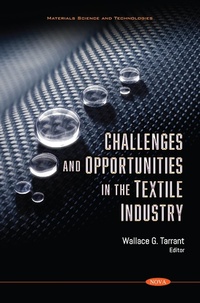
Challenges and Opportunities in the Textile Industry
Erschienen am 30. Oktober 2020
171 Seiten
978-1-5361-8780-9 (ISBN)
Beschreibung

This compilation presents a detailed review of current research, developments, and progress on nanotechnology usage for the elimination of dyes from effluents released by textile industries. The benefits of using nanomaterials for functionalized textile production are presented, and the applications of nanomaterials in the most known functional technical textiles are discussed. The authors present the results of empirical studies carried out in the Portuguese industrial context, including the textile sector, where the relationship between negative effects associated with shift work and the adoption of certain management practices by organizations is analyzed. Additionally, the authors discuss how, to achieve the Fourth Industrial Revolution, technological tools must be incorporated into both the production and consumption of textiles. The closing study indicates that it is possible to make objective pilling detection easily for standard fabric structures in the textile industry using databases created by measuring lots of samples.
Weitere Details
Weitere Ausgaben
Andere Ausgaben
Wallace G. Tarrant
Challenges and Opportunities in the Textile Industry
Buch
10/2020
Nova Science Publishers Inc
125,92 €
Versand in 15-20 Tagen
Inhalt
- Intro
- Contents
- Preface
- Chapter 1
- Nanotechnology for Dye Removal from Textile Industry Effluents
- Abstract
- 1. Introduction
- 2. Textile Dyes and Its Impact
- 3. Classification of Dyes
- 4. Nanotechnology for Dye Removal
- 5. Nanoparticles
- 6. Nanocomposites
- 7. Nano Filtration
- 8. Nano Catalyst
- 8.1. Nano Catalysts in Photocatalytic Degradation of Dyes
- 9. Electrospun Nanofibrous Membranes
- Conclusion
- Nomenclature
- References
- Chapter 2
- The Use of Nanomaterials in Functional Textiles
- Abstract
- Introductıon
- Antimicrobial Textile Applications of Nanomaterials
- Flame Retardant Textile Applications of Nanomaterials
- UV-Protectıve Textile Applications of Nanomaterials
- Superhydrophobic Textile Applications of Nanomaterials
- Electromagnetic Interference Shıelding Textıle Applıcatıons of Nanomaterials
- Wrınkle Resıstıve Textıle Applıcatıons of Nanomaterials
- Conclusion and Future Trends
- Acknowledgments
- References
- Chapter 3
- Textile Industry and Shift Work
- Abstract
- Introduction
- Shift Work
- Industrial Sector
- Consequences of Shift Work
- Health
- Family and Social Life
- Organizations
- Recommendations/Intervention Strategies
- Conclusion
- References
- Chapter 4
- Life-Cycle Assessment and Industry 4.0: An Integrated Model for the Textile and Apparel Industry
- Abstract
- Introduction
- Research Scenario
- Industry 4.0
- Life-Cycle Assessment (LCA)
- Textile and Apparel Industry
- Methods
- Results and Discussion
- Production Systems and Components
- LCA Simulation
- Technologica Assessment and Forecasting
- Conclusion
- References
- Biographical Sketches
- Chapter 5
- The Usage of Image Processing Techniques on the Determination of Pilling Grades
- Abstract
- Introduction
- The Difficulties in the Conventional Evaluation of the Pilling Grades
- Image Processing Studies as Potential Opportunities on the Objective Evaluation of the Pilling Grades
- Image Processing Studies in Matlab Software
- Steps in the Usage of Image Processing Toolbox
- Conclusion
- References
- Index
- Blank Page
