

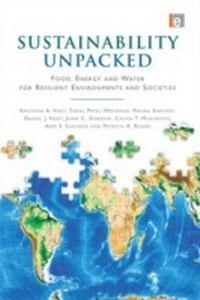
Sustainability Unpacked
Food, Energy and Water for Resilient Environments and Societies
1. Auflage
Erschienen am 25. Juni 2012
328 Seiten
978-1-136-53060-9 (ISBN)
Beschreibung

Food, water and energy form some of the basic elements of sustainability considerations. This ground-breaking book examines and decodes these elements, exploring how a range of countries make decisions regarding their energy and bio-resource consumption and procurement. The authors consider how these choices impact not only the societies and environments of those countries, but the world in general.
To achieve this, the authors review the merits of various sustainability and environmental metrics, and then apply these to 34 countries that are ranked low, medium or high on the human development index. The book assesses their resource capacities and the environmental impacts, both within and outside their country boundaries, from consuming food, water, and energy. The final section uses the lessons derived from the earlier analyses of resource consumption to explore the importance of geography, climates and sustainable management of forests and other natural resources for building resilient societies in the future.
To achieve this, the authors review the merits of various sustainability and environmental metrics, and then apply these to 34 countries that are ranked low, medium or high on the human development index. The book assesses their resource capacities and the environmental impacts, both within and outside their country boundaries, from consuming food, water, and energy. The final section uses the lessons derived from the earlier analyses of resource consumption to explore the importance of geography, climates and sustainable management of forests and other natural resources for building resilient societies in the future.
Rezensionen / Stimmen
'What is 'sustainability'? Taking a comprehensive yet simple approach, this book discusses the inter-linking and complex elements of sustainability and how they influence and are influenced by our society when it comes to making decisions about resource use. A must-read book for everyone interested in conservation, the environment and development.' - Dicky P. Simorangkir, Forest Program Director, The Nature Conservancy, Indonesia'A foundational reader that is encyclopedic in its scope and consideration of data to advance an analytical lens to plan and implement sustainable development that meets both the real-world tests of pessimists and ambitions of optimists.' - Steve Rhee, AAAS (American Association for the Advancement of Science) Science and Technology Fellow, US State Department (2007-9)
"In order to ''think like an ecosystem'' the book draws on a wide range of examples and metrics from past and present societies. It considers how societies collapsed or survived in the past as well as exploring nine indices pertinent to sustainability from 34 different countries ... The book makes a contribution to the literature through this ambitious attempt to pick apart sustainability with real life examples." - Orla Shortall, Agriculture and Human Values
Weitere Details
Auflage
1. Auflage
Sprache
Englisch
Verlagsort
London
Großbritannien
Verlagsgruppe
Taylor & Francis Ltd
Zielgruppe
Für höhere Schule und Studium
Produkt-Hinweis
Reflowable
Dateigröße
9,61 MB
ISBN-13
978-1-136-53060-9 (9781136530609)
Copyright in bibliographic data and cover images is held by Nielsen Book Services Limited or by the publishers or by their respective licensors: all rights reserved.
Schweitzer Klassifikation
Weitere Ausgaben
Andere Ausgaben
Kristiina Vogt | Toral Patel-Weynand | Maura Shelton
Sustainability Unpacked
Food, Energy and Water for Resilient Environments and Societies
Buch
09/2010
1. Auflage
Earthscan Ltd
256,50 €
Versand in 3-4 Wochen
Kristiina Vogt | Toral Patel-Weynand | Maura Shelton
Sustainability Unpacked
Food, Energy and Water for Resilient Environments and Societies
Buch
09/2010
1. Auflage
Earthscan Ltd
79,50 €
Versand in 3-4 Wochen
Personen
Kristiina A. Vogt, professor of ecosystem management and founder (and co-coordinator) of the Forest Systems and Bioenergy program at the University of Washington, Seattle, USA. She was one of the founders of a start-up bioenergy company, Renewol, which she currently chairs. She also is the Vice-President for Bio-Energy, Interforest LLC. She is a co-investigator on a multi-million dollar Integrative Graduate Education and Research Training (IGERT) grant funded by the NSF entitled 'Bio-resource Based Energy for Sustainable Societies'. Professor Vogt has authored or co-authored seven books and published over 135 refereed articles.
Toral Patel-Weynand, Affiliate Associate Faculty at the University of Washington (UW) and an Associate of the Forest Systems and Bioenergy, UW.
Maura Shelton, Research Associate with the Forest Systems and Bioenergy in the College of Forest Resources at the University of Washington. She is presently an NSF IGERT Bioenergy Fellow.
Daniel J. Vogt, Associate Professor in Soils and Ecosystem Ecology of the College of Forest Resources, University of Washington. He is an internationally-recognized scholar with over 50 author credits. He is also currently a senior consultant of Interforest, LLC, a sustainable forestry consulting firm, and a partner in a start-up bioenergy company, Renewol.
John C. Gordon, Chairman of Interforest, LLC, a sustainable forestry consulting firm, and a founder of the Candlewood Timber Group, Inc., a sustainable forestry company with forestland and operations in Argentina. He is also Pinchot Professor Emeritus of Forestry and Environmental Studies at the Yale School of Forestry and Environmental Studies. He has authored, coauthored or edited over 150 papers and books. He also is currently a partner in two start-up companies, Renewol, and Maximum Yield Associates.
Calvin T. Mukumoto, President of Renewol LLC, and Chief financial Officer for TSS Consultants.
Asep S. Suntana, Research Associate, Forest Systems and Bioenergy program at the University of Washington. He is also a LEAD fellow (Leadership for Environment and Development (LEAD) International and LEAD Indonesia Program) in Indonesia, China, and Canada (1998 - 2000).
Patricia A. Roads, Communications Director for the Center for Adaptive Policies in Ecosystems International, a non-profit organization originally based in Washington and now in Iceland.
Toral Patel-Weynand, Affiliate Associate Faculty at the University of Washington (UW) and an Associate of the Forest Systems and Bioenergy, UW.
Maura Shelton, Research Associate with the Forest Systems and Bioenergy in the College of Forest Resources at the University of Washington. She is presently an NSF IGERT Bioenergy Fellow.
Daniel J. Vogt, Associate Professor in Soils and Ecosystem Ecology of the College of Forest Resources, University of Washington. He is an internationally-recognized scholar with over 50 author credits. He is also currently a senior consultant of Interforest, LLC, a sustainable forestry consulting firm, and a partner in a start-up bioenergy company, Renewol.
John C. Gordon, Chairman of Interforest, LLC, a sustainable forestry consulting firm, and a founder of the Candlewood Timber Group, Inc., a sustainable forestry company with forestland and operations in Argentina. He is also Pinchot Professor Emeritus of Forestry and Environmental Studies at the Yale School of Forestry and Environmental Studies. He has authored, coauthored or edited over 150 papers and books. He also is currently a partner in two start-up companies, Renewol, and Maximum Yield Associates.
Calvin T. Mukumoto, President of Renewol LLC, and Chief financial Officer for TSS Consultants.
Asep S. Suntana, Research Associate, Forest Systems and Bioenergy program at the University of Washington. He is also a LEAD fellow (Leadership for Environment and Development (LEAD) International and LEAD Indonesia Program) in Indonesia, China, and Canada (1998 - 2000).
Patricia A. Roads, Communications Director for the Center for Adaptive Policies in Ecosystems International, a non-profit organization originally based in Washington and now in Iceland.
Inhalt
PART 1: From the Beginning
1. Sustainability - Clues for Positive Societal and Ecosystem Change
2. Learning From the Past: Why Societies Collapsed or Survived
PART 2: Scientific Approach to Decoding Sustainability
3. Today: Decoding Country Resource Stories
PART 3: The Real Country Stories
4. Fossil Energy Endowments and Externalities
5. Forests - the Backbone and Circulatory System for Human Societies
6. The Soil and Water Connection to Food: Adapt, Mitigate, or Die
PART 4. Climate and Soils: Unavoidable Constraints To Solar Capital
7. The Future: Climate Change as a Global Driver Impacting Sustainability
8. Where the Past and Future meet: Soils or the Unseen Earth that Nurtures Societies
9. The Ultimate Constraint to Human Sustainability: Solar Income
PART 5. Societies Adapt To a Quagmire of Resource Choices
10. Debunking Sustainability Myths
11. Portfolio for Managing Natural and Human Capital
12. Sustainable Ecosystems: Investments in Human and Natural Capital
References
1. Sustainability - Clues for Positive Societal and Ecosystem Change
2. Learning From the Past: Why Societies Collapsed or Survived
PART 2: Scientific Approach to Decoding Sustainability
3. Today: Decoding Country Resource Stories
PART 3: The Real Country Stories
4. Fossil Energy Endowments and Externalities
5. Forests - the Backbone and Circulatory System for Human Societies
6. The Soil and Water Connection to Food: Adapt, Mitigate, or Die
PART 4. Climate and Soils: Unavoidable Constraints To Solar Capital
7. The Future: Climate Change as a Global Driver Impacting Sustainability
8. Where the Past and Future meet: Soils or the Unseen Earth that Nurtures Societies
9. The Ultimate Constraint to Human Sustainability: Solar Income
PART 5. Societies Adapt To a Quagmire of Resource Choices
10. Debunking Sustainability Myths
11. Portfolio for Managing Natural and Human Capital
12. Sustainable Ecosystems: Investments in Human and Natural Capital
References
