

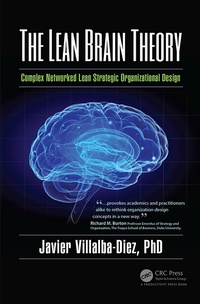
The Lean Brain Theory
Complex Networked Lean Strategic Organizational Design
Erschienen am 8. November 2017
187 Seiten
978-1-351-63168-6 (ISBN)
Beschreibung

The most complex organization known in the universe is inside of our heads: our brain. Because organizations are formed by human beings, The Lean Brain Theory aims to mimic human brain structure and functionality so as to enable the emergence of brain-like organizations in which the 'neurons' are the human-beings and the 'axons' ought to be Lean Management oriented behavioral and communication patterns. These networks ought to evolve towards brain-like configurations that display thinking-like processes and ultimately organizational consciousness. The Lean Brain Theory offers a quantifiable holistic framework to strategically design any organization as a human brain. By embedding complexity into the Strategic Organizational Design (SOD) and combining this with Lean Management and neuropsychological state of the art knowledge, The Lean Brain Theory ends up with the Brain-Organization metaphor and makes it possible.
This idea of embedding complexity into organizational design is a follow up to the book The Hoshin Kanri Forest. That book dealt with the methodology of creating 'forest-like' topologies. The Lean Brain Theory aims to set the ground for Lean organizations of the future that embrace both Business Intelligence and Complex Networked Lean Strategic Organizational Design. The organization as a super-network evolves towards 'intelligent' Human-Brain-like entity. The Lean Brain Theory ultimately seeks to integrate an anthropomorphic organizational paradigm with future tendencies of technological advances. In this way, the brain-like organization emerging from it can be regarded as bionic.
This idea of embedding complexity into organizational design is a follow up to the book The Hoshin Kanri Forest. That book dealt with the methodology of creating 'forest-like' topologies. The Lean Brain Theory aims to set the ground for Lean organizations of the future that embrace both Business Intelligence and Complex Networked Lean Strategic Organizational Design. The organization as a super-network evolves towards 'intelligent' Human-Brain-like entity. The Lean Brain Theory ultimately seeks to integrate an anthropomorphic organizational paradigm with future tendencies of technological advances. In this way, the brain-like organization emerging from it can be regarded as bionic.
Rezensionen / Stimmen
"Today, our processes and organizations are becoming more and more complex. The Lean Brain Theory provides both the necessary theoretical background and a fully tested in practice approach to enable corporations to cope with such process and organizational complexity."-Steffen Scheuring Head of Lean Management Global Manufacturing & Quality EMEA/LA Fresenius Medical Care Deutschland GmbH
"Learning is a process and processes need time, especially in complex and ever changing environments. Time is the most important critical success factor. The Hoshin Kanri Forest and The Lean Brain Theory helped me and my organization learn faster and more effectively by embedding complexity within our organizational design configuration. An outstanding WOW effect!"
-Franz Obermeier, Head of Filling Technology, Bottling Technology Krones AG
"This book challenges the reader by combining state of the art neurobiological knowledge, lean strategic organizational design, artificial intelligence models to effectively compute today's business complexity and the mathematical approach needed to build an actionable strategy in practice.
The scientific lean management concepts outlined in The Lean Brain Theory are likely to game-change the way collective organizational alignment is understood."
-Prof. Dr.-Ing. Joaquin Ordieres-Mere, Expert in Big Data and Business Intelligence, Universidad Politecnica de Madrid
"The Lean Brain Theory of Organization Design using the brain as metaphor is a provocative statement and a challenge. It builds upon traditional theory of information processing, but goes beyond to formalize a network communications approach. In the author's own words: I introduced the concept of Lean Structural Network (LSN) and Lean Functional Networks (LFN). Both LSNs and LFNs are directed networks in which the nodes N are the people forming the organization and the edges are respectively the lean oriented business communication standard patterns (CPD)nA for LSN and the actions in the Do phase for LFN. This network model captures informational relations and connectivity correlation matrices. Traditional issues, such as learning, culture, leadership, power, and strategic problem solving are discussed informally, but also formally within the model.
The Lean Brain Theory can be read on two levels: the first is a rich informal narrative - a personal statement, and the second is the more formal model with mathematical formulations and detailed explanatory charts. With the implications for management the lean brain theory provokes academics and practitioners alike to rethink organization design concepts in a new way."
-Richard M. Burton, Professor Emeritus of Strategy and Organization. The Fuqua School of Business, Duke University "Today, our processes and organizations are becoming more and more complex. The Lean Brain Theory provides both the necessary theoretical background and a fully tested in practice approach to enable corporations to cope with such process and organizational complexity."
-Steffen Scheuring Head of Lean Management Global Manufacturing & Quality EMEA/LA Fresenius Medical Care Deutschland GmbH
"Learning is a process and processes need time, especially in complex and ever changing environments. Time is the most important critical success factor. The Hoshin Kanri Forest and The Lean Brain Theory helped me and my organization learn faster and more effectively by embedding complexity within our organizational design configuration. An outstanding WOW effect!"
-Franz Obermeier, Head of Filling Technology, Bottling Technology Krones AG
"This book challenges the reader by combining state of the art neurobiological knowledge, lean strategic organizational design, artificial intelligence models to effectively compute today's business complexity and the mathematical approach needed to build an actionable strategy in practice.
The scientific lean management concepts outlined in The Lean Brain Theory are likely to game-change the way collective organizational alignment is understood."
-Prof. Dr.-Ing. Joaquin Ordieres-Mere, Expert in Big Data and Business Intelligence, Universidad Politecnica de Madrid
"The Lean Brain Theory of Organization Design using the brain as metaphor is a provocative statement and a challenge. It builds upon traditional theory of information processing, but goes beyond to formalize a network communications approach. In the author's own words: I introduced the concept of Lean Structural Network (LSN) and Lean Functional Networks (LFN). Both LSNs and LFNs are directed networks in which the nodes N are the people forming the organization and the edges are respectively the lean oriented business communication standard patterns (CPD)nA for LSN and the actions in the Do phase for LFN. This network model captures informational relations and connectivity correlation matrices. Traditional issues, such as learning, culture, leadership, power, and strategic problem solving are discussed informally, but also formally within the model.
The Lean Brain Theory can be read on two levels: the first is a rich informal narrative - a personal statement, and the second is the more formal model with mathematical formulations and detailed explanatory charts. With the implications for management the lean brain theory provokes academics and practitioners alike to rethink organization design concepts in a new way."
-Richard M. Burton, Professor Emeritus of Strategy and Organization. The Fuqua School of Business, Duke University
Weitere Details
Sprache
Englisch
Verlagsort
London
Großbritannien
Verlagsgruppe
Taylor & Francis Ltd
Zielgruppe
Für Beruf und Forschung
Illustrationen
17 Line drawings, color; 7 Halftones, color; 24 Illustrations, color
Dateigröße
64,22 MB
ISBN-13
978-1-351-63168-6 (9781351631686)
Copyright in bibliographic data and cover images is held by Nielsen Book Services Limited or by the publishers or by their respective licensors: all rights reserved.
Schweitzer Klassifikation
Weitere Ausgaben
Andere Ausgaben
Javier Villalba-Diez, PhD
The Lean Brain Theory
Complex Networked Lean Strategic Organizational Design
Buch
11/2017
1. Auflage
CRC Press
62,06 €
Artikel z.Zt. nicht lieferbar
Person
Javier Villalba-Diez, PhD. is currently director and founder of an international consulting company that has the mission of empowering organizations achieve their strategic goals while increasing trust. Dr. Villalba-Diez is a Mechanical Engineer with Technische Universitaet Muenchen, Germany and Industrial Engineer with Technical University Madrid, Spain (2003) He received his PhD in Engineering, Economics and Organizational Innovation from the Technical University Madrid in 2016. His current research interests include Hoshin Kanri and Business Intelligence. He has a background of more than 15 years as lean consultant and several years as production manager in a number of positions related to manufacturing operations in German, American and Japanese manufacturing facilities. His research and work has brought him to numerous companies and hundreds of factories, where he collaborates with people to test ideas and share lessons learned. He splits his time between Spain, Germany, USA, and Japan. He is also the author of The Hoshin Kanri Forest: Lean Strategic Organizational Design.
Inhalt
Introduction.
Part 1. THE METAPHOR.
Chaper 1. Brain-Organizational paradigm.
Part 2. THE METHOD.
Chapter 2.The emergence.
Chapter 3. The rise of the Lean Brain.
Part 3. THE THEORY.
Chapter 4. The Lean Brain Theory.
Chapter 5. Perspectives on Organizational Culture
Part 4. APPLICATIONS.
Chapter 6. Interpersonal Power and the Lean Brain.
Chapter 7. Closing Reflections.
HAGAKURE ??
Appendix. H4 Art.
References
Part 1. THE METAPHOR.
Chaper 1. Brain-Organizational paradigm.
Part 2. THE METHOD.
Chapter 2.The emergence.
Chapter 3. The rise of the Lean Brain.
Part 3. THE THEORY.
Chapter 4. The Lean Brain Theory.
Chapter 5. Perspectives on Organizational Culture
Part 4. APPLICATIONS.
Chapter 6. Interpersonal Power and the Lean Brain.
Chapter 7. Closing Reflections.
HAGAKURE ??
Appendix. H4 Art.
References
