

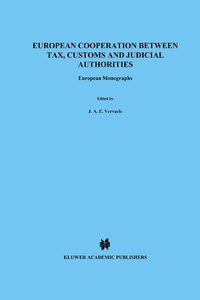
European Cooperation Between Tax, Customs and Judicial Authorties
European Monographs
Erschienen am 1. Dezember 2001
314 Seiten
978-90-411-8168-8 (ISBN)
Beschreibung

This book offers an English translation, updated to mid-2001, of an acclaimed Dutch study which appeared earlier that year. The study was originally commissioned by the Dutch Ministry of Justice, which recognized that the way to clear standards of cooperation lay through in-depth comparative research into the relevant law, practice, and recent experience of several major national jurisdictions.
A five-member research group worked with the help of the Willem Pompe Institute of Criminal Law and Criminology, the Foundation for the Promotion of Criminal Law Research, and the Utrecht Faculty of Law's Centre for Enforcement of European Law.
In order to focus meaningfully on the theme of combating fraud in its most significant current manifestations, the researchers restricted their study to customs law, fiscal law, and agricultural law in four EC countries. Among the core legal matters investigated are the following:
- exchange of enforcement data;
- performance of acts of investigation;
- the "moment" in each legal system at which it is necessary to switch from administrative assistance to assistance in criminal matters; and
- the manner in which national systems of evidence deal with evidence from abroad.
Based on a close study of legislation and case law in each of the four countries-in addition to numerous personal interviews-the analysis clearly identifies the legal problems, and makes recommendations as to how transnational administrative law and cooperation in criminal matters may be most effectively arranged.
A five-member research group worked with the help of the Willem Pompe Institute of Criminal Law and Criminology, the Foundation for the Promotion of Criminal Law Research, and the Utrecht Faculty of Law's Centre for Enforcement of European Law.
In order to focus meaningfully on the theme of combating fraud in its most significant current manifestations, the researchers restricted their study to customs law, fiscal law, and agricultural law in four EC countries. Among the core legal matters investigated are the following:
- exchange of enforcement data;
- performance of acts of investigation;
- the "moment" in each legal system at which it is necessary to switch from administrative assistance to assistance in criminal matters; and
- the manner in which national systems of evidence deal with evidence from abroad.
Based on a close study of legislation and case law in each of the four countries-in addition to numerous personal interviews-the analysis clearly identifies the legal problems, and makes recommendations as to how transnational administrative law and cooperation in criminal matters may be most effectively arranged.
Weitere Details
Weitere Ausgaben
Andere Ausgaben
Buch
12/2001
1. Auflage
Kluwer Law International
96,30 €
Versand in 10-20 Tagen
Inhalt
- Cover
- Half Title Page
- Title Page
- Copyright Page
- Preface
- Table of Contents
- CHAPTER 1 Introduction
- 1.1 GENERAL CONTEXT OF RESEARCH
- 1.2 SCOPE OF SURVEY AND DEFINITION OF THE PROBLEM
- 1.3 METHODOLOGY, COMPOSITION OF SURVEY GROUP AND JUSTIFICATION
- CHAPTER 2 Supranational rules governing cooperation in administrative and criminal matters
- 2.1 RULES AND INSTITUTIONAL CONTEXT
- 2.1.1 International law
- 2.1.2 European Union law
- 2.2 MUTUAL ADMINISTRATIVE ASSISTANCE WITHIN THE EUROPEAN UNION
- 2.2.1 Introduction: historical development
- 2.2.2 Mutual administrative assistance as a concept
- 2.2.3 Horizontal mutual administrative assistance in customs and agricultural matters
- 2.2.4 Horizontal mutual administrative assistance in tax matters
- 2.2.5 Vertical cooperation in tax and customs matters: the position of the European Commission
- 2.3 COOPERATION IN CRIMINAL MATTERS WITHIN THE EUROPEAN UNION
- 2.3.1 International mutual assistance in criminal matters: a historical survey
- 2.3.2 Mutual assistance in criminal matters as a concept
- 2.3.3 The 1959 European mutual assistance convention and the protocol
- 2.3.4 Schengen and the Convention applying the Schengen Agreement
- 2.3.5 Third Pillar cooperation
- 2.3.6 Treaty cooperation along the dividing line between criminal law and other areas of law
- 2.4 Transition between types of cooperation in the case of transnational cooperation
- CHAPTER 3 Country analysis - The Netherlands
- 3.1 INTRODUCTION AND SCOPE
- 3.2 TAX, CUSTOMS AND AGRICULTURE: NATIONAL ANTI-FRAUD MEASURES
- 3.2.1 Formal sources of law: substantive legislation, enforcement legislation and case law
- 3.2.2 Structure of organisation
- 3.2.3 Division of jurisdiction for administrative and criminal law enforcement
- 3.2.4 Instruments: control, investigation and prosecution
- 3.2.5 Judicial and extrajudicial disposal
- 3.2.6 Duty of secrecy - disclosure of information between tax authorities and judicial authorities
- 3.2.7 Rules of evidence: means of evidence, evidential value and use of evidence
- 3.3 TAXATION, CUSTOMS AND AGRICULTURE: TRANSNATIONAL ANTI-FRAUD MEASURES
- 3.3.1 Formal sources of law: horizontal and vertical cooperation
- 3.3.2 Structure of organisation for cooperation
- 3.3.3 Powers to cooperate
- 3.3.4 Exceptions to cooperation (grounds for refusal)
- 3.3.5 Information provided for specific purposes
- 3.3.6 Legal protection
- 3.3.7 Use of evidence
- CHAPTER 4 Country analysis - Germany
- 4.1 INTRODUCTION
- 4.2 TAX, CUSTOMS AND AGRICULTURE
- 4.2.1 Formal sources of law: substantive legislation, enforcement legislation and case law
- 4.2.2 Structure of organisation
- 4.2.3 Instruments: control, investigation and prosecution
- 4.2.4 Extrajudicial disposal
- 4.2.5 Judicial disposal
- 4.2.6 Una via and cumulation
- 4.2.7 Duty of secrecy
- 4.2.8 Rules of evidence
- 4.3 TRANSNATIONAL ANTI-FRAUD MEASURES
- 4.3.1 Horizontal transnational anti-fraud measures
- 4.3.2 Vertical transnational cooperation
- CHAPTER 5 Country analysis - France
- 5.1 INTRODUCTION: COHABITATION À LA FRANÇAISE?
- 5.2 TAX, CUSTOMS AND AGRICULTURE: NATIONAL ANTI-FRAUD MEASURES
- 5.2.1 Formal sources of law: substantive legislation, enforcement legislation and case law
- 5.2.2 Structure of organisation
- 5.2.3 Instruments: control, investigation and prosecution
- 5.2.4 Extrajudicial disposal
- 5.2.5 Judicial disposal
- 5.2.6 Una via and cumulation
- 5.2.7 Duty of secrecy - disclosure of information between tax authorities, customs authorities and judicial authorities
- 5.2.8 Rules of evidence: means of evidence, evidential value and use of evidence
- 5.3 TAXATION, CUSTOMS AND AGRICULTURE: TRANSNATIONAL ANTI-FRAUD MEASURES
- 5.3.1 Horizontal transnational anti-fraud measures
- 5.3.2 Vertical transnational cooperation
- CHAPTER 6 Country analysis - England and Wales
- 6.1 INTRODUCTION
- 6.2 TAX, CUSTOMS AND AGRICULTURE: NATIONAL ANTI-FRAUD MEASURES
- 6.2.1 Formal sources of law: substantive legislation, enforcement legislation and case law
- 6.2.2 Structure of organisation
- 6.2.3 Instruments: control, investigation, prosecution and trial
- 6.2.4 Extrajudicial disposal
- 6.2.5 Judicial disposal
- 6.2.6 Una via and cumulation
- 6.2.7 Duty of secrecy - disclosure of information between tax authorities, customs authorities and judicial authorities
- 6.2.8 Rules of evidence: means of evidence and evidential value
- 6.3 TAXATION, CUSTOMS AND AGRICULTURE: TRANSNATIONAL ANTI-FRAUD MEASURES
- 6.3.1 Horizontal cooperation
- 6.3.2 Vertical cooperation
- 6.3.3 Conclusion
- CHAPTER 7 Comparative law conclusions
- 7.1 SUPRANATIONAL RULES FOR COOPERATION IN ADMINISTRATIVE MATTERS AND IN CRIMINAL MATTERS
- 7.1.1 Rules governing horizontal cooperation
- 7.1.2 Rules governing vertical cooperation and operational powers of the European Union
- 7.2 THE STRUCTURE OF NATIONAL ENFORCEMENT SYSTEMS
- 7.3 THE STRUCTURE OF HORIZONTAL AND VERTICAL COOPERATION IN THE MEMBER STATES
- 7.4 THE COORDINATION BETWEEN MUTUAL ADMINISTRATIVE ASSISTANCE AND MUTUAL ASSISTANCE IN CRIMINAL MATTERS IN SUPRANATIONAL AND NATIONAL LAW
- 7.4.1 The coordination between mutual administrative assistance and mutual assistance in criminal matters under supranational law
- 7.4.2 National rules
- 7.5 USE OF EVIDENCE
- CHAPTER 8 Problems, directions for solutions, and recommendations
- 8.1 PROBLEMS
- 8.2 POSSIBLE SOLUTIONS AND RECOMMENDATIONS
- 8.3 CONCLUSION
- Literature
- Authorities and experts who have assisted in the survey
- Back Cover
