

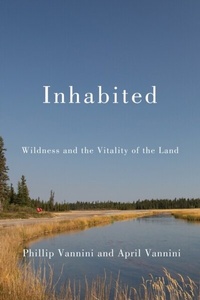
Inhabited
Wildness and the Vitality of the Land
1. Auflage
Erschienen am 15. November 2021
296 Seiten
978-0-2280-1027-2 (ISBN)
Beschreibung

People are key elements of wild places. At the same time, human entanglements with wild ecologies involve extractivism, the growth of resource-based economies, and imperial-colonial expansion, activities that are wreaking havoc on our planet.
Through an ethnographic exploration of Canada's ten UNESCO Natural World Heritage sites, Inhabited reflects on the meanings of wildness, wilderness, and natural heritage. As we are introduced to local inhabitants and their perspectives, Phillip Vannini and April Vannini ask us to reflect on the colonial and dualist assumptions behind the received meaning of wild, challenging us to reimagine wildness as relational and rooted in vitality. Over the three years they spent in and around these sites, they learned from Indigenous and non-Indigenous peoples about their entanglements with each other and with non-human animals, rocks, plants, trees, sky, water, and spirits. The stories, actions, and experiences they encountered challenge conventional narratives of wild places as uninhabited by people and disconnected from culture and society. While it might be tempting to dismiss the idea of wildness as outdated in the Anthropocene era, Inhabited suggests that rethinking wildness offers a better - if messier - way forward.
Part geography and anthropology, part environmental and cultural studies, and part politics and ecology, Inhabited balances a genuine love of nature's vitality with a culturally responsible understanding of its interconnectedness with more-than-human ways of life.
Through an ethnographic exploration of Canada's ten UNESCO Natural World Heritage sites, Inhabited reflects on the meanings of wildness, wilderness, and natural heritage. As we are introduced to local inhabitants and their perspectives, Phillip Vannini and April Vannini ask us to reflect on the colonial and dualist assumptions behind the received meaning of wild, challenging us to reimagine wildness as relational and rooted in vitality. Over the three years they spent in and around these sites, they learned from Indigenous and non-Indigenous peoples about their entanglements with each other and with non-human animals, rocks, plants, trees, sky, water, and spirits. The stories, actions, and experiences they encountered challenge conventional narratives of wild places as uninhabited by people and disconnected from culture and society. While it might be tempting to dismiss the idea of wildness as outdated in the Anthropocene era, Inhabited suggests that rethinking wildness offers a better - if messier - way forward.
Part geography and anthropology, part environmental and cultural studies, and part politics and ecology, Inhabited balances a genuine love of nature's vitality with a culturally responsible understanding of its interconnectedness with more-than-human ways of life.
Rezensionen / Stimmen
"Artfully crafted and extremely accessible, Inhabited is informed by a spirit of modesty and generosity throughout its pages. Nothing compares to this book in its scope, contemporary relevance, and empirical depth, and its contemporary political and social importance can hardly be overstated in an era of global environmental change and anxiety." Tim Edensor, Manchester Metropolitan University "The range of people the authors speak to, and the respect with which they heed their words, is an impressive model of ethnographic fieldwork. The book is, admirably, not written from above, or below even, but somewhere in the messy middle where our everyday lives occur, matching the relational wildness for which the authors advocate." Gavin Van Horn, Center for Humans and NatureWeitere Details
Sprache
Englisch
Verlagsort
Montreal, QC
Kanada
Zielgruppe
Für Beruf und Forschung
Editions-Typ
Digitale Ausgabe
Illustrationen
14 photos
14 photos
Dateigröße
4,32 MB
ISBN-13
978-0-2280-1027-2 (9780228010272)
Copyright in bibliographic data and cover images is held by Nielsen Book Services Limited or by the publishers or by their respective licensors: all rights reserved.
Schweitzer Klassifikation
Weitere Ausgaben
Andere Ausgaben
Buch
11/2021
McGill-Queen's University Press
35,50 €
Versand in 15-20 Tagen
Buch
11/2021
McGill-Queen's University Press
160,37 €
Artikel z.Zt. nicht lieferbar
Personen
Phillip Vannini is professor in the School of Communication and Culture at Royal Roads University. April Vannini teaches in the School of Communication and Culture at Royal Roads University.
Inhalt
- Cover
- Inhabited
- Title
- Copyright
- Contents
- Figures
- 1 Introduction
- 2 Vitality and Relationality
- 3 Ecological Heritage
- Interlude: Fog
- 4 Entanglement
- 5 Intensity
- 6 Inhabitation
- Interlude: Bear Spray
- 7 Atmosphere
- Interlude: The Lonesome Loon
- 8 Exhaustion
- Interlude: NOT Alone
- 9 Aliveness
- 10 Sacred Ways of Life
- Notes
- References
- Index
