

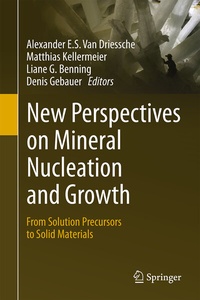
New Perspectives on Mineral Nucleation and Growth
Beschreibung

In the last decade, numerous studies have demonstrated the existence of alternative pathways to nucleation and crystallisation that oppose the classical view. Such proposed scenarios include multistage reactions proceeding via various precursor species and/or intermediate phases. The aim of this book is to review and discuss these recent advances in our understanding of the early stages of mineralisation through a series of contributions that address both experimental and theoretical studies about the formation and nature of initial precursor species (e.g., prenucleation clusters, dense liquid phases, amorphous nanoparticles, etc.) as well as their transformations leading to the stable mineral phase. Several chapters are devoted to cutting-edge analytical techniques used for investigating the above processes in situ, in real time and at conditions relevant to both natural and industrial processes. At the end of the book, the editors summarize the key questions that still need to be addressed in order to establish a complete picture of the nucleation and growth processes involved during the formation of minerals
Weitere Details
Weitere Ausgaben
Andere Ausgaben
Personen
Dr. Alexander Van Driessche is connected to the University of Granada and is an expert in the field of Chemical Kinetics, Chemical Thermodynamics and Materials Chemistry.
Prof Liane G Benning is Professor of Experimental Biogeochemistry and connected to the School of Earth and Environment at Leeds University. Her research addresses geochemical reaction mechanisms at low to hydrothermal temperatures in inorganic and biologic systems.
Field-work in the last few years included geothermal extreme environments in Iceland and New Zealand and cryogenic extreme environments (cold deserts) in the European Arctic (Svalbard, Greenland, Iceland).
Professor Dennis Gebauer, works for the university of Konstanz in Konstanz and is since 2014 a member of the executive board of the Graduate School of Chemistry of the Chemistry department of that same university. Besides, being a member of the management Committee of the COST action TD0903 and a member of the ScientificStaff of the Max Planck Institute.
Dr. Mathias Kellermeier is connected to BASF after receiving his PhD summa cum laude n Co-Mineralization of Alkaline-Earth Metal Carbonates and Silica" at the university of Regensburg in 2011.
