

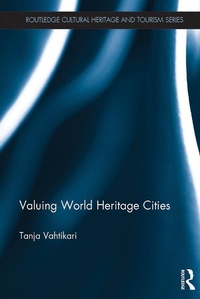
Valuing World Heritage Cities
Erschienen am 3. November 2016
246 Seiten
978-1-317-00259-8 (ISBN)
Beschreibung

With its celebrated World Heritage List, UNESCO steers the global heritage agenda through the definition and redefinition of what constitutes heritage and by offering the highest-level forum for heritage professionalism. While it is the national governments that nominate sites for inclusion in the World Heritage List, and the intergovernmental World Heritage Committee that makes the final decision on inclusion or non-inclusion, it is the International Council on Monuments and Sites (ICOMOS) for cultural heritage that determines whether the necessary level of 'outstanding universal value' is met.
Focusing on the discourses of ICOMOS and their transmission to the local context, this book is the first in-depth historical analysis of the construction of heritage value in the context of cities illustrated through a case study of Old Rauma in Finland. The book contributes to the understanding of the discursive and constructed nature of World Heritage values as opposed to intrinsic values, critically scrutinizes the role of ICOMOS in making valuations concerning urban heritage, and sheds light on the interactions and tensions of universal and local (urban) perspectives in the practice of heritage valuation.
Valuing World Heritage Cities is the first in-depth historical analysis of the construction of heritage value in the context of cities in the transnational discourses of heritage. This unique and timely contribution will be of interest to scholars and students working in Heritage Studies, Cultural Geography, Urban Studies and Tourism.
Focusing on the discourses of ICOMOS and their transmission to the local context, this book is the first in-depth historical analysis of the construction of heritage value in the context of cities illustrated through a case study of Old Rauma in Finland. The book contributes to the understanding of the discursive and constructed nature of World Heritage values as opposed to intrinsic values, critically scrutinizes the role of ICOMOS in making valuations concerning urban heritage, and sheds light on the interactions and tensions of universal and local (urban) perspectives in the practice of heritage valuation.
Valuing World Heritage Cities is the first in-depth historical analysis of the construction of heritage value in the context of cities in the transnational discourses of heritage. This unique and timely contribution will be of interest to scholars and students working in Heritage Studies, Cultural Geography, Urban Studies and Tourism.
Weitere Details
Reihe
Sprache
Englisch
Verlagsort
London
Großbritannien
Verlagsgruppe
Taylor & Francis Ltd
Zielgruppe
Für höhere Schule und Studium
Illustrationen
3 Tables, black and white; 5 Line drawings, black and white; 4 Halftones, black and white; 9 Illustrations, black and white
Dateigröße
1,72 MB
ISBN-13
978-1-317-00259-8 (9781317002598)
Copyright in bibliographic data and cover images is held by Nielsen Book Services Limited or by the publishers or by their respective licensors: all rights reserved.
Schweitzer Klassifikation
Weitere Ausgaben
Andere Ausgaben
Tanja Vahtikari
Valuing World Heritage Cities
Buch
02/2018
1. Auflage
Routledge
79,25 €
Versand in 10-20 Tagen
Tanja Vahtikari
Valuing World Heritage Cities
Buch
11/2016
1. Auflage
Routledge
231,70 €
Versand in 10-20 Tagen
Person
Tanja Vahtikari is Postdoctoral Research Fellow at the Finnish Centre of Excellence in Historical Research at the University of Tampere, Finland.
Inhalt
1 Introduction
2 Intrinsic value, uncontestable expertise: ICOMOS, UNESCO and outstanding universal value
3 Catching up with "the spirit of the moment"
4 World Heritage cities: which urban pasts? Whose urban histories?
5 World Heritage cities: what urban futures?
6 Outstanding universal value and the local narrative of place and heritage: Old Rauma
7 Conclusions
2 Intrinsic value, uncontestable expertise: ICOMOS, UNESCO and outstanding universal value
3 Catching up with "the spirit of the moment"
4 World Heritage cities: which urban pasts? Whose urban histories?
5 World Heritage cities: what urban futures?
6 Outstanding universal value and the local narrative of place and heritage: Old Rauma
7 Conclusions
