

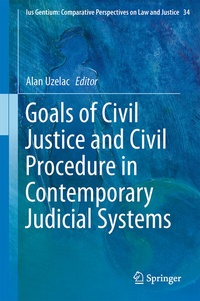
Goals of Civil Justice and Civil Procedure in Contemporary Judicial Systems
Beschreibung
This book is a collection of papers that address a fundamental question: What is the role of civil justice and civil procedure in the various national traditions in the contemporary world? The book presents striking differences among a range of countries and legal traditions, but also points to common trends and open issues. It brings together prominent experts, professionals and scholars from both civil and common law jurisdictions. It represents all main legal traditions ranging from Europe (Germanic and Romanic countries, Scandinavia, ex-Socialist countries) and Russia to the Americas (North and South) and China (Mainland and Hong Kong). While addressing the main issue - the goals of civil justice - the book discusses the most topical concerns regarding the functioning and efficiency of national systems of civil justice. These include concerns such as finding the appropriate balance between accurate fact-finding and the right to a fair trial within a reasonable time, the processing of hard cases and the function of civil justice as a specific public service. In the mosaic of contrasts and oppositions special place is devoted to the continuing battle between the individualistic/liberal approach and the collectivist/paternalistic approach - the battle in which, seemingly, paternalistic tendencies regain momentum in a number of contemporary justice systems.
Weitere Details
Weitere Ausgaben
Inhalt
Preface.- Table of Contents.- Part I General Synthesis.- Chapter 1 Goals of Civil Justice and Civil Procedure in the Contemporary World Global Developments - Towards Harmonisation (and Back); Alan Uzelac.- Part II National Perspectives.- Chapter 2 Civil Justice in Austrian-German Tradition; Christian Koller.- Chapter 3 Civil Justice in Pursuit of Efficiency; C.H. van Rhee.- Chapter 4 Goals of Civil Justice When Nothing Works: The Case of Italy; Elisabetta Silvestri.- Chapter 5 Goals of Civil Justice in Norway: Readiness for a Pragmatic Reform; Inge Lorange Backer.- Chapter 6 'American Exceptionalism' in Goals for Civil Litigation; Richard Marcus.- Chapter 7 Civil Justice with Multiple Objectives The Unique Path of Hong Kong's Civil Justice Reform; Peter C.H. Chan and David Chan.- Chapter 8 Social Harmony at the Cost of Trust Crisis: Goals of Civil Justice in China'; Yulin Fu.- Chapter 9 Civil Litigation in Russia: 'Guided Justice' and Revival of Public Interest; Dmitry HeroldovichNokhrin.- Chapter 10 Battle between Individual Rights and Public Interest in Hungarian Civil Procedure; Miklós Kengyel and Gergely Czoboly.- Chapter 11 (In)compatibility of Procedural Preclusions with the Goals of Civil Justice: An Ongoing Debate in Slovenia; Ales Galic.- Chapter 12 Judicial Activism as Goals Setting - Civil Justice in Brazil; Teresa Arruda Alvim Wambier.- List of Contributors.
