

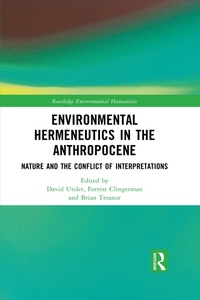
Environmental Hermeneutics in the Anthropocene
Nature and the Conflict of Interpretations
Erschienen am 15. Oktober 2025
278 Seiten
978-1-040-43958-6 (ISBN)
Beschreibung
Environmental Hermeneutics in the Anthropocene is a diverse collection of essays that approach contemporary environmental problems with the tools and perspectives provided by the tradition of philosophical hermeneutics, advanced by philosophers such as Martin Heidegger, Hans-Georg Gadamer, and Paul Ricoeur.
Engaging both established and new voices, this book presents a significant contribution to the field by expanding the scope of philosophical hermeneutics to environmental issues. It addresses a broad scope of environmental topics such as the Anthropocene, climate change, degrowth, environmental justice, the limits of language in understanding nature, and environmental aesthetics in environmental practice. Together, the chapters show the crisis of regional and global environmental problems to be in part a crisis of interpretation. The ways that human beings understand their relationship to environments shape and determine how to act and live within places. Yet the values and ideals that different people have about their lived environments often come into conflict. Thus hermeneutics plays an important role in environmental discourse: it helps adjudicate these conflicting understandings.
This collection of essays demonstrates the unique way that environmental hermeneutics can be employed to understand environments in this age of the Anthropocene. It will appeal to researchers and upper-level students in environmental humanities, environmental studies, ethics and philosophy.
Engaging both established and new voices, this book presents a significant contribution to the field by expanding the scope of philosophical hermeneutics to environmental issues. It addresses a broad scope of environmental topics such as the Anthropocene, climate change, degrowth, environmental justice, the limits of language in understanding nature, and environmental aesthetics in environmental practice. Together, the chapters show the crisis of regional and global environmental problems to be in part a crisis of interpretation. The ways that human beings understand their relationship to environments shape and determine how to act and live within places. Yet the values and ideals that different people have about their lived environments often come into conflict. Thus hermeneutics plays an important role in environmental discourse: it helps adjudicate these conflicting understandings.
This collection of essays demonstrates the unique way that environmental hermeneutics can be employed to understand environments in this age of the Anthropocene. It will appeal to researchers and upper-level students in environmental humanities, environmental studies, ethics and philosophy.
Weitere Details
Reihe
Sprache
Englisch
Verlagsort
London
Großbritannien
Verlagsgruppe
Taylor & Francis Ltd
Zielgruppe
Für höhere Schule und Studium
Für Beruf und Forschung
Dateigröße
10,93 MB
ISBN-13
978-1-040-43958-6 (9781040439586)
Copyright in bibliographic data and cover images is held by Nielsen Book Services Limited or by the publishers or by their respective licensors: all rights reserved.
Schweitzer Klassifikation
Weitere Ausgaben
Personen
David Utsler teaches philosophy at North Central Texas College (USA). Utsler received his Ph.D. in philosophy from the University of North Texas, specializing in philosophical hermeneutics and environmental philosophy. He is a co-editor of Interpreting Nature: The Emerging Field of Environmental Hermeneutics (Fordham 2014) and is the author of Paul Ricoeur and Environmental Philosophy (Lexington 2024). He has peer-reviewed articles in journals such as Philosophy Today, Environmental Philosophy, Quaestiones Disputatae, and Analecta Hermeneutica. Utsler currently serves as the co-director of The International Association for Environmental Philosophy and treasurer for The North Texas Philosophical Association.
Forrest Clingerman was Professor of Religion and Philosophy at Ohio Northern University, USA. He researches on a variety of topics related to environmental thought, including place, climate, aesthetics, and the Anthropocene. He is co-editor of Arts, Religion, and the Environment: Exploring Nature's Texture (Brill 2018) and Interpreting Nature: The Emerging Field of Environmental Hermeneutics (Fordham 2014).
Brian Treanor is professor of philosophy at Loyola Marymount University, where he teaches courses in environmental philosophy, philosophy and literature, and philosophy of religion, among other subjects. In 2011, he was awarded the President's Fritz B. Burns Distinguished Teaching Award. He is the author or co-editor of ten books, including: Melancholic Joy (Bloomsbury 2021), Philosophy in the American West (Routledge 2020), Carnal Hermeneutics (Fordham 2015), Being-in-Creation (Fordham 2015), Emplotting Virtue (SUNY 2014), and Interpreting Nature (Fordham 2014). He is currently working on two monographs, one exploring the meaning of "nature" and "wilderness," and the other arguing for the selfhood of non-human nature.
Forrest Clingerman was Professor of Religion and Philosophy at Ohio Northern University, USA. He researches on a variety of topics related to environmental thought, including place, climate, aesthetics, and the Anthropocene. He is co-editor of Arts, Religion, and the Environment: Exploring Nature's Texture (Brill 2018) and Interpreting Nature: The Emerging Field of Environmental Hermeneutics (Fordham 2014).
Brian Treanor is professor of philosophy at Loyola Marymount University, where he teaches courses in environmental philosophy, philosophy and literature, and philosophy of religion, among other subjects. In 2011, he was awarded the President's Fritz B. Burns Distinguished Teaching Award. He is the author or co-editor of ten books, including: Melancholic Joy (Bloomsbury 2021), Philosophy in the American West (Routledge 2020), Carnal Hermeneutics (Fordham 2015), Being-in-Creation (Fordham 2015), Emplotting Virtue (SUNY 2014), and Interpreting Nature (Fordham 2014). He is currently working on two monographs, one exploring the meaning of "nature" and "wilderness," and the other arguing for the selfhood of non-human nature.
Inhalt
Acknowledgements
Contributors
Preface
David Utsler & Brian Treanor
Introduction
David Utsler & Brian Treanor
1 Earthy Hermeneutics: Beyond the Metaphor of the Text
Brian Treanor
2 Translating Nature: Hermeneutics, Otherness, and the Limits of Environmental Understanding
Nathan M. Bell
3 Hermeneutics in the Wilderness
Cassandra Falke
4 Interpretation and the Anthropocene
Alexander Federau
5 The Hermeneutical Challenge of the Anthropocene: Rethinking Environmental Hermeneutics
Patryk Szaj
6 Sacrifice Zones and Interpreting the Anthropocene
Forrest Clingerman
7 The Beautiful and the Good in Practice: Gadamer and Environmental Hermeneutics
William Konchak
8 Is There a Measure on Earth? Heidegger and the Hermeneutical Problems of De-growth
Magdalena Holy-Luczaj
9 Situating Hermeneutics in Environmental Humanities: place, meaning, and interpretation
Martinho Soares
10 Interpreting Environmental Sustainability: Envisioning a Sustainable Future with Paul Ricoeur
Maria Cristina Clorinda Vendra
11 Fragility and Finitude in the Face of the Climate Crisis: On Worldview and Action
Christina M. Gschwandtner
12 Re-Placing Displacement
David Utsler
13 Sketching Gadamer's Contribution to Landscape Aesthetics: Play, Space, and Historicity
Elena Romagnoli
Afterword: Environmental Justice and the Moral Terrains of Environmental Hermeneutics in the Anthropocene
Robert Melchior Figueroa
Contributors
Preface
David Utsler & Brian Treanor
Introduction
David Utsler & Brian Treanor
1 Earthy Hermeneutics: Beyond the Metaphor of the Text
Brian Treanor
2 Translating Nature: Hermeneutics, Otherness, and the Limits of Environmental Understanding
Nathan M. Bell
3 Hermeneutics in the Wilderness
Cassandra Falke
4 Interpretation and the Anthropocene
Alexander Federau
5 The Hermeneutical Challenge of the Anthropocene: Rethinking Environmental Hermeneutics
Patryk Szaj
6 Sacrifice Zones and Interpreting the Anthropocene
Forrest Clingerman
7 The Beautiful and the Good in Practice: Gadamer and Environmental Hermeneutics
William Konchak
8 Is There a Measure on Earth? Heidegger and the Hermeneutical Problems of De-growth
Magdalena Holy-Luczaj
9 Situating Hermeneutics in Environmental Humanities: place, meaning, and interpretation
Martinho Soares
10 Interpreting Environmental Sustainability: Envisioning a Sustainable Future with Paul Ricoeur
Maria Cristina Clorinda Vendra
11 Fragility and Finitude in the Face of the Climate Crisis: On Worldview and Action
Christina M. Gschwandtner
12 Re-Placing Displacement
David Utsler
13 Sketching Gadamer's Contribution to Landscape Aesthetics: Play, Space, and Historicity
Elena Romagnoli
Afterword: Environmental Justice and the Moral Terrains of Environmental Hermeneutics in the Anthropocene
Robert Melchior Figueroa
