

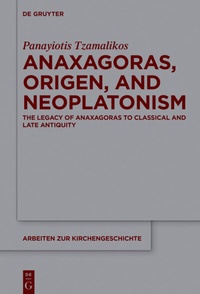
Anaxagoras, Origen, and Neoplatonism
Beschreibung

Origen has been always studied as a theologian and too much credit has been given to Eusebius' implausible hagiography of him. This book explores who Origen really was, by pondering into his philosophical background, which determines his theological exposition implicitly, yet decisively. For this background to come to light, it took a ground-breaking exposition of Anaxagoras' philosophy and its legacy to Classical and Late Antiquity (Plato, Aristotle, Stoics, Origen, Neoplatonism), assessing critically Aristotle's distorted representation of Anaxagoras. Origen, formerly a Greek philosopher of note, whom Proclus styled an anti-Platonist, is placed in the history of philosophy for the first time. By drawing on his Anaxagorean background, and being the first to revive the Anaxagorean Theory of Logoi, he paved the way to Nicaea. He was an anti-Platonist because he was an Anaxagorean philosopher with far-reaching influence, also on Neoplatonists such as Porphyry. His theology made an impact not only on the Cappadocians, but also on later Christian authors. His theory of the soul, now expounded in the light of his philosophical background, turns out more orthodox than that of some Christian stars of the Byzantine imperial orthodoxy.
Rezensionen / Stimmen
"[...] Tzamalikos has a grasp of the ancient philosophical corpus, including the Aristotelian commentators who make up almost half of it, that is matched by only a handful of living scholars, none of whom could pretend to his equally comprehensive grasp of patristic literature. For this reason alone, his study demands our attention [...]"M. J. Edwards in: Journal of Ecclesiastical History 2018, 610-612
Weitere Details
Weitere Ausgaben
Andere Ausgaben
Person
Inhalt
- Intro
- Preface
- Contents
- Abbreviations
- Introduction
- Part I. The Philosophy of Anaxagoras
- Chapter 1. The Principles
- Chapter 2. A religious outcast criticized
- Chapter 3. Aristotle as a critic
- Chapter 4. A twofold creation
- Chapter 5. The will of Mind
- Chapter 6. Potentiality
- Chapter 7. Simplicius' reply to Aristotle
- Conclusion of Part I: Truth and Becoming in Anaxagoras
- Part II. The Legacy of Anaxagoras to Classical and Late Antiquity
- Chapter 8. Plato and Aristotle
- Chapter 9. The Stoics
- Chapter 10. The Neoplatonists
- Part III. Origen
- Chapter 11. Origen, a pupil of Anaxagoras
- Chapter 12. Divine intellects: from Aristotle to Late Antiquity
- Part IV. Theory of the Soul
- Chapter 13. Theory of the soul: from Anaxagoras to Late Antiquity
- Conclusion
- Appendix I. The wondrous Greek travels to the East
- Appendix II. Origen and the homoousion. A critical edition of two unpublished texts
- Bibliography
- Index of Names
- Index of Terms
- Index of Greek Terms
- Index of Modern Names
