

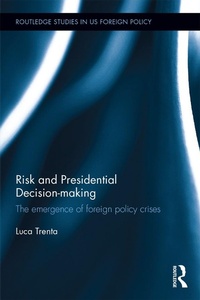
Risk and Presidential Decision-making
The Emergence of Foreign Policy Crises
Erschienen am 20. Mai 2016
232 Seiten
978-1-317-52126-6 (ISBN)
Beschreibung

This book aims at gauging whether the nature of US foreign policy decision-making has changed after the Cold War as radically as a large body of literature seems to suggest, and develops a new framework to interpret presidential decision-making in foreign policy. It locates the study of risk in US foreign policy in a wider intellectual landscape that draws on contemporary debates in historiography, international relations and Presidential studies.
Based on developments in the health and environment literature, the book identifies the President as the ultimate risk-manager, demonstrating how a President is called to perform a delicate balancing act between risks on the domestic/political side and risks on the strategic/international side. Every decision represents a 'risk vs. risk trade-off,' in which the management of one 'target risk' leads to the development 'countervailing risks.' The book applies this framework to the study three major crises in US foreign policy: the Cuban Missile Crisis, the seizure of the US Embassy in Tehran in 1979, and the massacre at Srebrenica in 1995. Each case-study results from substantial archival research and over twenty interviews with policymakers and academics, including former President Jimmy Carter and former Senator Bob Dole.
This book is ideal for postgraduate researchers and academics in US foreign policy, foreign policy decision-making and the US Presidency as well as Departments and Institutes dealing with the study of risk in the social sciences. The case studies will also be of great use to undergraduate students.
Based on developments in the health and environment literature, the book identifies the President as the ultimate risk-manager, demonstrating how a President is called to perform a delicate balancing act between risks on the domestic/political side and risks on the strategic/international side. Every decision represents a 'risk vs. risk trade-off,' in which the management of one 'target risk' leads to the development 'countervailing risks.' The book applies this framework to the study three major crises in US foreign policy: the Cuban Missile Crisis, the seizure of the US Embassy in Tehran in 1979, and the massacre at Srebrenica in 1995. Each case-study results from substantial archival research and over twenty interviews with policymakers and academics, including former President Jimmy Carter and former Senator Bob Dole.
This book is ideal for postgraduate researchers and academics in US foreign policy, foreign policy decision-making and the US Presidency as well as Departments and Institutes dealing with the study of risk in the social sciences. The case studies will also be of great use to undergraduate students.
Rezensionen / Stimmen
'This path breaking study identifies the President as the ultimate manager always having to balance between the demands of the American people and the requirements of remaining a great power. The author makes more than a significant contribution to the field: he breaks new ground. An excellent volume' - Professor Michael Cox Director. IDEAS, LSE'Do U.S. Presidents assess risk differently today than they did during the Cold War? Luca Trenta has written an engaging book exploring how American Presidents use the concepts of "risk" and "risk management" in their decision-making. He deftly compares crises during and after the Cold War to convincingly demonstrate a significant consistency between how U.S. leaders craft policy in the two eras. Using insights from broader international relations theory-especially sociological theories, Trenta reframes the traditional literature on foreign policy analysis to give us a broader understanding of how leaders cope with risk. A conceptually impressive account, this book will interest scholars of international politics, but also students of decision-making under uncertainty.' - Jasen J. Castillo, Associate Professor, Bush School of Government and Public Service, Texas A&M University
'For those interested in studying US foreign policy through the lens of 'risk', this is an indispensable book. Trenta's command of both the conceptual literature and his case studies is formidable.' - Adam Quinn, University of Birmingham, UK 'This path breaking study identifies the President as the ultimate manager always having to balance between the demands of the American people and the requirements of remaining a great power. The author makes more than a significant contribution to the field: he breaks new ground. An excellent volume' - Professor Michael Cox, Director. IDEAS, LSE, UK
'Do U.S. Presidents assess risk differently today than they did during the Cold War? Luca Trenta has written an engaging book exploring how American Presidents use the concepts of "risk" and "risk management" in their decision-making. He deftly compares crises during and after the Cold War to convincingly demonstrate a significant consistency between how U.S. leaders craft policy in the two eras. Using insights from broader international relations theory-especially sociological theories, Trenta reframes the traditional literature on foreign policy analysis to give us a broader understanding of how leaders cope with risk. A conceptually impressive account, this book will interest scholars of international politics, but also students of decision-making under uncertainty.' - Jasen J. Castillo, Associate Professor, Bush School of Government and Public Service, Texas A&M University, USA
'For those interested in studying US foreign policy through the lens of 'risk', this is an indispensable book. Trenta's command of both the conceptual literature and his case studies is formidable.' - Adam Quinn, University of Birmingham, UK
Weitere Details
Reihe
Sprache
Englisch
Verlagsort
London
Großbritannien
Verlagsgruppe
Taylor & Francis Ltd
Zielgruppe
Für höhere Schule und Studium
Dateigröße
1,99 MB
ISBN-13
978-1-317-52126-6 (9781317521266)
Copyright in bibliographic data and cover images is held by Nielsen Book Services Limited or by the publishers or by their respective licensors: all rights reserved.
Schweitzer Klassifikation
Weitere Ausgaben
Andere Ausgaben
Buch
06/2020
1. Auflage
Routledge
51,96 €
Versand in 15-20 Tagen
Buch
06/2016
1. Auflage
Routledge
208,50 €
Versand in 10-20 Tagen
Person
Luca Trenta holds a PhD from the School of Government and International Affairs, Durham University. He is a Lecturer in International Relations in the Department of Political and Cultural Studies, Swansea University.
Inhalt
Introduction: Risk and the Cold War/post-Cold War divide Chapter 1: Risk in International Relations and foreign policy Chapter 2: A new framework: risk vs. risk trade-offs, crises and International Relations Chapter 3: 'I should have said that we don't care:' the Kennedy Administration and Cuba, 1961-1962 Chapter 4: 'We are sticking with the Shah: the Carter Administration and Iran, 1977-1979 Chapter 5: 'Why is this happening and we are not doing anything?' The Clinton Administration and the risky road to Srebrenica, 1992-1995 Conclusion
