

Policy-Making in a Transformative State
Beschreibung

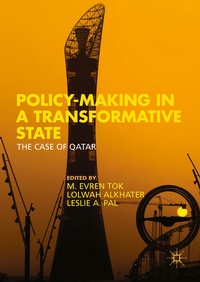
This book explores, in a series of detailed case studies, how public policy is actually made in Qatar. While Qatar is a Gulf monarchy, its governance is complex. Other analysts have tried to come to grips with this complexity using qualified descriptions of the system such as 'late rentier,' 'pluralized autocracy,' 'tribal democracy,' or 'soft authoritarian.' The authors of the volume use the lens of a transformative state. Qatar is deliberately engaged in a rapid process of radical economic and societal transformation. That process has its contradictions and tensions, particularly with regards to achieving a balance between Islam, social traditions, and modernity. This book explores how it also has a specific policy dynamic of generating ideas and institutions, developing policy and program designs, implementation and coordination.
Weitere Details
Weitere Ausgaben
Andere Ausgaben
Personen
M. Evren Tok is an assistant professor and program coordinator at the Public Policy in Islam Program, Qatar Faculty of Islamic Studies, Hamad Bin Khalifa University. His teaching and research revolves around state-market-society relations, policy analysis, natural resource governance and Islamic perspectives on sustainability.
Lolwah Alkhater is a policy analyst. Her research interests include education reform, human capital development, family and identity and religion in the public sphere. She is also a part-time lecturer in the Department of Public Administration and Development Economies at the Doha Institute for Graduate Studies, and a member of the board of directors of the 'Naqd wa Tanweer' (Enlightenment and Critique) Centre for Humanities, a pan-Arab initiative.
Leslie A. Pal is Chancellor's Professor of Public Policy and Administration at Carleton University, Canada. He has published extensively on international policy transfer, comparative public policy, and governance.
