

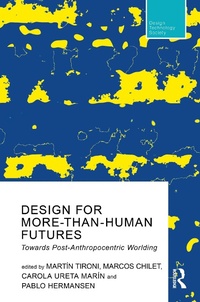
Design For More-Than-Human Futures
Towards Post-Anthropocentric Worlding
1. Auflage
Erschienen am 18. September 2023
194 Seiten
978-1-000-95476-0 (ISBN)
Beschreibung

This book explores the work of important authors in the search for a transition towards more ethical design focused on more-than-human coexistence.
In a time of environmental crises in which the human species threatens its own survival and the highest level of exacerbation of the idea of a future and technological innovation, it is important to discard certain anthropocentric categories in order to situate design beyond the role that it traditionally held in the capitalist world, creating opportunities to create more just and sustainable worlds. This book is an invitation to travel new paths for design framed by ethics of more-than-human coexistence that breaks with the unsustainability installed in the designs that outfit our lives. Questioning the notion of human-centered design is central to this discussion. It is not only a theoretical and methodological concern, but an ethical need to critically rethink the modern, colonialist, and anthropocentric inheritance that resonates in design culture. The authors in this book explore the ideas oriented to form new relations with the more-than-human and with the planet, using design as a form of political enquiry.
This book will be of interest to academics and students from the world of design and particularly those involved in emerging branches of the field such as speculative design, critical design, non-anthropocentric design, and design for transition.
In a time of environmental crises in which the human species threatens its own survival and the highest level of exacerbation of the idea of a future and technological innovation, it is important to discard certain anthropocentric categories in order to situate design beyond the role that it traditionally held in the capitalist world, creating opportunities to create more just and sustainable worlds. This book is an invitation to travel new paths for design framed by ethics of more-than-human coexistence that breaks with the unsustainability installed in the designs that outfit our lives. Questioning the notion of human-centered design is central to this discussion. It is not only a theoretical and methodological concern, but an ethical need to critically rethink the modern, colonialist, and anthropocentric inheritance that resonates in design culture. The authors in this book explore the ideas oriented to form new relations with the more-than-human and with the planet, using design as a form of political enquiry.
This book will be of interest to academics and students from the world of design and particularly those involved in emerging branches of the field such as speculative design, critical design, non-anthropocentric design, and design for transition.
Rezensionen / Stimmen
"More than fifty years ago Viktor Papanek denounced that design was one of the biggest culprits of the planetary crisis. Half a century later, Design for more-than-human futures: Towards post-anthropocentric worlding, tries to reinvent design by making planet Earth together the object, the means and the end of every design process. The result is a series of original perspectives that our century together will have to extend and develop." - Emanuele Coccia, Associate Professor, Ecole des Hautes Etudes en Sciences Sociales (EHESS), ParisWeitere Details
Reihe
Auflage
1. Auflage
Sprache
Englisch
Verlagsort
London
Großbritannien
Verlagsgruppe
Taylor & Francis Ltd
Zielgruppe
Für höhere Schule und Studium
Produkt-Hinweis
Reflowable
Illustrationen
18 Halftones, black and white; 18 Illustrations, black and white
ISBN-13
978-1-000-95476-0 (9781000954760)
Copyright in bibliographic data and cover images is held by Nielsen Book Services Limited or by the publishers or by their respective licensors: all rights reserved.
Schweitzer Klassifikation
Weitere Ausgaben
Andere Ausgaben
Martin Tironi | Marcos Chilet | Carola Ureta Marin
Design For More-Than-Human Futures
Towards Post-Anthropocentric Worlding
Buch
03/2025
1. Auflage
Routledge
52,00 €
Versand in 10-20 Tagen
Martin Tironi | Marcos Chilet | Carola Ureta Marin
Design For More-Than-Human Futures
Towards Post-Anthropocentric Worlding
Buch
09/2023
1. Auflage
Routledge
215,32 €
Versand in 10-20 Tagen
Personen
Martin Tironi is a sociologist at Pontificia Universidad Catolica de Chile; holds a master's degree in Sociology from Sorbonne V and a PhD from Center de Sociologie de l'Innovation, Ecole des Mines de Paris; and is post-doctorate, Center de Sociologie de l'Innovation, Ecole des Mines de Paris. He is Visiting Fellow at the Center for Invention and Social Process, Goldsmiths, University of London, 2018. His research areas are anthropology of design, multispecies design, digital devices and technologies, and urban infrastructures. He is currently Director of the School of Design of Pontificia Universidad Catolica de Chile and the Head Milenio project 'Futures of Artificial Intelligence Research' (FAIR).
Marcos Chilet is a designer who earned his undergraduate degree from Pontificia Universidad Catolica de Chile and an MA from Goldsmith College, University of London. He is now Professor of Future Scenarios at the School of Design, Pontificia Universidad Catolica de Chile. His practice and research areas are critical design, the relationship between politics, designers, and media technologies. He recently published the book Materiales Televisivos: hacia una economia digital de los contenidos about the impact of international streaming services in the Chilean TV culture. He was part of the curatorial team of the Chilean pavilion entitled Tectonic Resonances that won the London Design Biennale in 2021. He is currently Sub-Director of the School of Design of Pontificia Universidad Catolica de Chile.
Carola Ureta Marin is a designer and visual communicator based in London, specialized in editorial design, cultural development, and historical research projects. She obtained her BA in Design (2012), an MA in Cultural Management (2015) in Chile, and an MA in Visual Communication from Royal College of Art, London (2022). She was part of the curatorial team of the Chilean pavilion entitled Tectonic Resonances that won the London Design Biennale in 2021. She is a frequent speaker at international congresses on Design Studies and Design History: Taipei (2016), Barcelona (2018), New York (2020), Quebec (2021), and Melbourne (2022). She is Director and Creator of The City as Text (La Ciudad como Texto), a collaborative digital platform that allows online visitors to partake in a virtual walk through 2.4 km of Santiago de Chile's main avenue during a specific date and time.
Pablo Hermansen is a designer who holds a PhD in Architecture and Urban Studies from Pontificia Universidad Catolica de Chile. Dr. Hermansen's research and publications focus on the material conditions of interspecies coexistence, prototyping as a more-than-human research device, and performative strategies for the political visibility of counter-hegemonic groups in public space. He works in the fields of digital museography and interactive installation and provides consulting services in the area of critical service design for public institutions.
Marcos Chilet is a designer who earned his undergraduate degree from Pontificia Universidad Catolica de Chile and an MA from Goldsmith College, University of London. He is now Professor of Future Scenarios at the School of Design, Pontificia Universidad Catolica de Chile. His practice and research areas are critical design, the relationship between politics, designers, and media technologies. He recently published the book Materiales Televisivos: hacia una economia digital de los contenidos about the impact of international streaming services in the Chilean TV culture. He was part of the curatorial team of the Chilean pavilion entitled Tectonic Resonances that won the London Design Biennale in 2021. He is currently Sub-Director of the School of Design of Pontificia Universidad Catolica de Chile.
Carola Ureta Marin is a designer and visual communicator based in London, specialized in editorial design, cultural development, and historical research projects. She obtained her BA in Design (2012), an MA in Cultural Management (2015) in Chile, and an MA in Visual Communication from Royal College of Art, London (2022). She was part of the curatorial team of the Chilean pavilion entitled Tectonic Resonances that won the London Design Biennale in 2021. She is a frequent speaker at international congresses on Design Studies and Design History: Taipei (2016), Barcelona (2018), New York (2020), Quebec (2021), and Melbourne (2022). She is Director and Creator of The City as Text (La Ciudad como Texto), a collaborative digital platform that allows online visitors to partake in a virtual walk through 2.4 km of Santiago de Chile's main avenue during a specific date and time.
Pablo Hermansen is a designer who holds a PhD in Architecture and Urban Studies from Pontificia Universidad Catolica de Chile. Dr. Hermansen's research and publications focus on the material conditions of interspecies coexistence, prototyping as a more-than-human research device, and performative strategies for the political visibility of counter-hegemonic groups in public space. He works in the fields of digital museography and interactive installation and provides consulting services in the area of critical service design for public institutions.
Inhalt
1. Notes on Excess: Towards Pluriversal Design 2. Anticipations of more than human futures 3. Design's Intimacies: The Indeterminacy of Design with Machines and Mushrooms 4. Growing Materials: Technical and Caring Processes as Rooted Design Practices 5. Learning from Accidental Abundance 6. How would animals and architects co-design if we built the right contract? 7. Before the idiot, the poet? Aesthetic figures and design 8. Revisiting Empathy by Gentrifying Our Guts: Exploring Design as a Cosmopolitical Diplomacy Practice Through Microbial Fruits of Istanbul 9. Design Beyond Human Concerns: A Sancocho-Style Approach 10. Furrowing the 'Marana': Designing to sail out of the Anthropocene
