

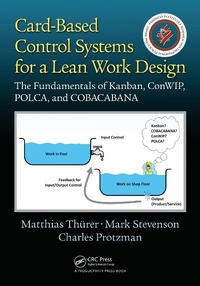
Card-Based Control Systems for a Lean Work Design
The Fundamentals of Kanban, ConWIP, POLCA, and COBACABANA
Erschienen am 27. Juli 2017
219 Seiten
978-1-4987-8834-2 (ISBN)
Beschreibung

Many shops have simplified their production control by using card-based systems such as kanban and Constant Work-in-Process (ConWIP). Although these systems provide a simple and highly effective visual approach for controlling manufacturing and service operations, all too many shops struggle with failed implementations or achieve results that fall
Rezensionen / Stimmen
I know that the depth of theoretical and practical experience among the authors by Matthias Thurer, Mark Stevenson, Charles Protzman over a broad range of industries gives them extraordinary insight into the practical implementation side of "getting Lean" - The sum of this extensive learning is reflected in this new book; Card-Based Control Systems for a Lean Work Design: The Fundamentals of Kanban, ConWIP, POLCA, and COBACABANA. The reader will find that theauthors share critical information to develop and implement a successful shop floor control system for their organization. Anyone reading this book, whether they are just getting started or have many Lean implementations under their belt, will discover a wealth of thought provoking new material.Victor Chance, Former VP Supply Chain Procurement & External Operations, Johnson and Johnson Medical Devices and Diagnostics Sector
Weitere Details
Sprache
Englisch
Verlagsort
OR
USA
Verlagsgruppe
Taylor & Francis Inc
Zielgruppe
Für Beruf und Forschung
Produkt-Hinweis
Reflowable
Illustrationen
83 s/w Abbildungen, 15 s/w Tabellen
83 b/w images and 15 tables
Dateigröße
5,30 MB
ISBN-13
978-1-4987-8834-2 (9781498788342)
Copyright in bibliographic data and cover images is held by Nielsen Book Services Limited or by the publishers or by their respective licensors: all rights reserved.
Schweitzer Klassifikation
Weitere Ausgaben
Andere Ausgaben
Matthias Thurer | Mark Stevenson | Charles Protzman
Card-Based Control Systems for a Lean Work Design
The Fundamentals of Kanban, ConWIP, POLCA, and COBACABANA
Buch
07/2017
1. Auflage
CRC Press
267,29 €
Versand in 10-20 Tagen
Matthias Thurer | Mark Stevenson | Charles Protzman
Card-Based Control Systems for a Lean Work Design
The Fundamentals of Kanban, ConWIP, POLCA, and COBACABANA
Buch
02/2016
1. Auflage
Productivity Press
49,50 €
Versand in 15-20 Tagen
Personen
Matthias Thurer is a professor at Jinan University, China. He earned his master's degree from the Technical University of Berlin and a PhD from the University of Coimbra. He maintains a broad research network regularly visiting universities such as Lancaster University, the University of Clemson, Michigan State University and the University of Groningen. Before getting involved in academia, Matthias worked for several companies and became a master craftsman. Simple control for complex shops is one of Matthias' main research interests. He has published widely on production control systems and is a leading expert on Workload Control and Control of Balance by Card Based Navigation (COBACABANA). Mark Stevenson is a full Professor at Lancaster University Management School in the UK. He earned a bachelor's and PhD from the Department of Management Science at Lancaster University. Mark's PhD was on Workload Control, the production planning and control concept for low-volume, high-variety shops that underpins COBACABANA. Mark's research has included implementing the Workload Control concept in practice to learn from the implementation process and results. He has published widely in peer-reviewed academic Operations Management journals, including those on production planning and control. Charles Protzman is an internationally renowned Lean implementer, trainer, and Shingo Prize winning author with over 33 years of experience in Materials and Operations Management. He has consulted with manufacturers, hospitals, government agencies and other service industries. In 1997, Charlie formed Business Improvement Group, LLC, which is located in Baltimore, MD, and specializes in implementing Lean thinking principles and the Lean Business Delivery System - LBDS. Charlie has spent the last 22 years implementing successful Lean product line conversions, kaizen events, and administrative business system improvements (transactional lean) across the U.S. and internationally.
Inhalt
Basic Concepts
Highlights
What Is a Production/Service System?
What Is a Business Operation/Process?
What Does a Card-Based Control System Actually Control?
Why Use a Card-Based Control System Rather than the Latest Technology?
Summary: What Card-Based Control Systems Do (And What They Do Not Do) 20
Highlights Revisited
Basic Principles Underpinning a Card-Based Control System
Highlights
Input/Output Control
Visualizing the Stability of the Shop Floor/Station: The Throughput Diagram
Summary: Input/Output Control Underpinning Card-Based Control
Highlights Revisited
Simplified Scheduling through Pool Sequencing and a Shop Floor Dispatching Rule
Highlights
Some Rules for Priority Dispatching on the Shop Floor
Visualizing On-Time Performance: The Order Progress Diagram
Summary: Simplified Scheduling through Priority Dispatching
Highlights Revisited
How to Diagnose a Control Problem?
Highlights
Criterion 1: Make/Produce/Assemble/Build/Serve, etc. To-Stock or To-Order
Criterion 2: The Customer Penetration (Inventory/Order Separation) Point
Criterion 3: Routing Characteristics
Criterion 4: Variability and Uncertainty in Resource Requirements
Summary: Diagnosing the Control Problem
Highlights Revisited
The Inventory Control Problem: Kanban Systems
Highlights
Kanban for the Internal Supply Chain: The Six Rules of Kanban Systems
Work-in-Process Kanban vs. Production Kanban
Kanban for Shop Floor Control
Applicability of Kanban Systems
Summary: Kanban Systems
Highlights Revisited
The Low Variability Order Control Problem: ConWIP
Highlights
ConWIP: How Does It Work?
The Applicability of ConWIP
Summary: ConWIP
Highlights Revisited
Inventory Control Plus Material Requirements Planning for the Order Control Problem: POLCA
Highlights
Paired-Cell Overlapping Loops of Cards with Authorization (POLCA): How Does It Work?
Applicability of POLCA
Summary: POLCA
Highlights Revisited
How to Solve the High Variety Order Control Problem: COBACABANA
Highlights
Control of Balance by Card-Based Navigation (COBACABANA)
COBACABANA: How Does It Work?
Balancing Workloads: The Main Order Release Function of COBACABANA
COBACABANA Recognizes the Difference between Direct and Indirect Work
Simplifying the Need for Processing Time Estimations
COBACABANA and High Processing Time Variability: Starvation Avoidance
Premature Station Idleness and Order Release
Summary: COBACABANA
Highlights Revisited
COBACABANA's Card-Based System for Delivery Time Estimation Highlights
Card-Based Delivery Time Estimation: How Does It Work?
COBACABANA as a Comprehensive System
Using the Salesperson's Display for Output Control
Summary: COBACABANA's Delivery Date Estimation Procedure
Highlights Revisited
Summary: Framework of Applicability
Highlights
Loop Structure and Its Implications for the Application of Card-Based Systems
Card Properties and Their Implications for the Application of Card-Based Systems
The Need for IT Support and Its Implications for the Application of Card-Based Systems
Final Considerations: Nested Card-Based Control Systems
Implementation Information
Highlights
What Is a Production/Service System?
What Is a Business Operation/Process?
What Does a Card-Based Control System Actually Control?
Why Use a Card-Based Control System Rather than the Latest Technology?
Summary: What Card-Based Control Systems Do (And What They Do Not Do) 20
Highlights Revisited
Basic Principles Underpinning a Card-Based Control System
Highlights
Input/Output Control
Visualizing the Stability of the Shop Floor/Station: The Throughput Diagram
Summary: Input/Output Control Underpinning Card-Based Control
Highlights Revisited
Simplified Scheduling through Pool Sequencing and a Shop Floor Dispatching Rule
Highlights
Some Rules for Priority Dispatching on the Shop Floor
Visualizing On-Time Performance: The Order Progress Diagram
Summary: Simplified Scheduling through Priority Dispatching
Highlights Revisited
How to Diagnose a Control Problem?
Highlights
Criterion 1: Make/Produce/Assemble/Build/Serve, etc. To-Stock or To-Order
Criterion 2: The Customer Penetration (Inventory/Order Separation) Point
Criterion 3: Routing Characteristics
Criterion 4: Variability and Uncertainty in Resource Requirements
Summary: Diagnosing the Control Problem
Highlights Revisited
The Inventory Control Problem: Kanban Systems
Highlights
Kanban for the Internal Supply Chain: The Six Rules of Kanban Systems
Work-in-Process Kanban vs. Production Kanban
Kanban for Shop Floor Control
Applicability of Kanban Systems
Summary: Kanban Systems
Highlights Revisited
The Low Variability Order Control Problem: ConWIP
Highlights
ConWIP: How Does It Work?
The Applicability of ConWIP
Summary: ConWIP
Highlights Revisited
Inventory Control Plus Material Requirements Planning for the Order Control Problem: POLCA
Highlights
Paired-Cell Overlapping Loops of Cards with Authorization (POLCA): How Does It Work?
Applicability of POLCA
Summary: POLCA
Highlights Revisited
How to Solve the High Variety Order Control Problem: COBACABANA
Highlights
Control of Balance by Card-Based Navigation (COBACABANA)
COBACABANA: How Does It Work?
Balancing Workloads: The Main Order Release Function of COBACABANA
COBACABANA Recognizes the Difference between Direct and Indirect Work
Simplifying the Need for Processing Time Estimations
COBACABANA and High Processing Time Variability: Starvation Avoidance
Premature Station Idleness and Order Release
Summary: COBACABANA
Highlights Revisited
COBACABANA's Card-Based System for Delivery Time Estimation Highlights
Card-Based Delivery Time Estimation: How Does It Work?
COBACABANA as a Comprehensive System
Using the Salesperson's Display for Output Control
Summary: COBACABANA's Delivery Date Estimation Procedure
Highlights Revisited
Summary: Framework of Applicability
Highlights
Loop Structure and Its Implications for the Application of Card-Based Systems
Card Properties and Their Implications for the Application of Card-Based Systems
The Need for IT Support and Its Implications for the Application of Card-Based Systems
Final Considerations: Nested Card-Based Control Systems
Implementation Information
