

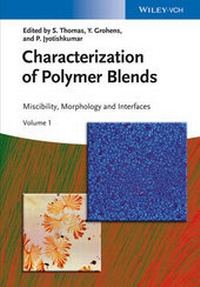
Characterization of Polymer Blends
Beschreibung

Leading researchers from industry and academia, as well as from government and private research institutions around the world summarize recent technical advances in chapters devoted to their individual contributions. In so doing, they examine a wide range of modern characterization techniques, from microscopy and spectroscopy to diffraction, thermal analysis, rheology, mechanical measurements and chromatography. These methods are compared with each other to assist in determining the best solution for both fundamental and applied problems, paying attention to the characterization of nanoscale miscibility and interfaces, both in blends involving copolymers and in immiscible blends. The thermodynamics, miscibility, phase separation, morphology and interfaces in polymer blends are also discussed in light of new insights involving the nanoscopic scale. Finally, the authors detail the processing-morphology-property relationships of polymer blends, as well as the influence of processing on the generation of micro and nano morphologies, and the dependence of these morphologies on the properties of blends. Hot topics such as compatibilization through nanoparticles, miscibility of new biopolymers and nanoscale investigations of interfaces in blends are also addressed.
With its application-oriented approach, handpicked selection of topics and expert contributors, this is an outstanding survey for anyone involved in the field of polymer blends for advanced technologies.
Weitere Details
Weitere Ausgaben
Andere Ausgaben
Personen
International and Inter University Centre for Nanoscience and Nanotechnology
at Mahatma Gandhi University, Kottayam (India). He is a Fellow of the Royal
Society of Chemistry and a Fellow of the New York Academy of Sciences. Thomas
has published over 530 papers in peer reviewed journals on polymer composites,
membranes separation, polymer blend and alloy, polymeric scaffolds for tissue
engineering, and polymer recycling research and has edited 40 books. He has
supervised 65 doctoral students. The H Index of Prof. Thomas is 66 and he has more
than 17,000 citations to his credit. Recently, Professor Thomas has been awarded
the MRSI and CRSI medals.
Yves Grohens is head of the Laboratory for Engineering of Materials (LIMATB)
located at the University of South Brittany, France. His research interests include
interface science in nano and bio-composites as well as confinement applications
and (bio)polymer behaviour in model thin films. Grohens has published more than
120 papers in international journals devoted to polymers and surface science.
Jyotishkumar Parameswaranpillai is DST INSPIRE Faculty at the Department of
Polymer Science and Rubber Technology, Cochin, Kerala (India). Dr. Jyotishkumar's
research focuses on thermosetting and thermoplastic polymer blends and
nanocomposites, smart thermosetting materials, biomaterials, bio-polymers and
bio-nanocomposites. He has won many awards as he advances his research career
including the recent INSPIRE Faculty Fellowship. Dr. Jyotishkumar has published
30 papers in international journals devoted to polymers.
Inhalt
Polymer blends: State of the Art, New Challenges, and Opportunities
Miscible Blends Based on Biodegradable Polymers
Thermodynamics and Morphology and Compatibilization of Polymer Blends
Characterization of Polymer Blends: Rheological Studies
Characterization of Phase Behavior in Polymer Blends by Light Scattering
Characterization of Polymer Blends by X-ray Scattering: WAXS and SAXS
Characterization of Polymer Blends and Block Copolymers by Neutron Scattering: Miscibility and Nanoscale Morphology
Ultrasound in Polymer Blends
Characterization of Polymer Blends: Ellipsometry
Inverse Gas Chromatography
Thermal Analysis in Polymer Blends
Dynamic Mechanical Thermal Analysis of Polymer Blends
Thermomechanical Analysis and Processing of Polymer Blends
Water Sorption and Solvent Sorption Techniques
Modeling and Simulation
VOLUME II
Optical Microscopy (Polarized, Interference and Phase Contrast Microscopy) and Confocal Microscopy
Electron Microscopic Analysis of Multicomponent Polymers and Blends
Characterization of Polymer Blends using SIMS and Nano SIMS
Fluorescence Microscopy Techniques for the Structural Analysis of Polymer Materials
Characterization of Polymer Blends by FTIR Spectroscopy
Characterization of Polymer Blends by Solid-State NMR Spectroscopy
Characterization of Polymer Blends by Infrared, Near-Infrared and Raman Imaging
Electron Paramagnetic Resonance Spectroscopy and Forward Recoil Spectrometry
Characterization of Polymer Blends using UV-Visible Spectroscopy
Fluorescence Spectroscopy
Characterization of Polymer Blends by Dielectric Spectroscopy and Thermally Simulated Depolarization Current
Positron Annihilation Spectroscopy: Polymer Blends and Miscibility
List of Contributors
Mohammad Mahdi Abolhasani
University of Kashan
Chemical Engineering Department
Kashan
Iran
Mamdouh H. Abou-Taleb
Cairo University
Faculty of Science
Physics Department
Giza
Egypt
and
Taif University
Faculty of Science
Physics Department
21974 Taif
Saudi Arabia
Rameshwar Adhikari
Tribhuvan University
Central Department of Chemistry
Kirtipur
Kathmandu
Nepal
and
Nepal Polymer Institute (NPI)
Kathmandu
Nepal
Hiroyuki Aoki
Kyoto University
Advanced Biomedical Engineering Research Unit
Kyoto-Daigaku-Katsura
Nishikyo
Kyoto 615-8510
Japan
Syed Marghoob Ashraf
Jamia Millia Islamia (A Central University)
Department of Chemistry
Materials Research Laboratory
Maulana Mohammad Ali Jauhar Marg
New Delhi 110025
India
José-David Badia
Universitat Politècnica de València
Instituto de Tecnología de Materiales
Camino de Vera, s/n
46022 València
Spain
Gabriel Bernardo
University of Minho
Institute for Polymers and Composites/I3N
Campus de Azurém
4800-058 Guimarães
Portugal
Seth B. Darling
Argonne National Laboratory
Center for Nanoscale Materials
9700 South Cass Avenue
Argonne, IL60439
USA
and
University of Chicago
Institute for Molecular Engineering
5801 South Ellis Avenue
Chicago, IL 60637
USA
Dieter Fischer
Leibniz-Institute for Polymer Research
Hohe Str. 6
01069 Dresden
Germany
Yves Grohens
Université de Bretagne Sud
Laboratoire Ingénierie des Matériaux de Bretagne
Rue St Maudé
56100 Lorient
France
Natalia Hernandez-Montero
University of the Basque Country (UPV/EHU)
School of Engineering
Department of Mining-Metallurgy Engineering & Materials Science
POLYMAT - Basque Center for Macromolecular Design and Engineering
Alameda de Urquijo s/n.
48013 Bilbao
Spain
Vahid Karimkhani
Amirkabir University of Technology
Department of Polymer Engineering and Color Technology
Tehran
Iran
and
Case Western Reserve University
Department of Macromolecular Science and Engineering
2100 Adelbert Road
Cleveland, OH 44106
USA
David Kazmer
University of Massachusetts at Lowell
Department of Plastics Engineering
1 University Avenue
Lowell, MA 01854
USA
Michael R. Kessler
Washington State University
School of Mechanical and Materials Engineering
Pullman, WA 99164
USA
Éva Kiss
Eötvös Loránd University
Institute of Chemistry
Laboratory of Interfaces and Nanostructures
Pázmány P. s. 1/a
1117 Budapest
Hungary
Krzysztof Kruczala
Jagiellonian University
Faculty of Chemistry
Ul. Ingardenia 3/139
30-060 Krakow
Poland
Jae Wook Lee
Sogang University
Department of Chemical and Biomolecular Engineering
Applied Rheology Center
Seoul 121-742
Korea
Sangmook Lee
Dankook University
Division of Chemical Engineering
126, Jukjeon-dong, Suji-gu
Gyeonggi-do 448-701
Korea
Samy A. Madbouly
Iowa State University
Department of Materials Science and Engineering
Ames, IA 50011
USA
and
Cairo University
Faculty of Science
Department of Chemistry
Orman-Giza 12613
Egypt
Alfonso Mart??nez-Felipe
Universitat Politècnica de València
Instituto de Tecnología de Materiales
Camino de Vera, s/n
46022 València
Spain
Emilio Meaurio
University of the Basque Country (UPV/EHU)
School of Engineering
Department of Mining-Metallurgy Engineering & Materials Science
POLYMAT - Basque Center for Macromolecular Design and Engineering
Alameda de Urquijo s/n.
48013 Bilbao
Spain
Kasylda Milczewska
Poznan University of Technology
Institute of Chemical Technology and Engineering
pl. M. Sklodowskiej-Curie 2
60-965 Poznan
Poland
Jorge Morgado
Instituto de Telecomunicações
Av. Rovisco Pais
1049-001 Lisbon
Portugal
and
Instituto Superior Técnico
Department of Bioengineering
UL, Av. Rovisco Pais
1049-001 Lisbon
Portugal
Kell Mortensen
University of Copenhagen
Niels Bohr Institute
Universitetsparken 5, D306
2100 Copenhagen
Denmark
Yukihiro Ozaki
Kwansei Gakuin University
School of Science and Technology
Sanda
Hyogo 669-1337
Japan
Jyotishkumar Parameswaranpillai
Cochin University of Science and Technology
Department of Polymer Science and Rubber Technology
Cochin
Kerala 682022
India
R. Shanti Rajantharan
University of Malaya
Faculty of Science
Department of Physics
Centre for Ionics University of Malaya
Jalan Lembah Pantai
50603 Kuala Lumpur
Malaysia
Muruganathan Ramanathan
Oak Ridge National Laboratory
Center for Nanophase Materials Sciences
One Bethel Valley Rd
Oak Ridge, TN 37831
USA
Chikkakuntappa Ranganathaiah
University of Mysore
Department of Studies in Physics
Manasagangotri
Mysore 570006
India
and
University of Western Australia
School of Physics
ARC Center of Excellence - Center for Antimatter-Matter Studies
35 Stirling Highway Crawley
Perth WA 6009
Australia
Ufana Riaz
Jamia Millia Islamia (A Central University)
Department of Chemistry
Materials Research Laboratory
Maulana Mohammad Ali Jauhar Marg
New Delhi 110025
India
Amparo Ribes-Greus
Universitat Politècnica de València
Instituto de Tecnología de Materiales
Camino de Vera, s/n
46022 València
Spain
Fatemeh Sabzi
Shiraz University of Technology
Department of Chemical Engineering
Modarres Blv.
Shiraz 71555-313
Iran
Laura Santonja-Blasco
Universitat Politècnica de València
Instituto de Tecnología de Materiales
Camino de Vera, s/n
46022 València
Spain
Jose-Ramon Sarasua
University of the Basque Country (UPV/EHU)
School of Engineering
Department of Mining-Metallurgy Engineering & Materials Science
POLYMAT - Basque Center for Macromolecular Design and Engineering
Alameda de Urquijo s/n.
48013 Bilbao
Spain
Harumi Sato
Kobe University
Graduate School of Human Development and Environment
Nada-ku
Kobe
Hyogo 657-8501
Japan
Yingrui Shang
Tianjin University
College of Material Science and Engineering
Department of Polymer Science and Engineering
Tianjin
China
Jitendra Sharma
Shri Mata Vaishno Devi University
School of Physics
Kakriyal Katra
Reasi
Jammu & Kashmir 182320
India
Suchart Siengchin
King Mongkut's University of Technology North Bangkok
The Sirindhorn International Thai-German Graduate School of Engineering (TGGS)
Department of Mechanical and Process Engineering
1518 Wongsawang Road
Bangsue
Bangkok 10800
Thailand
Heinz W. Siesler
University of Duisburg-Essen
Department of Physical Chemistry
Schuetzenbahn 70
45117 Essen
Germany
Zdenk Starý
Friedrich-Alexander-University Erlangen-Nuremberg
Institute of Polymer Materials
Martensstrasse 7
91058 Erlangen
Germany
Ramesh T. Subramaniam
University of Malaya
Faculty of Science
Department of Physics
Centre for Ionics University of Malaya
Jalan Lembah Pantai
50603 Kuala Lumpur
Malaysia
Petr Svoboda
Tomas Bata University in Zlin
Faculty of Technology
Department of Polymer Engineering
Nam. T. G. Masaryka 275
762 72 Zlin
Czech Republic
and
Tomas Bata University in Zlin
University Institute
Centre of Polymer Systems
Nad Ovcirnou 3685
760 01 Zlin
Czech Republic
Ewa Szajdziska-Pitek
Jagiellonian...
