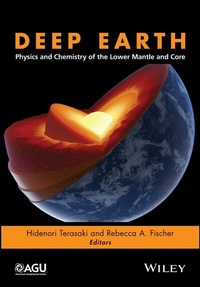
Deep Earth
Beschreibung
Deep Earth: Physics and Chemistry of the Lower Mantle and Core highlights recent advances and the latest views of the deep Earth from theoretical, experimental, and observational approaches and offers insight into future research directions on the deep Earth, In recent years, we have just reached a stage where we can perform measurements at the conditions of the center part of the Earth using state-of-the-art techniques, and many reports on the physical and chemical properties of the deep Earth have come out very recently, Novel theoretical models have been complementary to this breakthrough, These new inputs enable us to compare directly with results of precise geophysical and geochemical observations, This volume highlights the recent significant advancements in our understanding of the deep Earth that have occurred as a result, including contributions from mineral/rock physics, geophysics, and geochemistry that relate to the topics of:
I, Thermal structure of the lower mantle and core
II, Structure, anisotropy, and plasticity of deep Earth materials
III, Physical properties of the deep interior
IV, Chemistry and phase relations in the lower mantle and core
V, Volatiles in the deep Earth
The volume will be a valuable resource for researchers and students who study the Earth's interior, The topics of this volume are multidisciplinary, and therefore will be useful to students from a wide variety of fields in the Earth Sciences,
Hidenori Terasaki is a Professor in the Department of Earth and Space Science at Osaka University, Hidenori's research focuses on studying the earth interior composition, with particular emphasis on measuring density, viscosity, interfacial tension, temperature and pressure related to mantle and core properties and formation, He is a recipient of the young scientist research award in the Mineralogical Society of Japan and Japan Society of High Pressure Science and Technology, He is a member of the American Geophysical Union, The Japan Society of High Pressure Science and Technology, The Iron and Steel Institute of Japan, Japan Association of Mineralogical Sciences and The Japanese Society for Planetary Science,
Rebecca Fischer is a PhD candidate in the Department of the Geophysical Sciences at the University of Chicago, Her research focuses on the formation and chemical evolution of the Earth, with particular focus emphasis on the physical and chemical properties of minerals and melts at extreme conditions, She uses diamond anvil cells and laser-heating to experimentally recreate the high pressures (up to >150 GPa) and high temperatures (several thousand K) of the Earth's deep interior, combined with numerical simulations of accretion, She has been the recipient of organizational fellowships and scholarships (NSF) for her scholarly research on the Interior of the Earth,
Weitere Details
Weitere Ausgaben
Inhalt
- Intro
- TITLE PAGE
- TABLE OF CONTENTS
- CONTRIBUTORS
- PREFACE
- Part I: Thermal Strucure of Deep Earth
- 1 Melting of Fe Alloys and the Thermal Structure of the Core
- 1.1. INTRODUCTION
- 1.2. METHODS FOR DETERMINATION OF MELTING
- 1.3. RESULTS ON MELTING OF IRON
- 1.4. RESULTS ON MELTING OF IRON-RICH ALLOYS
- 1.5. APPLICATION TO THE THERMAL STRUCTURE OF THE CORE
- 1.6. CONCLUSIONS
- ACKNOWLEDGMENTS
- REFERENCES
- 2 Temperature of the Lower Mantle and Core Based on Ab Initio Mineral Physics Data
- 2.1. INTRODUCTION
- 2.2. AB INITIO METHODS FOR MINERAL PHYSICS
- 2.3. ADIABATIC TEMPERATURE PROFILES
- 2.4. THERMAL STRUCTURE IN D? LAYER
- 2.5. CMB HEAT FLOW
- 2.6. CONCLUSIONS
- ACKNOWLEDGMENTS
- REFERENCES
- 3 Heat Transfer in the Core and Mantle
- 3.1. INTRODUCTION
- 3.2. THERMAL CONDUCTIVITY OF EARTH'S CORE
- 3.3. MANTLE
- 3.4. HEAT TRANSPORT ACROSS CORE-MANTLE BOUNDARY
- REFERENCES
- 4 Thermal State and Evolution of the Earth Core and Deep Mantle
- 4.1. INTRODUCTION
- 4.2. PRIMER ON THERMAL EVOLUTION OF EARTH
- 4.3. THERMAL EVOLUTION OF CORE
- 4.4. IMPLICATIONS FOR THERMAL EVOLUTION OF EARTH
- 4.5. CONCLUSIONS
- ACKNOWLEDGMENTS
- REFERENCES
- Part II: Structures, Anisotropy, and Plasticity of Deep Earth Materials
- 5 Crystal Structures of Core Materials
- 5.1. INTRODUCTION
- 5.3. THE FE-H SYSTEM
- 5.4. THE FE-C SYSTEM
- 5.5. THE FE-O SYSTEM
- 5.6. THE FE-SI SYSTEM
- 5.7. THE FE-P SYSTEM
- 5.8. THE FE-S SYSTEM
- 5.9. OTHER LIGHT ELEMENTS
- 5.10. CONCLUSION AND PERSPECTIVE
- REFERENCES
- 6 Crystal Structures of Minerals in the Lower Mantle
- 6.1. INTRODUCTION
- 6.2. BRIDGMANITE, (Mg,Fe)SiO3
- 6.3. FERROPERICLASE, (Mg,Fe)O
- 6.4. CaSiO3 PEROVSKITE
- 6.5. CaIrO3-TYPE POST-PEROVSKITE PHASE
- 6.6. SiO2 POLYMORPHS
- 6.7. ALUMINOUS PHASES
- 6.8. POSSIBLE HYDROUS PHASES
- 6.9. SUMMARY
- REFERENCES
- 7 Deformation of Core and Lower Mantle Materials
- 7.1. INTRODUCTION
- 7.2. METHODS
- 7.3. LOWER MANTLE
- 7.4. D? LAYER
- 7.5. INNER CORE
- 7.6. CONCLUSIONS
- ACKNOWLEDGMENT
- REFERENCES
- 8 Using Mineral Analogs to Understand the Deep Earth
- 8.1. INTRODUCTION
- 8.2. ANALOGS OF EARTH'S CORE MATERIALS
- 8.3. MIMICKING LOWERMOST MANTLE
- 8.4. CONCLUSIONS
- ACKNOWLEDGMENTS
- REFERENCES
- Part III: Physical Properties of Deep Interior
- 9 Ground Truth
- 9.1. INTRODUCTION
- 9.2. MODELS AND DATA
- 9.3. CORE WAVE SPEED MODELS
- 9.4. ANISOTROPY AND INNER CORE
- 9.5. LIQUID OUTER CORE
- 9.6. CONCLUSIONS
- REFERENCES
- 10 Physical Properties of the Inner Core
- ACKNOWLEDGMENTS
- REFERENCES
- 11 Physical Properties of the Outer Core
- 11.1. INTRODUCTION
- 11.2. DENSITY AND COMPRESSIBILITY OF LIQUID Fe ALLOYS
- 11.3. SOUND VELOCITY OF LIQUID Fe ALLOYS
- 11.4. CONSTRAINTS ON THE OUTER CORE COMPOSITION FROM DENSITY AND SOUND VELOCITY
- 11.5. TRANSPORT PROPERTIES OF LIQUID Fe ALLOYS
- 11.6. CONCLUSIONS
- ACKNOWLEDGMENT
- REFERENCES
- Part IV: Chemistry and Phase Relations of Deep Interior
- 12 The Composition of the Lower Mantle and Core
- 12.1. INTRODUCTION
- 12.2. CHONDRITES: BUILDING BLOCKS OF TERRESTRIAL PLANETS
- 12.3. COMPOSITIONAL MODEL FOR CORE
- 12.4. COMPOSITIONAL MODEL FOR BULK SILICATE EARTH (BSE) AND LOWER MANTLE
- 12.5. OUTSTANDING ISSUES AND WHAT LURKS DEEP IN MANTLE
- 12.6. FUTURE PROSPECTS
- REFERENCES
- 13 Metal-Silicate Partitioning of Siderophile Elements and Core-Mantle Segregation
- 13.1. PLANETARY DIFFERENTIATION AND CORE-MANTLE SEGREGATION
- 13.2. EXPERIMENTAL CONTROL OF P, T, FO2 AND COMPOSITION
- 13.3. METAL-SILICATE PARTITIONING
- 13.4. MODELING OF SIDEROPHILE ELEMENTS
- 13.5. SUMMARY AND FUTURE
- ACKNOWLEDGMENTS
- REFERENCES
- 14 Mechanisms and Geochemical Models of Core Formation
- 14.1. INTRODUCTION
- 14.2. MECHANISMS OF METAL-SILICATE SEGREGATION
- 14.3. GEOCHEMICAL MODELS OF CORE FORMATION
- 14.4. CONCLUSIONS AND OUTLOOK
- ACKNOWLEDGMENTS
- REFERENCES
- 15 Phase Diagrams and Thermodynamics of Core Materials
- 15.1. INTRODUCTION
- 15.2. THERMODYNAMIC BASIS
- 15.3. APPLICATION TO EXPERIMENTAL MELTING TEMPERATURES
- 15.4. PHASE RELATIONS AT ICB CONDITIONS
- 15.5. OUTLOOK
- REFERENCES
- 16 Chemistry of Core-Mantle Boundary
- 16.1. INTRODUCTION
- 16.2. INITIAL CONDITIONS FOR CMB CHEMISTRY
- 16.3. METAL-SILICATE EQUILIBRIA
- 16.4. DYNAMICAL CONSIDERATIONS OF CMB REACTIONS
- 16.5. SUMMARY
- REFERENCES
- 17 Phase Transition and Melting in the Deep Lower Mantle
- 17.1. INTRODUCTION
- 17.2. POST-PEROVSKITE PHASE TRANSITION
- 17.3. H-PHASE?
- 17.4. MELTING UNDER DEEP LOWER MANTLE PRESSURES
- 17.5. GEOPHYSICAL IMPLICATIONS
- 17.6. FUTURE PERSPECTIVE
- ACKNOWLEDGMENTS
- REFERENCES
- 18 Chemistry of the Lower Mantle
- 18.1. INTRODUCTION
- 18.2. EVIDENCE FOR CHEMICALLY DISTINCT LOWER MANTLE
- 18.3. POTENTIAL ORIGINS OF CHEMICALLY DISTINCT LOWER MANTLE
- 18.4. MINERALOGY AND CRYSTAL CHEMISTRY OF THE LOWER MANTLE
- 18.5 LOWER MANTLE MINERAL COMPOSITIONS
- 18.6. OXIDATION STATE OF IRON BRIDGMANITE AND ITS IMPLICATIONS
- 18.7. CONCLUSIONS
- ACKNOWLEDGMENTS
- REFERENCES
- 19 Phase Diagrams and Thermodynamics of Lower Mantle Materials
- 19.1. INTRODUCTION
- 19.2. METHODS FOR DETERMINING PHASE EQUILIBRIA
- 19.3. THERMODYNAMICS AND STABILITY
- 19.4. PHASE DIAGRAMS OF LOWER MANTLE MINERALS
- 19.5. CONCLUSIONS
- ACKNOWLEDGMENTS
- REFERENCES
- Part V: Volatiles in Deep Interior
- 20 Hydrogen in the Earth's Core: Review of the Structural, Elastic, and Thermodynamic Properties of Iron-Hydrogen Alloys
- 20.1. INTRODUCTION
- 20.2. STABLE PHASES OF IRON-HYDROGEN ALLOYS
- 20.3. HIGH-PRESSURE PROPERTIES OF FeH
- 20.4. HYDROGEN IN EARTH'S CORE
- 20.5. CONCLUSIONS AND FUTURE DIRECTIONS
- ACKNOWLEDGMENTS
- REFERENCES
- 21 Stability of Hydrous Minerals and Water Reservoirs in the Deep Earth Interior
- 21.1. INTRODUCTION
- 21.2. HYDROUS MINERALS AND NOMINALLY ANHYDROUS MINERALS
- 21.3. EXISTENCE OF NEW HYDROUS PHASE, MgSiO2(OH)2 (PHASE H) AND ITS RELATION TO d-ALOOH
- ACKNOWLEDGMENTS
- REFERENCES
- 22 Carbon in the Core
- 22.1. INTRODUCTION
- 22.2. COSMOCHEMICAL AND GEOCHEMICAL CONSTRAINTS ON EARTH'S CARBON BUDGET
- 22.3. CARBON CONTENT OF CORE FROM SOLUBILITY AND PARTITIONING EXPERIMENTS
- 22.4. MINERAL PHYSICS CONSTRAINTS ON CARBON IN CORE
- 22.5. CONCLUDING REMARKS AND IMPLICATIONS
- ACKNOWLEDGMENTS
- REFERENCES
- INDEX
- END USER LICENSE AGREEMENT
Systemvoraussetzungen
Dateiformat: PDF
Kopierschutz: Adobe-DRM (Digital Rights Management)
Systemvoraussetzungen:
- Computer (Windows; MacOS X; Linux): Installieren Sie bereits vor dem Download die kostenlose Software Adobe Digital Editions (siehe E-Book Hilfe).
- Tablet/Smartphone (Android; iOS): Installieren Sie bereits vor dem Download die kostenlose App Adobe Digital Editions oder die App PocketBook (siehe E-Book Hilfe).
- E-Book-Reader: Bookeen, Kobo, Pocketbook, Sony, Tolino u.v.a.m. (nicht Kindle)
Das Dateiformat PDF zeigt auf jeder Hardware eine Buchseite stets identisch an. Daher ist eine PDF auch für ein komplexes Layout geeignet, wie es bei Lehr- und Fachbüchern verwendet wird (Bilder, Tabellen, Spalten, Fußnoten). Bei kleinen Displays von E-Readern oder Smartphones sind PDF leider eher nervig, weil zu viel Scrollen notwendig ist.
Mit Adobe-DRM wird hier ein „harter” Kopierschutz verwendet. Wenn die notwendigen Voraussetzungen nicht vorliegen, können Sie das E-Book leider nicht öffnen. Daher müssen Sie bereits vor dem Download Ihre Lese-Hardware vorbereiten.
Bitte beachten Sie: Wir empfehlen Ihnen unbedingt nach Installation der Lese-Software diese mit Ihrer persönlichen Adobe-ID zu autorisieren!
Weitere Informationen finden Sie in unserer E-Book Hilfe.