

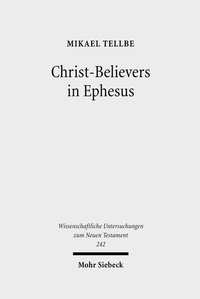
Christ-Believers in Ephesus
A Textual Analysis of Early Christian Identity Formation in a Local Perspective
1. Auflage
Erschienen am 21. Juli 2009
363 Seiten
978-3-16-151531-6 (ISBN)
Beschreibung

Mikael Tellbe befasst sich mit der Ausformung einer frühchristlichen Identität in der Stadt Ephesus, einem der großen Zentren der frühchristlichen Bewegung gegen Ende des ersten und zu Beginn des zweiten Jahrhunderts. Er konzentriert sich auf die sozialen und theologischen Unterschiede innerhalb dieser Bewegung: so zum Beispiel die sogenannte "Trennung der Wege" - also Fragen der Ethnizität - oder den Einfluss "abweichender" Gruppen und die Suche nach Autorität und Legitimation. Er befasst sich auch mit den Themenbereichen der Gemeinsamkeiten und der theologischen Einheit. Der Autor zeigt die Fruchtbarkeit der Textanalyse als Methode auf und arbeitet so die Bedeutung verschiedener Text-"Prototypen" heraus, mit deren Hilfe sich der Prozess einer frühchristlichen Identitätsbildung in Ephesus nachweisen lässt.
Weitere Details
Weitere Ausgaben
Andere Ausgaben

Mikael Tellbe
Christ-Believers in Ephesus
A Textual Analysis of Early Christian Identity Formation in a Local Perspective
Buch
07/2009
1. Auflage
Mohr Siebeck
114,00 €
Artikel ist vergriffen; siehe andere Ausgabe
Person
Inhalt
- Cover
- Acknowledgements
- Table of Contents
- Chapter 1. Diversity and Identity: How Diverse Was the Early Christian Movement in Ephesus?
- 1. Recent Studies on the History of the Early Christian Movement in Ephesus
- 1.1. Background: From Walter Bauer to Thomas Robinson
- 1.2. Werner Thiessen: Competing Heterogeneous Groups and Theologies Relating to Jewish-Gentile Issues
- 1.3. Mattias Günther: A Non-Heterogeneous Movement from the Founding of Apollos to the Triumph of John the Prophet
- 1.4. Helmut Koester: A Number of Diverse and Competing Groups Centred around Paul the Apostle and John the Prophet
- 1.5. Rick Strelan: A Jewish-Christian Pauline Community Interchanging with a Johannine Community
- 1.6. Michael Fieger: The Story of the Success of the Pauline Mission
- 1.7. Rainer Schwindt: The Complex Religious Climate at the Time of Paul's Mission in Ephesus and at the Time of Paul's Letter to the Ephesians
- 1.8. Paul Trebilco: Coexisting Pauline and Johannine Communities in Non-Hostile Interaction
- 1.9. Stephan Witetchek: Several Christian Communities Mainly Centered around Apollos, Paul and John the Prophet
- 2. Evaluation and Discussion
- 2.1. Ephesus and the Pauline Tradition
- 2.2. Ephesus and the Johannine Tradition
- 2.3. The Diversity of the Early Christian Movement in Ephesus
- 2.4. Text and Community
- 3. The Focus and Procedure of the Present Study
- Chapter 2. Ethnicity and Identity: Jewish Boundary Markers and Christian Communities in Ephesus
- 1. Jewish Diaspora Identity
- 2. Jewish Boundary Markers in Ephesus in the First Century BCE and the First Century CE
- 3. The Jewish Origin of the Christian Movement in Ephesus according to Luke's Account in Acts
- 4. Ethnicity and Universality in the 'Canonical' Texts
- 4.1. First and Second Timothy
- 4.2. The Johannine Letters
- 4.3. The Book of Revelation
- 5. The Second Century Evidence
- 5.1. Ignatius's Letter to the Ephesians
- 5.2. Justin's Dialogue with Trypho
- 5.3. Irenaeus and Polycrates
- 6. Concluding Remarks
- Chapter 3. Deviance and Identity: Towards a Theory of Social Identity Formation in Ephesus
- 1. The Formation of Social identity and Theories on Social Conflict, Deviance and Self-Categorization
- 1.1. Social Conflict Theory
- 1.2. Sociology of Deviance
- 1.3. Self-Categorization Theory
- 1.4. A Theory of the Formation of Early Christian Identities in Ephesus
- 2. The Process of Labeling and Identity Formation in First and Second Timothy
- 2.1. Motifs of Labeling
- 2.2. Vertical and Horizontal Identity
- 2.3. The Prototypical Believer: Timothy as the Ideal Typos
- 3. Concluding Remarks
- Chapter 4. Legitimacy and Identity: Textual Prototypes in Ephesus in Comparison and Competition
- 1. Prototypes in Comparison
- 1.1. The Prototype of the Pastor
- 1.2. The Prototype of the Prophet
- 1.3. The Prototype of the Presbyter
- 1.4. Comparative Analysis
- 2. Prototypes in Competition
- 2.1. The Presbyter in Response to the Pastor
- 2.2. The Prophet in Response to the Pastor
- 2.3. The Prophet in Response to the Presbyter
- 2.4. The Tradition of the Pastor (as Articulated by Bishop Ignatius) in Response to the Prophet
- 2.5. The Tradition of the Pastor (as Articulated by Bishop Ignatius) in Response to the Presbyter
- 2.6. The Reception of the Tradition of the Pastor, the Prophet and the Presbyter in Ephesus and Western Asia Minor in the Second Century CE
- 3. Concluding Remarks
- Chapter 5. Commonality and Identity: What Held the Early Christian Movement in Ephesus Together?
- 1. Translocal Networks
- 2. The Commonality of the Story of Jesus and Ethical Response in the 'Canonical' Texts
- 2.1. The Story of Jesus
- 2.1.1. The Story of Jesus in First and Second Timothy
- 2.1.2. The Story of Jesus in the Johannine Letters
- 2.1.3. The Story of Jesus in the Book of Revelation
- 2.1.4. The Commonality of the Story of Jesus in First and Second Timothy, in the Johannine Letters and in the Book of Revelation
- 2.2. The Ethical Response
- 2.2.1. The Ethical Response in First and Second Timothy
- 2.2.2. The Ethical Response in the Johannine Letters
- 2.2.3. The Ethical Response in the Book of Revelation
- 2.2.4. The Commonality of the Ethical Response in First and Second Timothy, in the Johannine Letters and in the Book of Revelation
- 3. The Story of Jesus and the Ethical Response in Ignatius's Letter to the Ephesians
- 3.1. The Story of Jesus in Ignatius's Letter to the Ephesians
- 3.2. The Ethical Response in Ignatius's Letter to the Ephesians
- 4. Concluding Remarks
- Bibliography
- 1. Primary Sources
- 1.1. Ancient Texts and Translations
- 1.2. Inscriptions and Papyri
- 2. Reference Works
- 3. Secondary Literature
- Index of Ancient Sources
- A. The Old Testament
- B. The New Testament
- C. Apocrypha and Septuagint
- D. Jewish Pseudoepigrapha
- E. Dead Sea Scrolls
- F. Philo
- G. Josephus
- H. Rabbinic Sources
- I. Apostolic Fathers
- J. Corpus Hermeticum
- K. Patristic Sources
- L. Other Greek and Latin Literary Sources
- M. Major Sources of Inscriptions
- Index of Modern Authors
- Index of Subjects
