

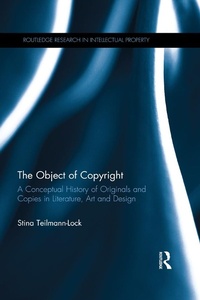
The Object of Copyright
A Conceptual History of Originals and Copies in Literature, Art and Design
1. Auflage
Erschienen am 24. Juli 2015
164 Seiten
978-1-317-80460-4 (ISBN)
Beschreibung
Recent years have seen a number of pressing developments in copyright law: there has been an enormous increase in the range and type of work accorded protection; the concept of the 'original work' has entered into national copyright acts; and intangible entities are now entitled to protection by copyright. All these are consequences of legislative and technological developments that can be traced back over two centuries and more. the result. This book presents an interdisciplinary study of the growth of copyright law, largely based on archival research and on archival materials only recently made available online. The new history here articulated helps to explain why print is no longer today the sole or even the chief object of copyright protection.
Taking its key examples from British, French and Danish copyright law, the book begins by exploring how the earliest copyright laws emerged out of the technological understanding of a printed 'copy,' and out of the philosophical notions of originals and copies, tangibles and intangibles. Dr Teilmann-Lockgoes on to examine the concept of the 'work' as it develops both conceptually and legally, as the object of protection, and then explains how, in a curious consequence, 'the work' turns the 'copy' into the 'mere' material instantiation of the intangible 'original'. The book concludes by addressing the considerable and complicated problems now emerging in copyright law following the inclusion of design within the scope of its protection. In this field Danish law, striving to protect Danish design, has been setting the trend for over a hundred years.
In its examination of terminological exchanges between the diverse legal traditions and philosophical discourse, and in its thorough investigation of particular terms central to copyright legislation, this interdisciplinary book will be of great interest to scholars and students of copyright and intellectual property law; it also makes an important contribution to literary studies, legal history and cultural theory.
Taking its key examples from British, French and Danish copyright law, the book begins by exploring how the earliest copyright laws emerged out of the technological understanding of a printed 'copy,' and out of the philosophical notions of originals and copies, tangibles and intangibles. Dr Teilmann-Lockgoes on to examine the concept of the 'work' as it develops both conceptually and legally, as the object of protection, and then explains how, in a curious consequence, 'the work' turns the 'copy' into the 'mere' material instantiation of the intangible 'original'. The book concludes by addressing the considerable and complicated problems now emerging in copyright law following the inclusion of design within the scope of its protection. In this field Danish law, striving to protect Danish design, has been setting the trend for over a hundred years.
In its examination of terminological exchanges between the diverse legal traditions and philosophical discourse, and in its thorough investigation of particular terms central to copyright legislation, this interdisciplinary book will be of great interest to scholars and students of copyright and intellectual property law; it also makes an important contribution to literary studies, legal history and cultural theory.
Rezensionen / Stimmen
"...this work by Teilmann-Lock presents a highly stimulating read; it is a concise and well-written study on the intellectual history of copyright that exemplifies, once again, the interdisciplinary potential of the conceptual-historical approach."MATTI LA MELA, European University Institute, Contributions to the History of Concepts
"It is precisely the power and the charm pf bringing Danish copyright history together with British and French histories that makes this book remarkable."
Joe Bellido, University of Kent, European Intellectual Property Review
Weitere Details
Reihe
Auflage
1. Auflage
Sprache
Englisch
Verlagsort
London
Großbritannien
Verlagsgruppe
Taylor & Francis Ltd
Zielgruppe
Für höhere Schule und Studium
Dateigröße
0,65 MB
ISBN-13
978-1-317-80460-4 (9781317804604)
Copyright in bibliographic data and cover images is held by Nielsen Book Services Limited or by the publishers or by their respective licensors: all rights reserved.
Schweitzer Klassifikation
Weitere Ausgaben
Person
Stina Teilmann-Lock is an Associate Professor of Design in the Department of Design and Communication at the University of Southern Denmark.
Inhalt
Introduction 1. Books in the world of letters 2. Printing paradigm copyright 3. Uncopyrightable art 4.Nineteenth-century artistic copyright in France 5. The making of the British 1862 Fine Art Copyright Act 6. Originals and copies 7. Design in Danish copyright law. Conclusion
