

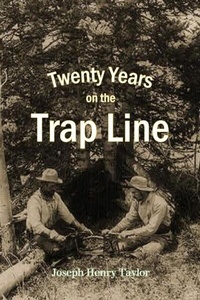
Twenty Years on the Trap Line
Beschreibung

"Taylor was a hunter and trapper at Painted Woods on the Missouri, has rare ability as well as opportunity for collecting material." -Ward County (N. D.) Reporter
"Spent several years with the Indians, engaged in trapping and hunting was a familiar character with all old-time Steamboat men on the Big Muddy." -The Bismarck Tribune (1908)
"A pioneer in the settlement of the upper Missouri river country, a hunter and trapper." - Bismarck Weekly Tribune (1895)
"A charming writer, and has the faculty of close observation usually well cultivated as is usual with all frontiersmen." -Fargo (N. D.) Forum
At a time when all Dakota was one vast battle ground for the "blood thirsty Sioux," the "Fost-eared Assinnaboines," "blackleg Anathaways," "painted Gros Ventres," "hidden faced Sisseton" and other "savage tribes," all engaged in a war of extermination, one tribe against another and all against the buffalo and the "pale face," Taylor survived as a hunter and trapper at Painted Woods on the Upper Missouri River.
Strange indeed would it be if any man who had passed so many years in this wild Dakota trapper's life should not have a tale to tell that were worth reading, and Taylor who had rare ability as an author tells his harrowing story of a trapper's life in his 1891 book "Twenty Years on the Trap Line." The book embraces the personal reminiscences of the author, of scenes and incidents along the upper Missouri river starting in 1867.
The author of the book was essentially a pioneer in the settlement of the upper Missouri river country. He came up the river from Yankton, before there was any settlement on the river where Bismarck stands now, and was at Painted Woods for years as a hunter and trapper. He is personally familiar, therefore, with all of the incidents of the early settlement of the country for miles up and down the Missouri river, and his work is the more interesting for that reason.
In describing one encounter with a war party, while trapping, Taylor writes:
"We were startled by rapid shots and loud yells. We looked in the direction of our lone pony and saw that he was surrounded by about twenty Indians yelling with a loud uproar. On discovering us they spread out like a fan, heading for our camp. Some of the Indians then commenced to yell in repetition, "Pah-don-ee-Pah-don-ee" (Sioux name for the Aricarees). They were a war party of Gros Ventres and Mandans...."
In describing his time as a "wolfer," Taylor notes that "the most frequented winter grounds of the professional wolf era on the southern plains were along the Republican and Smoky Hill Rivers of western Kansas, and the country about the neighborhood of the Staked Plains in northern Texas. The northern wolfer found their best grounds along the Milk, Muscelshell and Judith Rivers, and around the Bear Paw Mountains of Montana, and the Peace River country in Manitoba."
Joseph Henry Taylor (1845-1908) enlisted In the Union Army at the breaking out of the war, and served with credit. In 1864 he went to Iowa and this was the beginning of his adventurous career. After a trapping and hunting expedition in Iowa, he went to Yankton, then the capital of the territory of Dakota, in 1864 or 1865, becoming a trapper and living with Native Americans.
Weitere Details
Inhalt
- Intro
- PREFACE
- CHAPTER I. Spirit Lake and the Little Sioux Paver-
- Inkpaduta the Outlaw Chief.
- CHAPTER II. Santee Sioux Outbreak of 1862-Valley of the Little Sioux in 1863-An "Official" Wild Turkey Hunt.
- CHAPTER III. An Autumn Trap on Mill Creek 1865- Trapper's Outfit-The Start-Meet a Winnebago Chief-A Scare-Mink Leading Fur of the Season
- CHAPTER IV. More About the Autumn Trap on Mill Creek-Mink Trapping-Minister of the Gospel in Bad Business-A Fur Dealer's "Round Up.
- CHAPTER V. The Final Trap on Mill Creek-Trapper Hawthorne-Calling the Beaver-Lost on the Prairie-Inkpaduta's Sons.
- CHAPTER VI. About Beavers.
- CHAPTER VII. Along the Elkhorn River-Beaver "Up to Trap"-Camping Among the Wild Plums-An Elk Hunt-A Clean Burn Out.
- CHAPTER VIII. Wolfers and Wolfing.
- CHAPTER IX. On the Loup Pork of Platte River-Pawnee Indians as Guest:-Bloody Trail Baiting the Mink-Hunters and Trappers as Dreamers.
- CHAPTER X. Otter and Otter Trapping-A Mid-Winter Trap on Shell Creek.
- CHAPTER XII. "Signing Up" the Niobrara-Paper Towns for Eastern Investors-A Beautiful Prospect-The Poncas.
- CHAPTER XIII. Badgers, Raccoons, Skunks and Muskrats, and How to Trap them.
- CHAPTER XIV. Trapping at Lake of the Painted Woods, Heart River and Apple Creek, in North Dakota, 1871.
- CHAPTER XV. Eagles and Eagle Trapping.
- CHAPTER XVI. Foxes, Swifts and Coyotes, and Some of the Methods of Trapping Them.
- CHAPTER XVII. Upper White Earth River-Cinnamon Bears -Grennell's Ranch-Hunter Smith -A Dime Novel Episode.
- CHAPTER XVIII. Lake Mandan-The Last Winter Hunt- An Ice Gorge on the Missouri---Destruction of, the Deer
- CHAPTER XIX. About Some Birds of the Plains.
- CHAPTER XX. Painted Woods Rendezvous -A War Party of Bears-"Medicine" Elk and Deer -Mountain Lions-Long Soldier -Midnight Visitor-Last Trap.
