

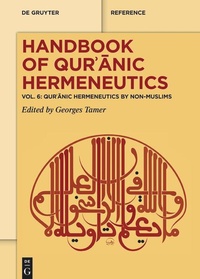
Qur?anic Hermeneutics by Non-Muslims
1. Auflage
Erschienen am 29. Dezember 2025
VI, 450 Seiten
978-3-11-132005-2 (ISBN)
Beschreibung
This project presents the hermeneutical approaches to the Qur?an of the most prominent Qur?anic scholars in Islamic intellectual history. Not only scholars who wrote commentaries on the Qur?an in the narrow sense of the word (
tafasir
) are to be presented, but also those who dealt hermeneutically with the Qur?an in various ways. The
Handbook of Qur?anic Hermeneutics
is the first book that discusses all the hermeneutical fields of the Qur?an. It will be published in seven volumes.
Weitere Details
Weitere Ausgaben
Person
Georges Tamer
, University of Erlangen-Nuremberg, Germany.
Inhalt
- Intro
- Contents
- Introduction
- Qur?anic Hermeneutics by Non-Muslims
- Greek-Byzantine Qur?anic Hermeneutics
- 1 Introduction
- 2 Major Anti-Islamic Works Engaging with the Qur?an
- 3 Analysis of the Aims, Methods, and Impact of the Engagement with the Qur?an
- 3.1 The Early Period (Seventh to Ninth Centuries)
- 3.2 The Coranus Graecus and its Reception (Ninth to Thirteenth Centuries)
- 3.2.1 Significant Features and Achievements in the Coranus Graecus
- 3.2.2 Theological and Intellectual Background of the Coranus Graecus
- 3.2.3 Historical Importance
- 3.2.4 Reception and Influence in Past and Present
- 3.3 The Caesura of the Fourth Crusade and the Later Period (Twelfth to Fifteenth Centuries)
- 3.3.1 Demetrius Cydones and his Translation of Contra Legem Sarracenorum
- 3.3.2 John VI Cantacuzenus' Anti-Islamic Corpus
- 4 Conclusion
- 5 Bibliography
- 5.1 Sources
- 5.2 Secondary Literature
- The Qur?an in the Literature of the Copts
- 1 Introduction
- 2 The Qur?an in Coptic Literary Texts
- 3 The Qur?an and the Arabophone Coptic Elite
- 3.1 Living in the Linguistic World of the Qur?an
- 3.2 Quoting the Qur?an
- 4 An Undercurrent: Controversial Texts
- 5 Towards Rules of Engagement
- 6 Conclusion
- 7 Bibliography
- 7.1 Sources
- 7.2 Secondary Literature
- 7.3 Online Sources
- Qur?anic Hermeneutics by Jews
- 1 Introduction
- 2 Translation as Interpretation: Hebrew Translations of the Qur?an
- 3 The Context of the First Translations
- 4 Later Translations
- 5 Hebrew Transcriptions of the Qur?an
- 6 The Cairo Genizah
- 7 Flavius Mithridates and Vat. Ebr. 357
- 8 Conclusion
- 9 Bibliography
- Traces of Hermeneutics in Latin Translations of the Qur?an
- 1 Introduction
- 2 Robert of Ketton
- 3 Mark of Toledo
- 4 Juan de Segovia
- 5 Flavius Mithridates
- 6 Juan Gabriel de Teruel (cor. 1525/931 by Leo Africanus)
- 7 Ignazio Lomellini
- 8 Translation Attributed to Cyril Lucaris
- 9 Johann Zechendorff
- 10 Germanus of Silesia
- 11 Ludovico Marracci
- 12 Appendix: Comparison of sura 1, al-Fati?a (The Opening), in the Latin Translations of the Qur?an
- 13 Bibliography
- 13.1 Sources
- 13.2 Secondary Literature
- John of Damascus
- 1 Introduction
- 2 John of Damascus and Islam
- 2.1 John's Biography
- 2.2 John's Writings on Islam
- 3 Analysis of haer. 100
- 3.1 Sura "The Woman"
- 3.1.1 John's Polemic against Polygamy
- 3.1.2 The Zayd Episode on Divorce
- 3.1.3 The Seed Field Metaphor
- 3.2 Sura "The Camel of God"
- 3.2.1 John as Witness of Qur?anic Text's Canonization
- 3.2.2 Christological Interpretation
- 3.2.3 Paradise and Hell in Islam
- 3.3 Sura "The Table"
- 3.4 Sura "The Heifer"
- 4 Conclusion
- 5 Bibliography
- 5.1 Sources
- 5.2 Secondary Literature
- ?Abd al-Masi? al-Kindi
- 1 Introduction: al-Kindi and the Apology
- 2 The Inimitability of the Qur?an in Content and Form
- 2.1 The Inimitability of the Qur?an in relation to its Content
- 2.1.1 Demonic Law
- 2.1.2 Genesis of the Qur?an
- 2.1.3 Accusation of Alteration
- 2.1.4 Transmission of the Qur?anic Text
- 2.2 The Inimitability of the Qur?an in Relation to Form
- 3 Falsification of Meaning
- 4 Conclusions
- 5 Bibliography
- 5.1 Sources
- 5.2 Secondary Literature
- Nicetas of Byzantium
- 1 Introduction
- 2 Life, Works, Political and Intellectual Context of Nicetas of Byzantium
- 2.1 Life and Works
- 2.2 Political and Intellectual Context of Nicetas of Byzantium
- 3 Analysis of the Refutation of the Qur?an and of Nicetas of Byzantium's Hermeneutical Method
- 3.1 Theological and Intellectual Background of Nicetas' Hermeneutical Approach and His Exegetical-Hermeneutical Principals
- 3.2 Significant Hermeneutical Features and Achievements in Nicetas' Polemics
- 3.3 Nicetas' Historical Importance, Reception, and Theological Influence in Past and Present
- 4 Conclusion
- 5 Bibliography
- 5.1 Sources
- 5.2 Secondary Literature
- Peter the Venerable
- 1 Introduction
- 2 Life and Works
- 3 Analysis of the Major Hermeneutical Works
- Outline placeholder
- Outline placeholder
- Summa totius haeresis Saracenorum (Summary of the whole heresy of the Saracens)
- Epistola de translatione sua (Letter concerning his translation)
- Contra sectam Saracenorum (Against the sect of the Saracens)
- 4 Conclusion
- 5 Bibliography
- 5.1 Sources
- 5.2 Secondary Literature
- Riccoldo da Monte di Croce
- 1 Introduction
- 2 Life and Works
- 3 Against the Law of the Saracens
- 3.1 Reception and Influence
- 4 Conclusion
- 5 Bibliography
- 5.1 Sources
- 5.2 Secondary Literature
- Nicholas of Cusa
- 1 Introduction
- 2 Life
- 3 Hermeneutical Works
- 4 Conclusion
- 5 Bibliography
- 5.1 Sources
- 5.2 Secondary Literature
- Martin Luther
- 1 Historical Introduction
- 2 Luther's Reception of the Qur?an
- 3 Luther's Treatment of the Qur?an in the Verlegung
- 4 Luther's Preface to the Qur?an
- 5 Conclusion
- 6 Bibliography
- 6.1 Sources
- 6.2 Secondary Literature
- Louis Massignon
- 1 The 'Apostle of the Sahara': Charles de Foucauld
- 2 Baghdad 1908/1326: The Conversion of Louis Massignon
- 3 The Discovery of Islamic Mysticism
- 4 Heretic or Martyr: Who was al-?allaj?
- 5 Substitution: Massignon in Damiette in 1934/1353
- 6 The Theological Exclusion of Islam
- 7 Abraham's Hospitality and Prayers
- 8 Abraham's "Prayer for Ishmael" - and the Consequences?
- 9 The "Mission" of Islam towards Jews and Christians
- 10 Massignon, Vaticanum II and the Muslims
- 11 Bibliography
- 11.1 Sources
- 11.2 Secondary Literature
- Toshihiko Izutsu
- 1 Introduction
- 2 Life, Works, and Political and Intellectual Context
- 2.1 Birth and Upbringing in Japan
- 2.2 A Period of Travel and Residence Outside of Japan
- 2.2.1 Life in Canada
- 2.2.2 Living in Iran
- 2.2.3 Attending the Annual Eranos Conference in Switzerland
- 2.3 Return to Japan and Death
- 3 First Japanese Translations of the Qur?an
- 4 Analysis of Izutsu's Major Qur?anic Works
- 4.1 Linguistic and Historical Approach
- 4.2 Philosophical and Metahistorical Approach
- 5 Conclusion
- 6 Bibliography
- 6.1 Sources
- 6.2 Secondary Literature
- Youakim Moubarac
- 1 Introduction
- 2 Life, Work, and Political and Intellectual Contexts
- 3 Works
- 4 Moubarac and his Geopolitical and Intellectual Context
- 4.1 Geopolitical Context
- 4.2 Intellectual Context
- 4.3 Landmarks and Influences
- 4.4 Moubarac and Massignon: A Fruitful Exchange
- 5 Analysis of Moubarac's Major Hermeneutical Works
- 5.1 Preliminary Considerations
- 5.2 A Truly Authentic Qur?an
- 5.3 Reconciling Islam with Itself
- 5.4 A Spiritual Approach Toward Islam
- 5.4.1 Exegetical-Hermeneutical Methods
- 5.4.2 Moubarac's Qur?anic Hermeneutics
- 6 The Universal Mission of Islam
- 6.1 The Junction of Abraham and Mu?ammad
- 6.2 The Mediating Function of Islam as Archer
- 6.3 The Eschatological Function of Islam
- 7 Characteristics and Hermeneutical Achievements
- 8 Bibliography
- 8.1 Sources
- 8.2 Secondary Literature
- Georges Khodr
- 1 Preliminary Remark
- 2 Biographical Note
- 3 Khodr's Understanding of Islam
- 4 Khodr's Qur?anic Hermeneutics
- 4.1 Theological Aspects
- 4.2 Linguistic and Aesthetic Aspects
- 5 Conclusion
- 6 Bibliography
- 6.1 Sources
- 6.2 Secondary Literature
- Paolo Dall'oglio
- 1 A Life Lived with Passion
- 2 Exegesis of Sura 18, al-Kahf (The Cave)
- 3 Conclusion
- 4 Bibliography
- 4.1 Sources
- 4.2 Secondary Literature
- The Qur?an in Bahai Writings
- 1 Introduction
- 2 The Writings of the Bab
- 2.1 The Qayyum al-asma?
- 2.2 Other Qur?an Commentaries by the Bab
- 3 The Writings of Baha?ullah and ?Abd al-Baha?
- 4 Conclusion
- 5 Bibliography
- 5.1 Sources
- 5.2 Secondary Literature
- Qur?anic Studies as Political Action in Nineteenth-Century Wissenschaft des Judentums
- 1 Introduction
- 2 History, Philology, and Politics
- 3 Abraham Geiger
- 4 Gustav Weil
- 5 History as Counter-Discourse and Subversive Process
- 6 Conclusion
- 7 Bibliography
- 7.1 Sources
- 7.2 Secondary Literature
- Qur?anic Hermeneutics in Western Scholarship on Islam
- Language and Structure in Western Qur?anic Hermeneutics
- 1 Introduction
- 1.1 What is Western QH?
- 2 Language Research in the Late Antiquity School of Qur?anic Hermeneutics
- 3 The Textual Framework I: Thematic and Structural Approaches
- 3.1 The Structural Thematic (Vertical) Approach
- 4 The Textual Framework II: Linguistic Approaches
- 4.1 A Tentative Map of Qur?anic Linguistics to Date
- 5 The Way Forward for the Study of Qur?anic Language and Structure
- 6 Bibliography
- Qur?anic Hermeneutics in Western Scholarship in Regard to the Qur?an and its Context
- 1 Introduction
- 2 Linguistic Context
- 3 Literary Context
- 4 Conceptual Context
- 5 Historical Context
- 6 Conclusion
- 7 Bibliography
- Qur?anic Hermeneutics and the Translation of the Qur?an
- 1 Introduction
- 2 Vernacularity Defined
- 3 The Vernacular as the Translocal
- 4 Translation and its Technologies
- 5 The History of the Qur?an's Translation
- 6 Translations into European Languages
- 7 Translations into African Languages
- 8 The Qur?an in Southeast and East Asia
- 9 Translations into South Asian Languages
- 10 The Impact of Printing Technology
- 11 Conclusion
- 12 Bibliography
- 12.1 Sources
- 12.2 Secondary Literature
- List of Contributors
