

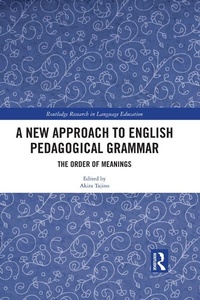
A New Approach to English Pedagogical Grammar
The Order of Meanings
Erschienen am 12. Oktober 2017
258 Seiten
978-1-315-39664-4 (ISBN)
Beschreibung

This book proposes Meaning-order Approach to Pedagogical Grammar (MAP Grammar) as a practical pedagogical approach in ESL and EFL contexts. Teaching grammar through an easy-to-understand three-dimensional model, MAP Grammar establishes the clause as the fundamental unit of English and interprets meaning units in the sentence, thus allowing visualizable association between individual grammar items. By focusing on the order of meaning (rather than the order of words) in a sentence, MAP Grammar also distills current descriptive sentence structures (typically taught as five or seven patterns) into one meaning-based sentence structure for teaching and learning. MAP Grammar makes syllabus design and teaching easier in the following ways:
Visualizing English grammar in a clear model, allowing association between individual grammar items.
Instruction relies on meaning, not metalanguage, making MAP Grammar easy to grasp.
The meaning-based sentence structure allows teachers to address global errors, and learners to produce comprehensible English.
Visualizing English grammar in a clear model, allowing association between individual grammar items.
Instruction relies on meaning, not metalanguage, making MAP Grammar easy to grasp.
The meaning-based sentence structure allows teachers to address global errors, and learners to produce comprehensible English.
Rezensionen / Stimmen
Meaning-Based Pedagogical Grammar provides a fresh new approach to grammar teaching and learning for communication. It is an exciting development, grounded in linguistic theory, that helps both teachers and learners to see the big picture of English grammar. Meaning-Based Pedagogical Grammar is perhaps the easiest way to teach. -- Professor Akihiko Haisa, Department of English Language, Culture, and Communication, Sagami Women's University'Given these minor caveats, the book makes a significant contribution to the literature by laying out a practical approach to teaching communication-oriented grammar. Readers, whether they consider themselves students, teachers, learners, or researchers, will be inspired by the lucid presentation of MAP grammar and its accessibility for practitioners and, most importantly, for learners.' - Larry Walker, Professor, Kyoto Prefectual University, Japan
Weitere Details
Reihe
Sprache
Englisch
Verlagsort
London
Großbritannien
Verlagsgruppe
Taylor & Francis Ltd
Zielgruppe
Für höhere Schule und Studium
Für Beruf und Forschung
Produkt-Hinweis
Reflowable
Illustrationen
13 Tables, black and white; 99 Line drawings, black and white; 6 Halftones, black and white
Dateigröße
9,06 MB
ISBN-13
978-1-315-39664-4 (9781315396644)
Copyright in bibliographic data and cover images is held by Nielsen Book Services Limited or by the publishers or by their respective licensors: all rights reserved.
Schweitzer Klassifikation
Weitere Ausgaben
Andere Ausgaben
Buch
03/2019
1. Auflage
Routledge
65,40 €
Versand in 15-20 Tagen
Buch
10/2017
1. Auflage
Routledge
207,80 €
Versand in 10-20 Tagen
Person
Akira Tajino is Professor of Educational Linguistics and Director of the International Academic Research and Resource Center for Language Education (i-ARRC) at Kyoto University, Japan. His research interests include EAP, classroom research, and pedagogical grammar. He is a recipient of the JACET (Japan Association of College English Teachers) Award for excellence in teaching (2011) and the JACET Award for excellence in academic publication (2014). He is the (co) author/editor of more than 20 books, including Researching Language Teaching and Learning: An Integration of Practice and Theory (Peter Lang, 2009) and Team Teaching and Team Learning in the Language Classroom: Collaboration for Innovation in ELT (Routledge, 2016), and has published articles in academic and professional journals. He has served on the editorial panel of several journals, including Oxford's ELT Journal.
Inhalt
Foreword (Thomas Bloor and Meriel Bloor)
Introduction (Akira Tajino)
Part I: A Meaning-order Approach to Pedagogical Grammar (MAP Grammar): Theoretical Background
1. MAP Grammar: Towards a systemic approach to ELT (Akira Tajino)
2. How should we design pedagogical grammar? (Yosuke Yanase)
3. Pedagogical Grammar: A theoretical background from the perspective of applied linguistics (Yoichi Watari)
4. MAP Grammar: A cognitive grammar perspective (Kazumi Taniguchi)
Part II: MAP Grammar and issues in ELT
5. MAP Grammar and ESP: Beyond the classroom (Hajime Terauchi and Sayako Maswana)
6. MAP and SLA: Teaching English to young learners in the EFL classroom (Emiko Izumi)
7. MAP Grammar and ICT applications (Toshiyuki Kanamaru and Daniel Roy Pearce)
8. MAP Grammar and motivation (David Dalsky, Ryan W. Smithers, and Yoshinari Sasaki)
9. MAP Grammar and Instructional Design (Sachi Takahashi, Daniel Roy Pearce, and David Dalsky)
10. Visualizing MAP Grammar: Utilizing visual aids to integrate the teaching of linguistic structure and content knowledge (Tim Stewart)
11. MAP Grammar and vocabulary (Yosuke Sasao)
12. MAP Grammar and listening (Kyoko Hosogoshi, Yuka Hidaka, and Daniel Roy Pearce)
13. MAP Grammar and relative clauses in EFL learners' writing (Noriko Kurihara, Kei Kawanishi, and Kiyo Sakamoto)
14. Voice from "practitioners": A collaborative exploration of MAP Grammar in an EFL classroom (Yoshitaka Kato, Hironori Watari, and Francesco Bolstad)
Part III: MAP Grammar: Practice reports and lesson plans
15. Developing a base of English expressions using MAP Grammar (Tomoko Jojima, Hisae Oyabu, and Yoko Jinnouchi)
16. Communication and critical thinking with MAP Grammar (Hiroshi Nakagawa, Yosuke Ishii)
17. MAP Grammar and recitation/reproduction activities (Kei Okuzumi)
18. A Stepwise application of MAP Grammar for speaking (Taiki Yamaoka)
19. Role-play interviews with MAP Grammar (Ryan W. Smithers)
20. Presentation projects with MAP Grammar (Hiroshi Yamada)
21. MAP on the job: Applying the order of meaning to an English for occupational purposes setting (James W. Gray)
Epilogue: A message for teachers (Akira Tajino)
Introduction (Akira Tajino)
Part I: A Meaning-order Approach to Pedagogical Grammar (MAP Grammar): Theoretical Background
1. MAP Grammar: Towards a systemic approach to ELT (Akira Tajino)
2. How should we design pedagogical grammar? (Yosuke Yanase)
3. Pedagogical Grammar: A theoretical background from the perspective of applied linguistics (Yoichi Watari)
4. MAP Grammar: A cognitive grammar perspective (Kazumi Taniguchi)
Part II: MAP Grammar and issues in ELT
5. MAP Grammar and ESP: Beyond the classroom (Hajime Terauchi and Sayako Maswana)
6. MAP and SLA: Teaching English to young learners in the EFL classroom (Emiko Izumi)
7. MAP Grammar and ICT applications (Toshiyuki Kanamaru and Daniel Roy Pearce)
8. MAP Grammar and motivation (David Dalsky, Ryan W. Smithers, and Yoshinari Sasaki)
9. MAP Grammar and Instructional Design (Sachi Takahashi, Daniel Roy Pearce, and David Dalsky)
10. Visualizing MAP Grammar: Utilizing visual aids to integrate the teaching of linguistic structure and content knowledge (Tim Stewart)
11. MAP Grammar and vocabulary (Yosuke Sasao)
12. MAP Grammar and listening (Kyoko Hosogoshi, Yuka Hidaka, and Daniel Roy Pearce)
13. MAP Grammar and relative clauses in EFL learners' writing (Noriko Kurihara, Kei Kawanishi, and Kiyo Sakamoto)
14. Voice from "practitioners": A collaborative exploration of MAP Grammar in an EFL classroom (Yoshitaka Kato, Hironori Watari, and Francesco Bolstad)
Part III: MAP Grammar: Practice reports and lesson plans
15. Developing a base of English expressions using MAP Grammar (Tomoko Jojima, Hisae Oyabu, and Yoko Jinnouchi)
16. Communication and critical thinking with MAP Grammar (Hiroshi Nakagawa, Yosuke Ishii)
17. MAP Grammar and recitation/reproduction activities (Kei Okuzumi)
18. A Stepwise application of MAP Grammar for speaking (Taiki Yamaoka)
19. Role-play interviews with MAP Grammar (Ryan W. Smithers)
20. Presentation projects with MAP Grammar (Hiroshi Yamada)
21. MAP on the job: Applying the order of meaning to an English for occupational purposes setting (James W. Gray)
Epilogue: A message for teachers (Akira Tajino)
