
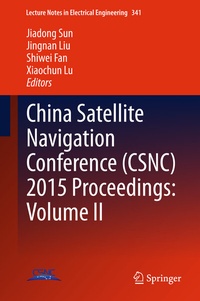
China Satellite Navigation Conference (CSNC) 2015 Proceedings: Volume II
Beschreibung
Alles über E-Books | Antworten auf Fragen rund um E-Books, Kopierschutz und Dateiformate finden Sie in unserem Info- & Hilfebereich.
China Satellite Navigation Conference (CSNC) 2015 Proceedings presents selected research papers from CSNC2015, held during 13th-15th May in Xian, China. The theme of CSNC2015 is Opening-up, Connectivity and Win-win. These papers discuss the technologies and applications of the Global Navigation Satellite System (GNSS), and the latest progress made in the China BeiDou System (BDS) especially. They are divided into 10 topics to match the corresponding sessions in CSNC2015, which broadly covered key topics in GNSS. Readers can learn about the BDS and keep abreast of the latest advances in GNSS techniques and applications.
SUN Jiadong is the Chief Designer of the Compass/ BDS, and the academician of Chinese Academy of Sciences (CAS); LIU Jingnan is a professor at Wuhan University. FAN Shiwei is a researcher at China Satellite Navigation Office; LU Xiaochun is an academician of Chinese Academy of Sciences (CAS).
Weitere Details
Weitere Ausgaben
Andere Ausgaben
Inhalt
Satellite Navigation Signal System, Compatibility & Interoperability.- Satellite Navigation Augmentation and Integrity Monitoring.- Satellite Navigation Models and Methods.

Systemvoraussetzungen
Dateiformat: PDF
Kopierschutz: Wasserzeichen-DRM (Digital Rights Management)
Systemvoraussetzungen:
- Computer (Windows; MacOS X; Linux): Verwenden Sie zum Lesen die kostenlose Software Adobe Reader, Adobe Digital Editions oder einen anderen PDF-Viewer Ihrer Wahl (siehe E-Book Hilfe).
- Tablet/Smartphone (Android; iOS): Installieren Sie bereits vor dem Download die kostenlose App Adobe Digital Editions oder die App PocketBook (siehe E-Book Hilfe).
- E-Book-Reader: Bookeen, Kobo, Pocketbook, Sony, Tolino u.v.a.m.
Das Dateiformat PDF zeigt auf jeder Hardware eine Buchseite stets identisch an. Daher ist eine PDF auch für ein komplexes Layout geeignet, wie es bei Lehr- und Fachbüchern verwendet wird (Bilder, Tabellen, Spalten, Fußnoten). Bei kleinen Displays von E-Readern oder Smartphones sind PDF leider eher nervig, weil zu viel Scrollen notwendig ist. Mit Wasserzeichen-DRM wird hier ein „weicher” Kopierschutz verwendet. Daher ist technisch zwar alles möglich – sogar eine unzulässige Weitergabe. Aber an sichtbaren und unsichtbaren Stellen wird der Käufer des E-Books als Wasserzeichen hinterlegt, sodass im Falle eines Missbrauchs die Spur zurückverfolgt werden kann.
Weitere Informationen finden Sie in unserer E-Book Hilfe.