

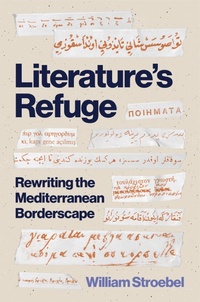
Literature's Refuge
Rewriting the Mediterranean Borderscape
1. Auflage
Erschienen am 18. Februar 2025
320 Seiten
978-0-691-26609-1 (ISBN)
Beschreibung

Stories silenced or sequestered by a century of mass displacement between Europe and the Middle East-recovered and retold at last
In 1923, the Greco-Turkish Population Exchange uprooted and swapped nearly two million Christians and Muslims, "pacifying" the so-called Near East through ethnic partition and refugeehood. This imposition of borders not only uprooted peoples from their place in the world; it also displaced many of their stories from a place in world literature. In Literature's Refuge, William Stroebel recovers and weaves together work by fugitive writers, oral storytellers, readers, copyists, editors, and translators dispersed by this massive "unmixing" of populations and the broader border logic that it set in motion. Stroebel argues that two complementary forces emerged as a template for the Eastern Mediterranean's cultural landscape: the modern border, which reshuffled people through a system of filters and checkpoints; and modern philology, which similarly reshuffled their words and works. Philologists and publishers defined modern literature by picking apart, extracting, reformatting, or dispossessing refugee and diasporic texts across a racialized borderscape-a gray zone of semi-inclusion and semi-exclusion, semimobility and immobility.
Stroebel reaches into the chinks and crannies of this borderscape to reconstitute the rich textual geography between Greek Orthodoxy and Sunni Islam, between Greek-script, Arabic-script, and Latin-script literary traditions at the edges of Europe and the Middle East. Doing so, he offers a new methodological toolkit for rewriting the modern borderscapes of world literature.
In 1923, the Greco-Turkish Population Exchange uprooted and swapped nearly two million Christians and Muslims, "pacifying" the so-called Near East through ethnic partition and refugeehood. This imposition of borders not only uprooted peoples from their place in the world; it also displaced many of their stories from a place in world literature. In Literature's Refuge, William Stroebel recovers and weaves together work by fugitive writers, oral storytellers, readers, copyists, editors, and translators dispersed by this massive "unmixing" of populations and the broader border logic that it set in motion. Stroebel argues that two complementary forces emerged as a template for the Eastern Mediterranean's cultural landscape: the modern border, which reshuffled people through a system of filters and checkpoints; and modern philology, which similarly reshuffled their words and works. Philologists and publishers defined modern literature by picking apart, extracting, reformatting, or dispossessing refugee and diasporic texts across a racialized borderscape-a gray zone of semi-inclusion and semi-exclusion, semimobility and immobility.
Stroebel reaches into the chinks and crannies of this borderscape to reconstitute the rich textual geography between Greek Orthodoxy and Sunni Islam, between Greek-script, Arabic-script, and Latin-script literary traditions at the edges of Europe and the Middle East. Doing so, he offers a new methodological toolkit for rewriting the modern borderscapes of world literature.
Weitere Details
Weitere Ausgaben
Andere Ausgaben
Buch
03/2025
Princeton University Press
103,95 €
Artikel z.Zt. nicht lieferbar
Buch
03/2025
Princeton University Press
43,50 €
Versand in 10-20 Tagen
Person
William Stroebel is assistant professor of modern Greek and comparative literature at the University of Michigan.
Inhalt
- Cover
- Contents
- Acknowledgments
- Preface
- Note on Transliteration and Translation
- Introduction
- Chapter One, in which Sani and his readers save the nightingale
- Chapter Two, in which Cavafy is scattered and gathered up and scattered again
- Chapter Three, in which witnesses to war tell their truths
- Chapter Four, in which displaced books make a place
- Chapter Five, in which the script is rewritten
- Afterword
- Notes
- Bibliography
- Index
