

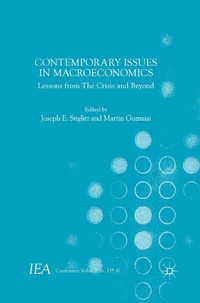
Contemporary Issues in Macroeconomics
Lessons from The Crisis and Beyond
Erschienen am 29. April 2016
XIV, 203 Seiten
978-1-137-52958-9 (ISBN)
Beschreibung

In this edited collection, Joseph Stiglitz and Martin Guzman present a series of studies on contemporary macroeconomic issues. The book discusses a set of key lessons for macroeconomic theory following the recent global financial crisis and explores unconventional monetary policy in a post-crisis world.
This volume is divided into five parts. The introduction includes keynote speeches by the Governors of the Bank of Japan and Central Bank of Jordan. Part one focuses on macroeconomic theory for understanding macroeconomic fluctuations and crises. Part two addresses the issue of the measurement of wealth. Part three discusses macroeconomic policies in times of crises. Finally, part four focuses on central banking and monetary policy.
This volume is divided into five parts. The introduction includes keynote speeches by the Governors of the Bank of Japan and Central Bank of Jordan. Part one focuses on macroeconomic theory for understanding macroeconomic fluctuations and crises. Part two addresses the issue of the measurement of wealth. Part three discusses macroeconomic policies in times of crises. Finally, part four focuses on central banking and monetary policy.
Weitere Details
Reihe
Auflage
1st ed. 2015
Sprache
Englisch
Verlagsort
London
Großbritannien
Verlagsgruppe
Palgrave Macmillan UK
Zielgruppe
Für Beruf und Forschung
Produkt-Hinweis
Reflowable
Illustrationen
XIV, 203 p.
Dateigröße
1,48 MB
ISBN-13
978-1-137-52958-9 (9781137529589)
DOI
10.1057/9781137529589
Schweitzer Klassifikation
Weitere Ausgaben
Andere Ausgaben
Buch
12/2015
Palgrave Macmillan
106,99 €
Versand in 10-20 Tagen
Person
Joseph E. Stiglitz is an American economist and a professor at Columbia University. A recipient of the Nobel Memorial Prize in Economic Sciences (2001) and the John Bates Clark Medal (1979), he is a former senior vice president and chief economist of the World Bank, and a former member and chairman of the (US president's) Council of Economic Advisers. In 2000, Stiglitz founded the Initiative for Policy Dialogue, a think tank on international development based at Columbia University, USA.
Martin Guzman is a postdoctoral research fellow at Columbia University Business School, USA, and Associate Professor at the University of Buenos Aires, Argentina. He is also a member of the INET Taskforce on Macroeconomic Externalities and a senior fellow at the Centre for International Governance Innovation.
Martin Guzman is a postdoctoral research fellow at Columbia University Business School, USA, and Associate Professor at the University of Buenos Aires, Argentina. He is also a member of the INET Taskforce on Macroeconomic Externalities and a senior fellow at the Centre for International Governance Innovation.
Inhalt
List of Figures
List of Tables
Foreword
Notes on Contributors
Presidential Address
Introduction; Joseph E. Stiglitz
Towards a General Theory of Deep Downturns
Keynote addresses by Central Bank Governors
1. The Practice and Theory of Unconventional Monetary Policy; Haruhiko Kuroda, Governor of the Central Bank of Japan
2. Monetary Policy in a Constrained Environment; Ziad Fariz, Governor of the Central Bank of Jordan
PART I: MACROECONOMIC THEORY FOR UNDERSTANDING FLUCTUATIONS AND CRISES
3. A Theory of Pseudo-Wealth; Martin Guzman and Joseph E. Stiglitz
4. Great Recession and Beyond: Revisiting the Pillars of Economic Thought; A. Erinc Yeldan
5. Is Financial Stability Possible in the Current International System?; James M. Boughton
6. Learning, Expectations, and the Financial Instability Hypothesis; Martin Guzman and Peter Howitt
PART II: MACROECONOMIC POLICIES IN UNSTABLE TIMES
7. The Short-and Long-Run Damages of Fiscal Austerity: Keynes beyond Schumpeter; Giovanni Dosi, Mauro Napoletano, Andrea Roventini, and Tania Treibich
8. Structural Divergence and Crisis in the Eurozone: The Role of NAIRU Economics; Servaas Storm and C.W.M. Naastepad
9. Managing the Exchange Rate in the Face of Volatile Capital Flows; Jonathan D. Ostry
10. Achieving Coherence Between Macroeconomic and Development Objectives; Gerald Epstein
PART III: CENTRAL BANKING AND MONETARY POLICY
11. Re-imagining Central Banking; Perry Mehrling
12. Taking Banks to Solow; Hans Gersbach, Jean-Charles Rochet, and Martin Scheffel
Index
List of Tables
Foreword
Notes on Contributors
Presidential Address
Introduction; Joseph E. Stiglitz
Towards a General Theory of Deep Downturns
Keynote addresses by Central Bank Governors
1. The Practice and Theory of Unconventional Monetary Policy; Haruhiko Kuroda, Governor of the Central Bank of Japan
2. Monetary Policy in a Constrained Environment; Ziad Fariz, Governor of the Central Bank of Jordan
PART I: MACROECONOMIC THEORY FOR UNDERSTANDING FLUCTUATIONS AND CRISES
3. A Theory of Pseudo-Wealth; Martin Guzman and Joseph E. Stiglitz
4. Great Recession and Beyond: Revisiting the Pillars of Economic Thought; A. Erinc Yeldan
5. Is Financial Stability Possible in the Current International System?; James M. Boughton
6. Learning, Expectations, and the Financial Instability Hypothesis; Martin Guzman and Peter Howitt
PART II: MACROECONOMIC POLICIES IN UNSTABLE TIMES
7. The Short-and Long-Run Damages of Fiscal Austerity: Keynes beyond Schumpeter; Giovanni Dosi, Mauro Napoletano, Andrea Roventini, and Tania Treibich
8. Structural Divergence and Crisis in the Eurozone: The Role of NAIRU Economics; Servaas Storm and C.W.M. Naastepad
9. Managing the Exchange Rate in the Face of Volatile Capital Flows; Jonathan D. Ostry
10. Achieving Coherence Between Macroeconomic and Development Objectives; Gerald Epstein
PART III: CENTRAL BANKING AND MONETARY POLICY
11. Re-imagining Central Banking; Perry Mehrling
12. Taking Banks to Solow; Hans Gersbach, Jean-Charles Rochet, and Martin Scheffel
Index
