

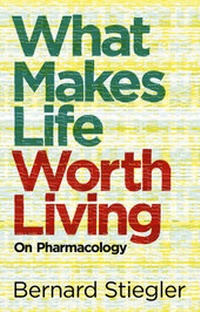
What Makes Life Worth Living
Beschreibung

Underlying these multiple symptoms is consumer capitalism, whichsystematically immiserates those whom it purports to liberate.Returning to Marx's theory, Stiegler argues that consumerismmarks a new stage in the history of proletarianization. It is nolonger just labour that is exploited, pushed below the limits ofsubsistence, but the desire that is characteristic of human spirit.
The cure to this malaise is to be found in what Stiegler calls a'pharmacology of the spirit'. Here, pharmacology hasnothing to do with the chemical supplements developed by thepharmaceutical industry. The pharmakon, defined as both cure andpoison, refers to the technical objects through which we openourselves to new futures, and thereby create the spirit that makesus human. By reference to a range of figures, from Socrates,Simondon and Derrida to the child psychoanalyst Donald Winnicott,Stiegler shows that technics are both the cause of our sufferingand also what makes life worth living.
Weitere Details
Weitere Ausgaben
Andere Ausgaben
Personen
Inhalt
Introduction: A Continent on the Move 1
1 Myriad Challenges and Opportunities 5
2 A Demographic Dividend or Just More People? 21
3 Tropical Dilemmas: Disease, Water, and More 35
4 Educating Future Generations 55
5 To War Rather than to Prosper 69
6 Accountability and the Wages of Corrupt Behavior 91
7 The Infrastructural Imperative 116
8 Harnessing Mobile Telephone Capabilities 134
9 China Drives Growth 151
10 Strengthening Governance 173
11 Creating Responsible Leadership 189
Notes 216
Select Bibliography 244
Index 252
Introduction
The loss of the feeling of existing
A mother, according to Donald Winnicott,1 by taking care of her infant, even before the child is old enough to speak, teaches it that life is worth living. She instils in the child the feeling that life is worth living.
Maternal care, which obviously provides this feeling back to the mother herself, passes through the intermediary of what Winnicott called the ‘transitional object’. This object enables and conditions the relation between mother and child and, as such, it is not a mere intermediary: it constitutes the mother as this mother, in her very way of being a mother, and this child as her child.
The transitional object has a distinct virtue: it does not exist. Certainly, something exists that enables it to appear – for example, a teddy bear or cuddly toy. But what makes this teddy bear or cuddly toy able to open up ‘transitional space’ – which Winnicott also called ‘potential space’ – in which the mother can encounter her child; what makes this teddy bear or cuddly toy able to become the transitional object, is that, beyond that part of the object that exists in external space, beyond or beneath this piece of cloth, there holds something that is precisely neither in exterior space, nor simply internal to either the mother or the child.
In this beyond or beneath of both the exterior and the interior, there is something that holds between the mother and her child, and which nevertheless does not exist. What takes hold between the mother and child in not existing, but in passing through the transitional object, and which therefore finds itself constituted by it, links and attaches them to one another through a wonderful relationship: a relation of love, of amour fou.
What holds and is upheld as this link through which these two beings become incommensurable and infinite for one another, is what, by allowing a place for that which is infinite, consists precisely to the immeasurable extent [dans la mesure et la démesure] that it does not exist – because the only things that exist are finite things.
This consistence, more than anything else, and before anything else, is what a mother protects when she protects her child. This protection, which is care par excellence, is grounded in the knowledge the mother has of the extra-ordinary character of the object – and that Winnicott calls transitional precisely in order to designate this extra-ordinariness.
Such was Winnicott's great discovery: the fact that maternal knowledge is knowledge of that which, in the transitional object, consists, though it does not exist, and which gives to the child placed under this protection the feeling that ‘life is worth living’.2
I argue in this work that the transitional object is the first pharmakon.
The question of the pharmakon first arose in contemporary philosophy with Jacques Derrida's commentary on the Phaedrus in ‘Plato's Pharmacy’.3
Writing – as hypomnesis, hypomnematon, that is, artificial memory – is that pharmakon whose artificial and poisonous effects Plato combats by opposing them to anamnesis, to thinking ‘for oneself’, that is, to the autonomy of thought. Derrida has shown, however, that this autonomy nevertheless always has something to do with heteronomy – in this case, that of writing – and that, while Plato opposes autonomy and heteronomy, they in fact constantly compose.
The transitional object is the first pharmakon because it is both an external object on which the mother and child are dependent (losing it is enough to make this clear) and in relation to which they are thus heteronomous; and an object that, not existing but consisting, provides (through this very consistence) sovereignty to both mother and child: their serenity, their trust in life, their feeling that life is worth living, their autonomy.
The pharmakon that is the transitional object is the point of departure for the formation of a healthy psychic apparatus. And it is also, in particular through sublimation, a condition of keeping the psychic apparatus of the adult in good health.
But Winnicott shows that a bad relation to this object and to its heteronomy is just as possible as the care that it alone makes possible. Dependence then becomes harmful, that is, destructive of autonomy and trust. The care that the mother must take of her child, then, necessarily includes the way she protects her child from this object: from what it contains that is threatening.4 And eventually she must teach her children to detach themselves from it.
It is in this way that the mother must bring the child to adopt – or not – its transitional situation, that is, its pharmacological situation, on the basis of which the child will be able to attain, or not, the feeling that life is worth living. By bringing the child to adopt the pharmakon, what Winnicott calls the good mother also teaches the child to detach itself from the transitional object so as to engage with other transitional spaces, with which it will establish other relations, all of which may distance the child from the mother herself – despite which she does not lose her infinite dimension.
This is why the transitional object does not only concern the child and mother: it is also, as first pharmakon, the origin of works of art and, more generally, of the life of the mind or spirit in all its forms, and thus of adult life as such. It is, finally, the origin of all objects, because an object is always that which, once upon a time, appeared to a mind that projected it.
We shall see that, ultimately, things can constitute a world only insofar as they irreducibly proceed from the transitional character of the object. Having become ordinary and everyday, and in this sense ‘mundane’ (or ‘intramundane’), the transitional object conserves its pharmacological dimension, even if this ‘mundanity’ tends to conceal this dimension. As such, it can always engage not only curative projection processes but poisonous ones, becoming, for example, the support of an addiction, the screen of melancholy, and even a drive of destruction, of murderous madness, of those dangerous states that result when the feeling that life is worth living has been lost.
To lose the feeling that life is worth living may drive one to furious madness.
Re-reading Playing and Reality over the last year in order to prepare a course which to some extent lies at the origin of the present work,5 I was astounded to discover that, according to Winnicott, the patients under his care had ‘lost the feeling of existing’. I was astounded because I immediately recalled that these were the exact words, ‘lost the feeling of existing’, that Richard Durn wrote in his diary when he admitted or forewarned, but a forewarning to no one in particular, that this loss was so abyssal and painful that it could well lead him to commit a massacre.6
The pharmakon is at once what enables care to be taken and that of which care must be taken – in the sense that it is necessary to pay attention: its power is curative to the immeasurable extent [dans la mesure et la démesure] that it is also destructive.
This ‘at once’ characterizes what I call a pharmacology, on which and from which I shall try to open perspectives in the pages which follow.
As far as I know, Derrida never envisaged the possibility of such a pharmacology – that is, of a discourse on the pharmakon understood in the same gesture in its curative and toxic dimensions. And this can only be a source of regret for us, those who, in the twenty-first century, are trying to remain non-inhuman beings, and for whom the question of the pharmakon is not merely an academic issue for learned philosophers: it obsesses each and every one of us.
This state of affairs [état de fait] requires a rule of law [état de droit], a thought that, even if it can no longer secure a clear separation between fact and right – a difference between heteronomy and autonomy that would be not only clear but absolute – nevertheless learns to distinguish them in a new way, that is, without opposing them. The pharmacological question that now concerns each and every one of us thus becomes a primary question for the academic world and for the world as a whole.
This pharmacological question haunts planetary consciousness and the planetary unconscious, just as it haunts the immense loss of trust that inevitably results from the loss of care. This question thus characterizes the economic and spiritual crisis afflicting the ‘earth-ark’.7 This crisis is therefore unprecedented, which means that it is more critical than ever.
Krisis means ‘decision’. We all now know that it is the future of terrestrial life that is at stake with unprecedented urgency. We all know, whether we admit it or whether we prefer to know nothing about it, nor even to hear about it, that with the historical sequence that began to unfold in 2007, every step counts, and seems to be systemically overloaded with consequences that would be extremely difficult...
