

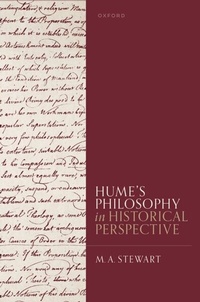
Hume's Philosophy in Historical Perspective
1. Auflage
Erschienen am 3. November 2022
407 Seiten
978-0-19-259056-5 (ISBN)
Beschreibung
David Hume was a highly original thinker. Nevertheless, he was a writer of his time and place in the history of philosophy. In this book, M. A. Stewart puts Hume's writing in context, particularly that of his native Scotland, but also that of British and European philosophy more generally. Through meticulous research Stewart brings to life the circumstances by means of which we can get a deeper understanding of Hume's writings on the nature and reach of human reason, the foundation of morals, and, especially, on the philosophy of religion. Stewart pays particular attention to Hume's intellectual development, beginning with his education at the College of Edinburgh, the writing of his Treatise of Human Nature, and his subsequent philosophical responses to criticisms of that book. He argues that Hume's scepticism set him at odds with the Christian Stoicism of Scottish contemporaries including that of Francis Hutcheson - and shows that this conflict played a major role in his failure to obtain the Edinburgh Moral Philosophy Chair in 1745. Stewart's detailed study of the physical character of Hume's surviving manuscripts in Chapters 8 and 9 provides the best available dating of his early 'Essay on Modern Chivalry', his 'Early Fragment on Evil' and the periods of composition of his Dialogues Concerning Natural Religion. Other chapters compare Hume's theory of abstraction with that of Locke and Berkeley, provide the 17th and 18th century philosophical context of the central argument of his essay 'Of miracles', and consider the 18th and 19th century reception of his writings in England and Ireland.
Weitere Details
Weitere Ausgaben
Person
The late M. A. Stewart was a historian of Philosophy and an authority on David Hume. He specialised in putting philosophical and theological views in their historical context. His work is marked by meticulous attention to detail, always returning to primary sources. He spent the larger part of his career at the University of Lancaster but held visiting positions at Aberdeen, Oxford, Canberra, and Sierra Leone. He was a towering figure in the establishment of history of ideas and history of philosophy in Britain, serving as President to the Eighteenth-Century Scottish Studies Society, the British Society for the History of Philosophy, and as the General Editor of The Clarendon Edition of the Works of John Locke.
Inhalt
- Introduction
- 1: Hume, David (1711-1776), Scottish philosopher and historian
- 2: The Scottish Enlightenment
- 3: Hume's intellectual development, 1711-1752
- 4: The Stoic legacy in the early Scottish Enlightenment
- 5: The kirk and the infidel
- 6: Two species of philosophy: The historical significance of the first 'Enquiry'
- 7: Academic freedom: Origins of an idea
- 8: An early fragment on evil
- 9: The dating of Hume's manuscripts
- 10: Abstraction and representation in Locke, Berkeley, and Hume
- 11: Hume and the "metaphysical argument a priori"
- 12: Hume's historical view of miracles
- 13: Hume's reception in Ireland
- 14: The early British reception of Hume's writings on religion
