

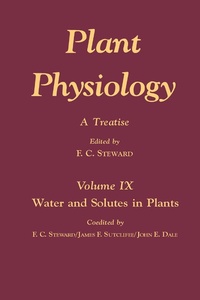
Plant Physiology 9
A Treatise: Water and Solutes in Plants
Erschienen am 2. Dezember 2012
630 Seiten
978-0-323-14426-1 (ISBN)
Beschreibung

Plant Physiology: A Treatise, Volume IX: Water and Solutes in Plants explores problems associated with water and solutes of plants as they grow. This book considers water relations of plant cells, along with transpiration and water balance, the physiology of stomata, ion uptake by roots from the soil, and salt relations of plants. This volume is organized into seven chapters and begins with an introduction to the water potential terminology used by plant physiologists in describing the water relations of plant communities, individual plants and their organs, and plant cells. An account of the elastic properties and hydraulic conductivity of plant cell walls is provided. The following chapters focus on the soil-plant-atmosphere continuum, water uptake and movement through plants, the effects of water deficit on plant development and other processes, and the mechanics of stomatal functioning. The book also introduces the reader to salt relations of plant cells, tissues, and roots as well as long-distance transport in the phloem, and then concludes by discussing the solute composition of cells during development. This book is a valuable resource for teachers, research workers, and students with specific interest in plant physiology.
Weitere Details
Weitere Ausgaben
Andere Ausgaben

Frederick C. Steward
Plant Physiology: v. 9
Buch
12/1986
Academic Press
159,88 €
Artikel ist vergriffen; siehe andere Ausgabe
Inhalt
Contributors to Volume IXPreface to Volume IXAn Explanatory NoteNote on the Use of Plant NamesChapter One Water Relations of Plant Cells I. Introduction II. Water Potential Terminology III. Recent Developments in Techniques IV. Elastic Properties and Hydraulic Conductivity V. The Control of Turgor VI. Future Developments ReferencesChapter Two Transpiration and the Water Balance of Plants I. Introduction II. Soil-Plant-Atmosphere Continuum III. Water Uptake and Movement through Plants IV. Plant Water Loss V. Development and Effects of Plant Water Deficit VI. Concluding Remarks ReferencesChapter Three The Physiology of Stomata: New Insights into Old Problems I. Introduction II. Cytology of Guard Cells III. Mechanics of Stomatal Functioning IV. Mechanisms behind the Turgor Changes of Guard Cells V. Responses to Light VI. Agents Causing Stomatal Closure VII. Energy Requirements for Stomatal Functioning VIII. Antitranspirants IX. Concluding Remarks ReferencesChapter Four Salt Relations of Cells, Tissues, and Roots I. Introduction II. Practical Aspects III. The Hunt for Carriers IV. Transport Systems V. Ion Transport and Metabolism VI. Regulation of Transport VII. Free Space VIII. Movement across the Cytoplasm to the Vacuole IX. Movement of Ions in the Symplasm X. Movement of Ions through the Root into the Xylem XI. Ion Uptake by Roots from the Soil XII. Epilogue ReferencesChapter Five Salt Relations of Intact Plants I. Introduction II. Ion Uptake III. Movement of Ions across the Root IV. Transport in the Xylem V. Salt Relations of Specialized Organs VI. Salt Relations of Specialized Plants: Halophytes VII. Patterns of Redistribution of Ions VIII. Salt Relations and Growth ReferencesChapter Six Phloem Transport I. Introduction II. Sources and Sinks III. The Channel IV. Mechanisms of Translocation V. Regulation of Translocation ReferencesChapter Seven Solutes in Cells: Their Responses during Growth and Development I. Introduction II. Solutes in Relation to Cells in Culture III. Procedures and Media That Affect Growth and Solutes IV. Other Salient Factors That Affect the Complement of Solutes in Cells V. Morphogenetic and Environmental Effects on the Solutes of Cells VI. Resume, Reflections, and Concluding Remarks ReferencesIndex to Plant NamesSubject Index
