

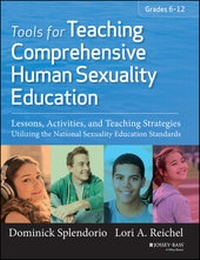
Tools for Teaching Comprehensive Human Sexuality Education, Enhanced Edition
Beschreibung

This book contains ready-to-use lesson plans referencing both the National Sexuality Education Standards and the National Health Education Standards, and is arranged into chapters by the seven topic areas outlined in the National Sexuality Education Standards. These include: anatomy and physiology, puberty and adolescent development, identity, pregnancy and reproduction, sexually transmitted infections, healthy relationships, and personal safety.
These dynamic 'pick and choose' lessons and activities have been field-tested in classrooms and workshops by the authors, who are recognized experts in this area. Many of the lessons contain an opening activity to immediately engage students, followed by student-centered learning experiences such as case studies, simulations, real-life scenarios, self-assessments, journals, and individual and group projects/presentations.
- Features lessons that incorporate the essential knowledge and skills to empower students to make healthy decisions related to their sexual health
- Includes performance indicators detailed what students should know and be able to do by the end of grades eight and twelve
- Offers supplementary web resources and assessment projects, as well as 'Home-School Connection' assignments to support family communication about sexuality
Dominick Splendorio, MS, taught middle and high school health and sexuality education for over 30 years in New York State. He is the founder of Prime Time Health, an educational consulting firm specializing in health-related presentations for schools, state education departments, and professional conferences.
Lori A. Reichel, PhD, has twenty plus years' experience teaching health education with award recognition at state and national levels. She is currently an assistant professor at the University of Wisconsin-Lacrosse in the Health Education and Health Promotion Department.
Weitere Details
Weitere Ausgaben
Andere Ausgaben
Inhalt
1
Anatomy and Physiology
An effective sexuality program provides a comprehensive view of sexuality, beginning with medically accurate information. The lessons and learning experiences in this chapter establish a baseline of appropriate terminology as well as a foundation for understanding more complex issues found in subsequent chapters. By participating in student-centered, interactive activities within a supportive classroom environment, students will learn accurate information and develop their skills. These lessons serve as a starting point for sexuality discussions, leading to lessons on pubertal changes found in Chapter Two.
Tips on How to Teach Students Effectively
Creating a safe, nonthreatening environment is essential for the success of any sexuality education program. The most effective sexuality educators are those who are comfortable with talking about sexuality, knowledgeable about the subject, and honest and nonjudgmental in their responses to students. Facilitation of student-friendly discussions is also needed.
To help educators acquire or strengthen their skills, professional development conferences and workshops are available. There are also online courses and webinars to keep teachers up to date on the latest research, effective teaching strategies, national and state standards, and advances in technology. It is recommended that you refer to local and state organizations for information on available trainings and resources.
Other tips to consider when teaching sexuality education lessons include
- Addressing both the positive and negative aspects of sexuality, rather than simply using “scare tactics.”
- Talking on the students' level. If students only know “slang” terms (not vulgarity) when asking legitimate questions, you can initially accept their questions while encouraging the use of medically accurate and classroom-appropriate terminology for future discussions.
- Being cautious of using terminology that implies heterosexuality. Many of the lessons in this book use the word “partner” rather than “boyfriend” or “girlfriend,” particularly in scenarios or role-plays. By using “gender-neutral” names (“Chris” and “Pat”), you are less likely to disenfranchise students who are gay, lesbian, or bisexual.
- If possible, arranging chairs in a semicircle or “concentric horseshoe” setup so that students can see one another during class discussions.
- Allowing for both sexes to participate in activities equally. Although it may sometimes be appropriate to separate males and females for certain topics or activities, allowing lessons to be coed encourages open lines of communication, the sharing of feelings, and different points of view.
- Not moralizing or judging. A teacher's role is to encourage health-enhancing behaviors, not to impose personal values on students. Set personal boundaries for the sharing of personal information and encourage students to do the same.
- Being sensitive to students' personal histories. It is possible that some issues raised during class discussions (for example, sexual abuse, unplanned pregnancy, or STIs) may create discomfort for some students. Inform students of available trusted adults within in the school and community for counseling and referrals.
- Taking a positive approach to sexuality education, focusing on what is sexually healthy rather than sexually unhealthy, and acknowledging that sexual feelings are normal and natural.
Most of the lessons in Chapter One are designed for middle school students, providing basic information on the female and male reproductive anatomy. Some lessons, however, may be used as a review with high school students or as a diagnostic assessment of what students know and are able to do.
Also, as with all lessons presented in the classroom setting, you need to evaluate these lessons before integrating them into an existing curriculum. You should follow state mandates and local guidelines, and should obtain approval of a district advisory committee or curriculum review panel to determine which lessons are most appropriate for the intended population.
Lesson 1: People Search
Level: Middle school Time: 30–40 minutes
National Health Education Standard
1. Core Concepts
National Sexuality Education Standards: Performance Indicator
- Describe male and female sexual and reproductive systems including body parts and their functions.
Rationale
Sometimes people do not feel comfortable talking about their sexual body parts. This interactive activity introduces students to the skill of communicating respectfully and without embarrassment about reproductive anatomy. It will also serve as a diagnostic assessment of what students already know and do not know about the male and female reproductive systems.
Materials and Preparation
Copies of “Reproductive Anatomy People Search” worksheet Copies of “Reproductive Anatomy and Physiology Vocabulary” worksheet
Procedure
1. Explain to students that they are going to be playing a game similar to bingo. It will be a people search in which they will try to find classmates who can answer questions or who fit particular descriptions. The topic will be male and female reproductive anatomy. Ask students to be respectful of their classmates, whether they can answer a question or not. 2. Distribute the “Reproductive Anatomy People Search” worksheet, and ask if students understand the task. Reinforce that they should not print their name on someone's paper unless they can justify what is written. Also, tell them that the activity is being timed, and that they will have five minutes to get all the boxes filled in. If someone does, that student should yell out “BINGO!” 3. If someone gets all sixteen boxes filled with names and yells “bingo,” that student should come to the front of the room. If no one gets all the boxes filled in after five minutes, call “TIME!” and have all students sit down. Ask how many people almost got all the boxes filled. Find the student who got the most boxes filled in and have her come to the front of the room. If there is a tie, have both students come to the front of the room. 4. Begin going over the sheet by asking the “bingo winner” who signed the first box (top left). When that person's name is given, call on him to give the answer. In this case, the answer should be “fallopian tubes.” Ask the person who signed that box to explain what he knows about the fallopian tubes and fertilization. Check for understanding and accuracy. Expand on the answer by asking the class to add anything not mentioned by the person who signed his name. 5. Continue with the same procedure given in the previous step, going over all boxes and statements. Facilitate discussions and clarify any misinformation. 6. At the end of the game, when the last box has been discussed, thank the bingo winner and the class for participating in the activity. 7. Hand out the “Reproductive Anatomy and Physiology Vocabulary” worksheet. 8. Pair off students or form small groups. Based on the information discussed in the people search, students should complete the worksheet by reading each definition and choosing the correct vocabulary word from the word bank to match the definition with the correct term. For your reference, the worksheet's answer key is as follows: 1. Fallopian tubes 2. Clitoris 3. Uterus 4. Testes 5. Penis 6. Menstruation 7. Breasts 8. Cervix 9. Scrotum 10. Labia 11. Semen 12. Vagina 13. Urethra 14. Erection 15. Ejaculation 9. Conclude the lesson by asking the processing questions. 10. For an optional assignment, any student who wishes to do so may bring his people search sheet home and discuss the activity and content with a parent or guardian. If the adult signs the sheet, confirming she discussed the answers with her child, the student obtains five extra credit points on the next test or quiz.
Processing
1. What is one thing you learned today that you did not know or understand before? 2. Where did you learn about your body? Where did you learn about the bodies of members of the opposite sex? 3. Who has spoken with a parent or guardian about sex? What was it like? Comfortable or uncomfortable? Who brought up the topic? 4. How many of you talked about this topic in elementary school? Who taught it? Was the conversation comfortable or uncomfortable? Why?
Assessment
- Students correctly provide information on the male and female reproductive systems during the people search.
- Students accurately complete the “Reproductive Anatomy and Physiology Vocabulary” worksheet.
- Students complete the optional assignment and have it signed...
