

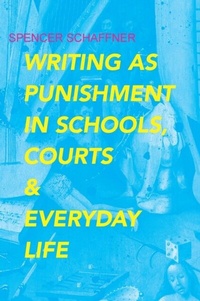
Writing as Punishment in Schools, Courts, and Everyday Life
1. Auflage
Erschienen am 11. Juni 2019
144 Seiten
978-0-8173-9236-9 (ISBN)
Beschreibung
A probing and prescient consideration of writing as an instrument of punishment
Writing tends to be characterized as a positive aspect of literacy that helps us to express our thoughts, to foster interpersonal communication, and to archive ideas. However, there is a vast array of evidence that emphasizes the counterbelief that writing has the power to punish, shame, humiliate, control, dehumanize, fetishize, and transform those who are subjected to it. In Writing as Punishment in Schools, Courts, and Everyday Life, Spencer Schaffner looks at many instances of writing as punishment, including forced tattooing, drunk shaming, court-ordered letters of apology, and social media shaming, with the aim of bringing understanding and recognition to the coupling of literacy and subjection.
Writing as Punishment in Schools, Courts, and Everyday Life is a fascinating inquiry into how sinister writing can truly be and directly questions the educational ideal that powerful writing is invariably a public good. While Schaffner does look at the darker side of writing, he neither vilifies nor supports the practice of writing as punishment. Rather, he investigates the question with humanistic inquiry and focuses on what can be learned from understanding the many strange ways that writing as punishment is used to accomplish fundamental objectives in everyday life.
Through five succinct case studies, we meet teachers, judges, parents, sex traffickers, and drunken partiers who have turned to writing because of its presumed power over writers and readers. Schaffner provides careful analysis of familiar punishments, such as schoolchildren copying lines, and more bizarre public rituals that result in ink-covered bodies and individuals forced to hold signs in public.
Schaffner argues that writing-based punishment should not be dismissed as benign or condemned as a misguided perversion of writing, but instead should be understood as an instrument capable of furthering both the aims of justice and degradation.
Weitere Details
Weitere Ausgaben
Inhalt
- Intro
- Contents
- Acknowledgments
- Introduction
- One. Punishing Children with Writing
- Two. Shame Parades
- Three. Writing on the Wasted
- Four. Forced Tattooing
- Five. Writing, Self-Reflection, and Justice
- Conclusion: Seeing Writing in a Dim Light
- Notes
- Works Cited
- Index
