

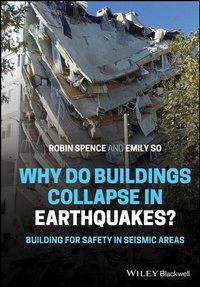
Why Do Buildings Collapse in Earthquakes? Building for Safety in Seismic Areas
Beschreibung
Learn from the personal experience and insights of leading earthquake engineering specialists as they examine the lessons from disasters of the last 30 years and propose a path to earthquake safety worldwide
Why Do Buildings Collapse in Earthquakes?: Building for Safety in Seismic Areas delivers an insightful and comprehensive analysis of the key lessons taught by building failures during earthquakes around the world. The book uses empirical evidence to describe the successes of earthquake engineering and disaster preparedness, as well as the failures that may have had tragic consequences.
Readers will learn what makes buildings in earthquake zones vulnerable, what can be done to design, build and maintain those buildings to reduce or eliminate that vulnerability, and what can be done to protect building occupants. Those who are responsible for the lives and safety of building occupants and visitors--architects, designers, engineers, and building owners or managers--will learn how to provide adequate safety in earthquake zones. The text offers useful and accessible answers to anyone interested in natural disasters generally and those who have specific concerns about the impact of earthquakes on the built environment.
Readers will benefit from the inclusion of:
* A thorough introduction to how buildings have behaved in earthquakes, including a description of the world's most lethal earthquakes and the fatality trend over time
* An exploration of how buildings are constructed around the world, including considerations of the impact of climate and seismicity on home design
* A discussion of what happens during an earthquake, including the types and levels of ground motion, landslides, tsunamis, and sequential effects, and how different types of buildings tend to behave in response to those phenomena
* What different stakeholders can do to improve the earthquake safety of their buildings
The owners and managers of buildings in earthquake zones and those responsible for the safety of people who occupy or visit them will find Why Do Buildings Collapse in Earthquakes? Building for Safety in Seismic Areas essential reading, as will all architects, designers and engineers who design or refurbish buildings in earthquake zones.
Weitere Details
Weitere Ausgaben
Personen
Robin Spence is a Structural Engineer, Professor Emeritus of Architectural Engineering at the University of Cambridge, a Fellow of Magdalene College and a Director of Cambridge Architectural Research Ltd. He was President of the European Association for Earthquake Engineering (2002-2006), Mallet-Milne Lecturer at the Institution of Civil Engineers (2007), and Nicholas Ambraseys Lecturer at the European Conference on Earthquake Engineering, Istanbul, (2014).
Emily So is Reader in Architectural Engineering at the University of Cambridge and a chartered civil engineer. She is Director of the Cambridge University Centre for Risk in the Built Environment, Director of Studies and Fellow in Architecture at Magdalene College and a Director of Cambridge Architectural Research Ltd. She is the 2010 Shah Family Innovation Prize winner, an award given annually by the Earthquake Engineering Research Institute (EERI).
Inhalt
Acknowledgments
Chapter 1. Introduction: why this book?
1.1 Earthquakes - an underrated hazard
1.2 Earthquakes, buildings, people
1.3 The authors' experience of earthquake risk assessment
1.4 Aims of this book
1.5 Outline of the book
References
Chapter 2. How do buildings behave in earthquakes?
2.1 Learning from earthquakes
2.2 Significant earthquakes since 2000
2.3 What can we learn from these significant earthquakes?
2.4 Earthquake losses in rich and poor countries
2.5 Are earthquake losses decreasing over time?
References
Chapter 3. How are buildings constructed in earthquake zones?
3.1 Introduction
3.2 Built form, climate and earthquake resistance
3.3 Building construction types by earthquake zone
Box 3.1 Profile: Randolph Langenbach
3.4 Summary
References
Chapter 4. What happens in an earthquake?
4.1 What is an earthquake?
4.2 Volcanic earthquakes and Induced seismicity
4.3 How earthquakes travel through different media
4.4 Secondary Hazards
Box 4.1 Profile: Toshitaka Katada
4.5 Compound threats
References
Chapter 5. How do different forms of construction behave in earthquakes?
5.1 Introduction: range and classification of building construction types
5.2 Masonry construction
Box 5.1 Profile: Laurie Baker
5.3 Reinforced concrete construction
5.4 Timber frame construction
5.5 Steel frame construction
5.6 Comparing the vulnerability of different construction types
References
Chapter 6 How is the population affected?
6.1 Causes of earthquake casualties
6.2 Casualties due to building collapses
6.3 Survivability of an occupant in a building
6.4 Other causes of casualties
6.5 How can we estimate the number of injured and killed in an earthquake?
6.6 Estimating fatalities due to building collapses
6.7 Estimating casualties from secondary hazards and cascading effects
6.8 The way forward
References
Chapter 7. How can buildings be improved?
7.1 Introduction
7.2 Design of engineered buildings
7.3 Strengthening existing buildings
7.4 Building for safety programmes
Box 7.1 Profile: Amod Dixit
Box 7.2 Profile: Rajendra and Rupal Desai
7.5 Public awareness of earthquake risk: creating a safety culture
References
Chapter 8. Successes and failures in earthquake protection: a country comparison
8.1 Introduction: the survey
8.2 High achievers
8.3 Limited achievers
8.4 Continuing and growing risks
8.5 Country comparison of unsafe structures
8.6 Comparison of the country groups
Acknowledgements
References
Chapter 9. The way forward: what part can different actors play?
9.1 International agencies and global initiatives
9.2 Governments
9.3 Businesses and organisations
9.4 Homeowners and individual citizens
Box 9.1. Profile: Tracy Monk
9.5 Scientists and Engineers
Box 9.2 Profile: Edward Ng
Box 9.3 Profile: Lucy Jones
9.6 Non-government organisations
9.7 Insurers
9.8 The way forward
References
1
Introduction: Why This Book
1.1 Earthquakes - An Underrated Hazard
Earthquakes have been a threat to human habitation throughout history, but until relatively recently, their causes were poorly understood. In the pre-scientific era, they were commonly ascribed to divine intervention. By the time of the Lisbon earthquake in 1755, there were many who understood that earthquakes had natural causes, but the mechanism remained unexplained, and the supernatural explanation was widely proclaimed, especially from church pulpits (Udias and Lopez Arroyo 2009). And over 150 years later, according to observer Axel Munthe (1929), the inhabitants of Messina, destroyed by a massive M7 earthquake in 1908, cried 'Castigo di Dio' ('punishment from God').
Only with the development of plate tectonics in the twentieth century has it become understood that earthquakes are associated with active faults in the earth's crust, with most of the largest occurring at the boundaries of the tectonic plates as they interact with each other (as explained in Chapter 4). We can now identify with some precision whereabouts on the earth's surface large earthquakes will occur. From measurements of the movements at plate boundaries, and from the historical record, we can make estimates of the largest magnitude event which can occur on a fault section, and approximately, the frequency with which events of different magnitude will occur. But the largest events commonly have return periods of several centuries or more (Bilham 2009), and science is still unable to predict, even to within a few decades, when the next large earthquake on any fault section will occur.
There is some evidence that the global earthquake mortality rate (deaths per 100 000 of the world's population) has been rather gradually reducing over the last century or so. But it is a very slow rate of improvement, and the variation from decade to decade is very large. The first decade of the twenty-first century was a bad one, with several earthquakes resulting in more than 50 000 deaths. Yet, over the same timescale, death rates from many other causes, such as infectious diseases and road accidents, have been very significantly reduced (ourworldindata.org/causes-of-death 2020). This has been made possible with the introduction of public health programmes and protection measures, backed by government legislation and action programmes, but supported and implemented by the general public. Such programmes could similarly be applied to reduce earthquake risk, but in many countries most at risk, this has not so far happened. Why is this?
The greatest impact from earthquakes is nearly always the damage to buildings (and other built artefacts - roads, buildings, dams) from the ground shaking caused by the propagation of the earthquakes' waves through the earth's crust, which can result in destruction over a wide area. Over the twentieth century, understanding the nature of ground motion and the way in which this is transmitted through structures has enabled engineers to develop ways to build buildings which are able to withstand the expected ground shaking with limited damage. This understanding, gradually increasing through the development of structural engineering theory and practice, combined with detailed field investigation of the effects of successive earthquakes has enabled codes of practice for building design to be developed, and these are nowadays mandatory for new construction in most cities of the world.
But, as the world's population grows, and urbanisation increases in pace, there are many places where new buildings are being constructed without any reference to good engineering practice for earthquake resistance.
This is partly because those responsible for constructing the new buildings are unaware or possibly unconcerned that a large earthquake may occur any time soon, and building controls are lax. It is also due to lack of education, information, skill and sense of urgency on the part of builders and building owners (Bilham 2009; Moullier and Krimgold 2015).
In rural areas of many poor countries, buildings are largely constructed using highly vulnerable materials such as adobe and unreinforced masonry. Poverty and lack of understanding, combined with a vast demand for new dwelling places, are thus fuelling the creation of a series of future disaster scenarios (Musson 2012).
In order to understand why buildings collapse in earthquakes and to find out what we can do about it, we must look at each of the three ingredients of the problem: earthquakes, buildings and people.
1.2 Earthquakes, Buildings, People
One of the reasons why earthquake risk does not get acted on is because it is not well understood by the public. Although the likely locations of large earthquakes are now known, the timescale of their recurrence is very long, and for most people at risk the last occurrence of 'the big one' for which they need to be prepared is many centuries ago, often before the present cities existed. People may be aware that they are living in an earthquake zone but fail to appreciate the possibility of events much larger than recent experience. In 2008, a modelling exercise, the California Shakeout, was done to support earthquake protection action for Southern California, which is threatened by a large earthquake on the San Andreas Fault (Jones and Benthian 2011). Lucy Jones, who led the modelling team speaks of the 'normalisation bias, the human inability to see beyond ourselves, so that what we experience now or in our recent memory becomes our definition of what is possible'. Seismologists had identified much greater earthquakes in the past than those in recent memory, but the last great earthquake on that section of the San Andreas Fault was in 1688. The modelling exercise, based on a plausible, but by no means worst-case scenario magnitude 7.8 earthquake on the southern section of the San Andreas Fault, showed that around 1500 buildings would collapse, and 300 000 would be severely damaged, causing around 1800 deaths and $213 billion losses. Fires would break out and could become uncontrollable. And the disruption caused to roads and pipelines would cause massive disruption to business, lasting for months. This modelling exercise led to a huge public awareness and preparation programme which has resulted in much reduced risks in California over the past decade.
But considerably more devastating consequences face many of the growing cities in other earthquake zones, particularly in Asia. The southern edge of the Eurasian Plate, stretching from the Mediterranean to China, and including Myanmar and Indonesia, is responsible for 85% of the world's historic earthquake deaths. And this is a region in which cities are today growing rapidly both in size and in number, fuelled by global population rise and urbanisation. Seismologist Roger Musson points to the risk in Tehran, today a city of 12 million people. The last major earthquake on the North Tehran Fault, passing close to the city centre, was in 1834 at a time when Tehran was a small town: an earthquake of M > 7 hitting Tehran today could cause as many as 1.4 million deaths. And seismologist Roger Bilham (2009) has estimated that a direct hit on a megacity (>10 million population) somewhere in the world once a century is now statistically probable, with a possible death toll exceeding one million, because of the combination of hazardous locations and structural vulnerability. The World Bank estimates that three billion people will live in substandard housing by 2030. By 2050, the UN projects that two-thirds of the world's population, around 7 billion people, will live in urban areas.
Unfortunately, because the threat to each city is seen as remote, protection from earthquakes is given a lower priority than other issues. Few households prioritise spending on safety from future earthquakes above pressing immediate concerns, like providing extra space or better comfort, unless required to do so by regulation. And elected governments tend to look for expenditure programmes and new regulations which will give returns within their current tenure of office, despite evidence that money spent on disaster mitigation often avoids much greater losses over time. For this reason, general development expenditure is given priority over disaster risk mitigation. And even within that part of government budgets devoted to natural disasters, those from other natural hazards are often given priority. Windstorm and flood damage are more immediate risks, particularly as these are becoming worse as a result of climate change.
Optimistically and opportunistically, the climate change agenda has provided a global focus on resilience of communities to natural threats. It is recognised that especially in developing countries, cycles of disasters have depleted decades of progress made in development. The deaths and destruction from earthquakes are preventable. Whilst the hazard itself is natural, the disasters are largely man-made, and completely preventable with proactive interventions.
1.3 The Authors' Experience of Earthquake Risk Assessment
The overall aim of our work over four decades at the University of Cambridge's Department of Architecture and at Cambridge Architectural Research Ltd has been to understand the vulnerability of buildings to earthquakes globally, in order to...
