

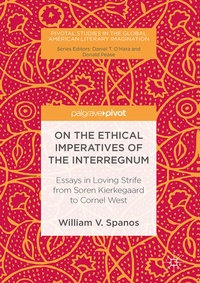
On the Ethical Imperatives of the Interregnum
Beschreibung

This book is an autobiographical meditation on the way in which the world's population has been transformed into a society of refugees and émigrés seeking -indeed, demanding- an alternative way of political belonging. Focusing on the interregnum we have precariously occupied since the end of World War II-and especially after 9/11- it constitutes a series of genealogical chapters that trace the author's journey from his experience as a prisoner of war in Nazi Germany to the horrific fire-bombing of Dresden in February 1945. In doing so, it explores his search for an intellectual vocation adequate to the dislocating epiphany he experienced in bearing witness to these traumatising events. Having subsequently lost faith in the logic of belonging perpetuated by the nation-state, Spanos charts how he began to look in the rubble of that zero zone for an alternative way of belonging: one in which the old binary -whose imperative was based on the violence of the Friend/enemy opposition- wasreplaced by a paradoxical loving strife that enriched rather than negated the potential of each side. The chapters in this book trace this errant vocational itinerary, from the author's early undergraduate engagement with Kierkegaard and Heidegger to Cornel West, moving from that disclosive occasion in the zero zone to this present moment.
Rezensionen / Stimmen
"In Loving Strife, Spanos writes something like an intellectual autobiography in a series of essays, each of which revisits predecessors and contemporaries whose work has mattered in his life and career. All the more remarkable for the circumstances of their composition, these essays align an important intellectual's sense of his engaged and creative inheritance with the modern minds that mattered most to his life and work." (Paul A. Bové, Distinguished Professor, University of Pittsburgh, USA)
"The history of ideas is sometimes viewed as an infinite conversation. In this book, William V. Spanos discloses the ways in which his own thinking has emerged from spirited conversations with others via a process he calls "a loving strife." Reflecting on his encounters with ten 'inaugural' figures-from Søren Kierkegaard to Hannah Arendt, Edward Said, and Cornel West-Spanos provides a genealogy both of his own critical theory and the postnational world in which we live." (Robert T. Tally Jr., Associate Professor of English, Texas State University, USA)
Weitere Details
Weitere Ausgaben
Andere Ausgaben
Person
William V. Spanos is Distinguished Professor Emeritus at Binghamton University (State University of New York), USA, and the founding editor of boundary 2:a journal of postmodern literature and culture which he edited from 1970-1987. He is the author of over hundred essays and many books on subject ranging from modernist and postmodernist literature, poststructuralist theory, and New Americanist studies.
Inhalt
Preface.- Chapter 1: Retrieving Kierkegaard for the Post-9/11 Occasion: A Late Meditation on the Secular.- Chapter 2: Heidegger and Das Nichts : An Autobiographical Meditation on the Question of the Nothing.- Chapter 3: The Enigma of T. S. Eliot: An Autobiographical Essay on the Contradictions between His Poetry and Prose.- Chapter 4: On the Place of Excrement: My Relation to the Poetry of William Butler Yeats.- Chapter 5: Hannah Arendt, Non-Jewish Jew: Our Contemporary Chapter 6: Edward W. Said and William V. Spanos: A Contrapuntal Affiliation.- Chapter 7: Robert Kroetsch, Play, and the Specter: A Meditation on a Friendship.- Chapter 8: A "Mad Generosity: Retrieving John Gardner.- Chapter 9: Robert Creeley, Quintessential American Poet: A Dialogue with a Departed Friend.- Chapter 10: Cornel West: My Black-American Brother.- Index.
