

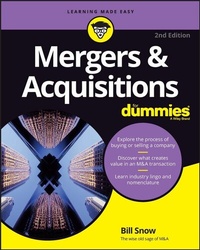
Mergers & Acquisitions For Dummies
Beschreibung

Mergers & Acquisitions For Dummies provides useful techniques and real-world advice for anyone involved with - or thinking of becoming involved with - transactional work. Whether you are a transactions pro, a service provider tangentially involved in transactions, or a student thinking of becoming an investment banker, this book will provide the insights and knowledge that will help you become successful. Business owners and executives will also find this book helpful, not only when they want to buy or sell a company, but if they want to learn more about what improves a company's value. The evaluation process used by M&A professionals to transact a business sale is often quite different from the processes used by owners and executives to manage those businesses.
In plain English terms that anyone can understand, this book details the step-by-step M&A process, describes different types of transactions, demonstrates various ways to structure a deal, defines methods to identify and contact targets, provides insights on how to finance transactions, reveals what helps and hurts a company's valuation, offers negotiating tips, explains how to perform due diligence, analyzes the purchase agreement, and discloses methods to help ensure the combined companies are successfully integrated. If you're getting involved with a merger or an acquisition, this book will help you gain a thorough understanding of what the heck is going on. Updates to this second edition include quality of earnings reports, representation and warranty insurance, how to hire investment bankers, changes to the offering documents, the rise of family offices, and the ubiquity of adjusted EBITDA (earnings before interest, tax, depreciation, and amortization) as a basis for valuation.
* Understand the merger and acquisition process in a simple, easy-to-understand manner
* Learn the nomenclature and terminology needed to talk and act like a player
* Determine how to hire the people who will help you conduct M&A deals
* Discover tips on how to successfully negotiate transactions
Mergers & Acquisitions For Dummies is a great choice for business owners and executives, students, service providers, and anyone interested in M&A transactions.
Weitere Details
Weitere Ausgaben
Andere Ausgaben
Person
Inhalt
Part 1: Planning to Do a Transaction 9
Chapter 1: Explaining Mergers and Acquisitions 11
Chapter 2: Learning M&A Rules and Decorum 27
Chapter 3: Utilizing the M&A Process 37
Chapter 4: Making Sense of the Economics of M&A 43
Chapter 5: Finding Buyers and Sellers 67
Part 2: Marketing the Transaction 101
Chapter 6: Explaining and Influencing Valuation 103
Chapter 7: Creating and Reviewing an Offering Document 129
Chapter 8: Reading and Writing the Offers 161
Part 3: Selling the Transaction 177
Chapter 9: Selecting Advisors 179
Chapter 10: Hiring an Investment Banker 193
Chapter 11: Arranging Meetings Between Buyer and Seller 207
Chapter 12: Financing the Transaction 219
Chapter 13: Learning How to Negotiate Successfully 245
Part 4: Concluding and Combining 267
Chapter 14: Confirming Due Diligence 269
Chapter 15: Documenting the Transaction 283
Chapter 16: Closing and Integrating the Acquisition 293
Chapter 17: Ensuring a Successful Acquisition 309
Part 5: The Part of Tens 325
Chapter 18: Ten Transaction Pitfalls 327
Chapter 19: Ten Reasons Acquisitions Fail 331
Chapter 20: Ten Lurking Problems for Sellers 335
Index 339
Introduction
Welcome to the second edition of Mergers & Acquisitions For Dummies! When I wrote the first edition, way back in the fall of 2010, I was excited to memorialize the ins and outs of the mergers and acquisitions (M&A) profession. This book was intended in large part as a guide for anyone interested in M&A - service providers, students, business owners - but in no small part I wrote the book for me. I did not fully comprehend that truth until the spring of 2011, when the publisher sent me a copy of the book, right before it was released. I was at home that Friday, and I marveled at the outcome of my hard work. Thanks to technology, experience, and opportunity, I was able to convert abstract thoughts into something tangible - a book. As I excitedly held that book in front of my housekeeper (she didn't care), I reflected on what I'm good at and what I'm not good at, and as I performed that bit of self-analysis, I began to examine how I learn.
The process of writing that first edition required me to think, consider, evaluate, and pithily explain the logic and reasoning and processes of the seemingly innumerable facets of M&A. I was already familiar with them, of course; M&A is how I make my living, but I discovered when I wrote about a subject I already knew well, I made new connections, analyzed known aspects in different ways, and uncovered fresh methods to explain what I already knew . or thought I knew. This process of introspection unveiled my preferred method of learning: I experience, I learn from those experiences, then I write about those experiences, and as I write, I learn even more. I wish I would have figured that out a long time ago.
The subject of this book has a long shelf life, and that's both a good and bad thing. The standards of the industry - along with its attendant terms, processes, and nomenclature - don't change much over time. That first edition remained relevant and valuable for years, a boon for the consumer, but that lack of change reduced the need to constantly update the book - a bummer for your dear ol' author, a mere humble scribe who wishes he had more opportunities to write. In other words, if you have the first edition and now are in the throes of an inner debate about buying the new version, proceed with confidence! More than a decade has elapsed from when the initial published work made its debut. The industry has seen some changes, and its attendant terms, processes, and nomenclature have evolved.
This new version of the book is a complete overhaul of the material from that first edition. Yes, some of the old text survives, but much of it has been updated, condensed, adjusted, relocated, and repurposed - tweaked, to use the parlance of today. This means, on occasion, fragments of an attempt at some literary fancy-pantsism in the first book will rear its head in the revised book, including traces of a partially developed theme. If you read the first edition and noticed occasional references to the classical elements of earth, water, air, and fire, that was not happenstance. I wrote that version in five "essential" parts, as I styled it in the original introduction, because I wanted each of the first four parts to reference one of the four elements of the ancients.
The fifth part - the fifth "essence," if you will - was the quintessential part of the book. It covered integration issues and provided guidance about what happens after the culmination of all that M&A work is realized. This is when plans come to fruition and conclusions are reached. This fifth element, the ether of the stars, as Aristotle posited, was the stuff of dreams, the aspiration of all that hard work to acquire, combine, and integrate companies. Beyond the beyond! It was a grandiose theme! Unfortunately, due to time constraints, I did not have the ability to go back and give the manuscript the ol' once-over and fully develop that theme, a literary device concocted for no other reason than to have a bit of fun. Oh, well. Publisher deadlines and all that.
This new version (sadly or happily, depending on your opinion of literary fancy-pantsism) does not feature a fully developed classical elements theme, so you will be unable to witness the firepower of a fully armed and operational For Dummies book - oh, wait a minute, never mind, sorry for the random Star Wars quote - instead, this second edition is chock-full o' material I have used in pitches to prospective clients and in presentations to business groups. Some of the changes the M&A industry has seen in the past decade include the growing importance of sell-side quality of earnings reports, the commonality of reps-and-warranties insurance to indemnify transactions, format changes to offering documents, the use of automation, the acceptance of virtual meetings and plant tours, the rise of family offices, higher valuations, a greater emphasis on environmental issues, and more. Perhaps the most telling change in the past decade is the focus on adjusted EBITDA - in the humble opinion of this humble scribe, a Frankenstein's monster of the financial world if one ever existed. Commensurate with that increase in valuations - inflation, as some say - I've provided more detail and context about what helps and hurts valuation.
I have used much of this new material from coast to coast in the United States, in the Middle East, and in Southeast Asia. It is road-tested. That's right, gentle reader, that venerable For Dummies book created some exciting new opportunities for your dear ol' author, and for that reason alone, I will always be thankful to Wiley Publishing. Hopefully, this new version will afford me the opportunity to make M&A presentations to even more of the world. Contact me - my passport is up to date!
In that first edition, I envisioned myself as a wise old sage, a knowledgeable rogue, a worldly and experienced bon vivant, a raconteur of the professional ranks - you know, that person who all of us, if we've been lucky, have happened upon at certain points in our lives. That wise old sage is the one who says, "Forget all that other stuff - here's what you really need to know." Though I still enjoy that role, the thrust of this overhauled book is the essence at the heart of every M&A transaction: What is the darn thing worth?
In almost every transaction I've worked on, the seller of a company has told me, "I wish I had known years ago all these things you're telling me now. I would have run my company better." The mergers and acquisitions process, which is described in detail in this book, reveals a tremendous amount of information for owners and executives of companies. The evaluation process used by M&A professionals to transact a business sale is often quite different from the processes used by owners and executives to manage those businesses.
Understanding the process of M&A, therefore, is not only beneficial to people in the business or aspiring to enter the business; that knowledge is equally insightful to owners and executives who are interested in learning what they can do to run their businesses better, more efficiently, and more effectively. If those criteria are met, the enterprise will have more value to both the seller and the buyer. And value, gentle reader - specifically, how both sides of a transaction determine, express, and appreciate that value - is what the exciting world of M&A is all about.
About This Book
Although the M&A process, like any sales process, involves a step-by-step approach, I've written this book so that you can simply refer to whatever section you need to read. Skim the index and table of contents and then go directly to the information you need.
My hope is that this book provides some insights for both buyers and sellers by helping each side see things from the other's perspective. Understanding the other side's motivation and rationale is the key to getting a deal done.
Conventions Used in This Book
I use a few conventions throughout this book to help make it more accessible:
- I format new words in italic and accompany them with definitions.
- Bold text highlights the active parts of numbered steps and signals the keywords in bulleted lists.
- Because mergers and acquisitions is kind of an unwieldy phrase, I often use the abbreviation M&A. You see it in the field all the time anyway, so why not use it here?
- When I say buyer, I'm referring to the individual or executives in a company seeking to acquire another company. When I say seller, I'm referring to the owner of a company or the owner's representatives (executives or advisors).
What You're Not to Read
My goal for this book was to write an easy-to-read, introductory look at the world of mergers and acquisitions. At times, however, some of the text may be a bit technical-sounding and in-depth, so I turned those parts into sidebars (those shaded gray boxes) or marked them with the Technical Stuff icon. You don't need to read those parts unless you really, really, really, really want to know more.
Foolish Assumptions
I assume you bought this book for any number of reasons:
- You're a business owner or an executive of a middle market or lower middle...
