

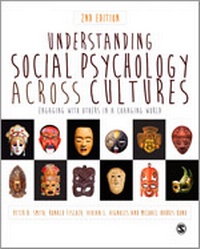
Understanding Social Psychology Across Cultures
Engaging with Others in a Changing World
2. Auflage
Erschienen am 22. August 2013
480 Seiten
978-1-4462-8601-2 (ISBN)
Beschreibung

Understanding Social Psychology Across Cultures Second Edition starts by asking why social psychology needs a cross-cultural perspective. It then examines cultural differences and their origins, before addressing traditional social psychological themes cross-culturally, for example group processes, self and identity, intergroup relations. Themes of contemporary relevance including migration, ethnic conflict and climate change are also covered. Key features:
Presentation of concepts and theories made accessible to the reader using practical examples and everyday life experiences from diverse parts of the world
Biographical portraits of key researchers in the field
Coverage of the appropriate methods for conducting state-of-the-art cross-cultural research
This textbook is appropriate for students of social and cross-cultural psychology. It will also interest practitioners wanting to understand the impact of culture on their fields of work, such as international relations, social policy, health promotion, ethnic relations and international business.
Presentation of concepts and theories made accessible to the reader using practical examples and everyday life experiences from diverse parts of the world
Biographical portraits of key researchers in the field
Coverage of the appropriate methods for conducting state-of-the-art cross-cultural research
This textbook is appropriate for students of social and cross-cultural psychology. It will also interest practitioners wanting to understand the impact of culture on their fields of work, such as international relations, social policy, health promotion, ethnic relations and international business.
Rezensionen / Stimmen
'... For anyone eager to learn about how members of different cultures are fundamentally different - and yet sometimes remarkably similar - this book provides a great read.'Roy F. Baumeister
Florida State University, Tallahassee, USA
'Understanding Social Psychology across Cultures 2e is an intellectual tour de force of the latest developments in cross-cultural social psychology. It is an essential resource for anyone interested in culture and human behavior.'
Michele J. Gelfand
University of Maryland, College Park, USA
'The new edition of this leading textbook in cross-cultural social psychology is the perfect introduction to the field. It has extraordinarily broad and up-to-date coverage of virtually all the important topics that have been studied.'
Shalom H. Schwartz
Hebrew University of Jerusalem, Israel By far the most interesting section of the book for me was the third one entitled "The World in Flux." Here, speech, levels of contact and group behaviour are brought together in plausible narrative at every level from individual interactions to intra- and intergroup dynamics. Acculturation, coping with cultural identity threat as well as bicultural identity development and integration are explored, relevant to many of today's burning cultural conflicts. What is the impact of globalization and its subtext of concomitant modernity and economic pressures in the mobility of people and cultural discourse? -- Dr. George F. Simons
Alle Preise
Weitere Details
Auflage
Second Edition
Sprache
Englisch
Verlagsort
London
Großbritannien
Zielgruppe
Für höhere Schule und Studium
ISBN-13
978-1-4462-8601-2 (9781446286012)
Copyright in bibliographic data and cover images is held by Nielsen Book Services Limited or by the publishers or by their respective licensors: all rights reserved.
Schweitzer Klassifikation
Weitere Ausgaben
Andere Ausgaben
Peter B. Smith | Ronald Fischer | Vivian L. Vignoles
Understanding Social Psychology Across Cultures
Engaging with Others in a Changing World
Buch
08/2013
2. Auflage
SAGE Publications Ltd
101,70 €
Versand in 15-20 Tagen
Peter B. Smith | Ronald Fischer | Vivian L. Vignoles
Understanding Social Psychology Across Cultures
Engaging with Others in a Changing World
Buch
08/2013
2. Auflage
SAGE Publications Ltd
196,40 €
Versand in 15-20 Tagen
Personen
PETER K SMITH is Emeritus Professor of Psychology at Goldsmiths College, University of London, U.K. He has a first degree from University of Oxford, and a PhD from University of Sheffield. His main area of research is on school bullying. He is currently particularly interested in country differences and cross-cultural comparisons. He has also carried out research on children's play; and on the role of grandparents in children's development. He has been involved in bullying research for 30 years. In the UK he helped produce the national anti-bullying pack Don't Suffer in Silence (1994, 2nd edition 2000). He chaired COST Action IS0801 on Cyberbullying (2008-2012). He chaired an Indian-European Research Networking Programme on Bullying, Cyberbullying, and Pupil Safety and Well-Being (2012-2015). He is currently on the Management Committee of COST Action CA18115, Transnational Collaboration on Bullying, Migration and Integration at School Level. In 2015 he was awarded the William Thierry Preyer award for Excellence in Research on Human Development, by the European Society for Developmental Psychology, and in 2018 the Student Wellbeing and Prevention of Violence (SWAPv) Award, from Flinders University, Australia. In December 2018 he received an Honorary Doctorate from the University of Vienna.
Ronald Fischer was born near Leipzig in former East Germany in 1976, and completed his doctorate in cross-cultural psychology at the University of Sussex in 2002. He is currently Reader in Psychology at the Victoria University of Wellington, New Zealand. He has spent much of his adult life exploring remote corners of the world, carrying a laptop and camera. He has broad interests concerning the interplay between culture and human functioning in diverse ecological settings, tackling these big questions applying multivariate statistics and multilevel models. He has published more than 100 papers and book chapters, and is an Associate Editor of the Journal of Cross-Cultural Psychology. Vivian L. Vignoles was born near Rochester, UK, in 1973, and obtained his PhD in social psychology at the University of Surrey in 2000. He is currently Reader in Social Psychology at the University of Sussex. His principal research interests are in self and identity processes and cross-cultural psychology, especially understanding the interplay of cultural, contextual, and motivational influences on identity construction, and he is principal investigator of the Culture and Identity Research Network. He has published more than 30 journal articles and book chapters and one edited book, and is an Associate Editor of the European Journal of Social Psychology. Michael Harris Bond was born in Toronto, Canada in 1944, obtaining his PhD in social psychology from Stanford University in 1970. Working first at Kwansei Gakuin University in Japan, he next joined the Chinese University of Hong Kong, where he was Professor of Social Psychology for many years. He has contributed to many aspects of cross-cultural psychology, focusing particularly on Chinese social behavior, comparative studies of belief systems, and improvements in cross-cultural research methods. He has published more than 270 papers and books in the field. In 2009, he was appointed Chair Professor at Hong Kong Polytechnic University.
Ronald Fischer was born near Leipzig in former East Germany in 1976, and completed his doctorate in cross-cultural psychology at the University of Sussex in 2002. He is currently Reader in Psychology at the Victoria University of Wellington, New Zealand. He has spent much of his adult life exploring remote corners of the world, carrying a laptop and camera. He has broad interests concerning the interplay between culture and human functioning in diverse ecological settings, tackling these big questions applying multivariate statistics and multilevel models. He has published more than 100 papers and book chapters, and is an Associate Editor of the Journal of Cross-Cultural Psychology. Vivian L. Vignoles was born near Rochester, UK, in 1973, and obtained his PhD in social psychology at the University of Surrey in 2000. He is currently Reader in Social Psychology at the University of Sussex. His principal research interests are in self and identity processes and cross-cultural psychology, especially understanding the interplay of cultural, contextual, and motivational influences on identity construction, and he is principal investigator of the Culture and Identity Research Network. He has published more than 30 journal articles and book chapters and one edited book, and is an Associate Editor of the European Journal of Social Psychology. Michael Harris Bond was born in Toronto, Canada in 1944, obtaining his PhD in social psychology from Stanford University in 1970. Working first at Kwansei Gakuin University in Japan, he next joined the Chinese University of Hong Kong, where he was Professor of Social Psychology for many years. He has contributed to many aspects of cross-cultural psychology, focusing particularly on Chinese social behavior, comparative studies of belief systems, and improvements in cross-cultural research methods. He has published more than 270 papers and books in the field. In 2009, he was appointed Chair Professor at Hong Kong Polytechnic University.
Inhalt
Part One: Establishing the Framework
1. Why Does Social Psychology Need a Cross-Cultural Perspective?
2. Clarifying the Way Forward with Culture: Theories and Frameworks
3. The Origins and Dynamics of Culture
4. How to do Cross-Cultural Psychology
Part Two: Core Aspects of Social Psychology in Cross-Cultural Perspective
5. Personality and Social Context
6. Cognition, Motivation and Emotion
7. Self and Identity Processes
8. Cultural Norms and Socialisation Processes
9. Interpersonal Behaviour
10. Group Processes
Part Three: The World in Flux
11. Intercultural Contact
12. Intergroup Relations
13. Acculturation
14. Globalisation and Cultural Change
15. The Unfinished Agenda
1. Why Does Social Psychology Need a Cross-Cultural Perspective?
2. Clarifying the Way Forward with Culture: Theories and Frameworks
3. The Origins and Dynamics of Culture
4. How to do Cross-Cultural Psychology
Part Two: Core Aspects of Social Psychology in Cross-Cultural Perspective
5. Personality and Social Context
6. Cognition, Motivation and Emotion
7. Self and Identity Processes
8. Cultural Norms and Socialisation Processes
9. Interpersonal Behaviour
10. Group Processes
Part Three: The World in Flux
11. Intercultural Contact
12. Intergroup Relations
13. Acculturation
14. Globalisation and Cultural Change
15. The Unfinished Agenda
