

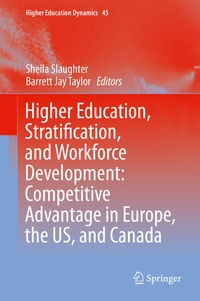
Higher Education, Stratification, and Workforce Development
Beschreibung
This work analyses how political economic shifts contribute to competition within higher education systems in the US, EU, and Canada. The authors highlight competition for prestige and public and private subsidies, exploring the consequences of these processes through theoretical and empirical analyses. Accordingly, the work highlights topics that will be of interest to a wide range of audiences. Concepts addressed include stratification, privatization of formerly public subsidies, preference for "high tech" academic fields, and the vocationalization of the curriculum (i.e., Science, Technology, Engineering and Mathematics: [STEM] fields, selected professions, and business) rather than the liberal arts or the Humboldtian vision of the university. Across national contexts and analytic methods, authors analyze the growth of national policies that see universities as a sub set of economic development, casting universities as corporate research laboratories and education as central to job creation. Throughout the volume, the authors make the case that national and regional approaches to politics and markets result in different experiences of consequences of academic capitalism. While these shifts serve the interests of some institutions, others find themselves struggling to meet ever-greater expectations with stagnant or shrinking resource bases.
Weitere Details
Weitere Ausgaben
Inhalt
Part I: Patterns of stratification . - 1. Marginson "Global stratification in higher education".- 2. Kauppinen Coco Choi & Brajkovic "Blurring Boundaries and Borders: Interlocks between AAU Institutions and Transnational Corporations".- 3. Taylor "The field dynamics of stratification among US research universities: The expansion of federal support for academic research, 2000-2008".- 4. Rosinger, Taylor & Slaughter "The crème de la crème: Stratification and accumulative advantage within US private research universities".- 5. Taylor, Rosinger & Slaughter "Patents and university strategies in the prestige economy".- Part II: Senior management, trustees, and policymakers.- 6. Susan Wright "The Imaginators of English University Reform".- 7. Barringer & Slaughter "University Trustees and the Entrepreneurial University: Inner circles, interlocks, and exchanges".- 8. Cantwell "The new prudent man".- 9. Tuchman "Accountability Regimes in Flagship Universities: How Strategic Planning Encourages Academic Capitalism".- Part III: Students, curriculum, and faculty.- 10. Karseth & Solbrekke "Curriculum trends in European higher education: The pursuit of the Humboldtian University ideas".- 11. Olson "Shifts in the logic of internationalization: a new space for academic capitalism.- 12. Walker "Stratification and vocationalization in Canadian higher education".- 13. Weis "Po
sitioning for Elite and Quasi-elite Colleges and Universities in the United States: Parent and Student Strategies for "Maintaining Advantage" in New Economic and Postsecondary Context".- Part IV: Counter-trends.- 14. Pinheiro "Humboldt meets Schumpeter? Interpreting the `Entrepreneurial Turn' in European Higher Education".- 15. Kwiek "From privatization (of the expansion era) to de-privatization (of the contraction era): A national counter-trend in global context".- 16. Pusser "A State Theoretical Approach to Understanding Contest in Higher Education".