

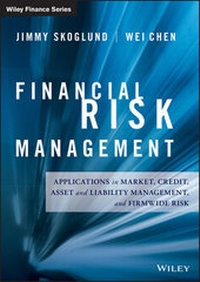
Financial Risk Management
Beschreibung

Weitere Details
Weitere Ausgaben
Nachauflagen
Andere Ausgaben
Personen
Inhalt
Preface
About this book
In recent years risk management has become one of the fastest growing disciplines in the banking industry. It is certainly fueled by the fundamental intermediary role that banks play in the economy that expands globally with significant complexity. It is also driven by more risk-seeking behavior of the industry in order to achieve more profits. Another important reason is the increasing sophistication of the quantitative capability, including both methodology and technology. There have been many books on quantitative risk management. Most of them focus on specialized subjects. Only few advanced financial risk management books are application-oriented.
This book evolved over a number of years as the authors worked in banks and software companies with risk management analytics development and risk systems implementation. Our experiences with development and implementation of risk analytics in banks globally have inspired us to write a comprehensive quantitative oriented risk management book from a practitioner's point of view. The book discusses models and applications in the areas of market, credit, asset and liability management, and firmwide risk. An introductory chapter also reviews the economic foundation of modern risk management and how it has reached the current stage, the evolution of regulatory practices, the construction of financial risk systems, and the growing importance of model risk management as banks are required to perform more and more complex risk calculations that involve many models.
After the introduction, we continue with two chapters on market risk followed by chapters on portfolio credit risk, counterparty credit risk, liquidity risk, and funds transfer pricing and profitability analysis. While this book is mostly organized around the traditional market, credit, and other risk categories to provide contexts for the presentation of the risk methodologies, we cross reference different methodologies and risks, and dedicate two chapters to firmwide risk. These are the last chapters in the book, which discuss firmwide risk aggregation and firmwide scenario analysis and stress testing. Our intention is to provide a holistic view of the modern integrated yet modularized risk management practice.
In the past, quantitative methods were largely considered to be useful for risk measurement only and rarely served as input to the risk-based decision process. Quantitative methods are now frequently used to provide guidance to the risk management itself as well as assist in risk-based business decisions. This is another aspect of the comprehensiveness that we wish to demonstrate in this book. An important motivation of the book is to bring together the methodologies that can be applied across risk types and establish a common ground of quantitative approaches on which firmwide risk analysis can be established.
Since risk regulations have driven a lot of the recent practices, we also relate the concepts in the book to the most recent regulations in each risk area. In many cases the relation explains the risk-modeling foundation and in some cases also drawbacks of the risk regulations. However, this book is not a regular textbook overview on risk analysis in the sense that we have chosen to only include risk models and risk applications where we have acquired significant experience from both our research and actual implementations at banks. Hence, the book is significantly biased to the risk methods and models that we have found practically useful.
To put emphasis on the practical use of risk models the book includes many application examples illustrating how the models are used in practice. Therefore, our aim is to provide enough details that readers can actually implement the methods if they follow the discussions in this book. The book represents the collective experience of not only the authors but also the people we have worked with in the past-both in banks and in risk technology.
Whom is this book for?
While this book emphasizes the financial risk management methods and models, we approach all the subjects from application aspects. Because the book is written with application in mind, we have skipped a lot of theoretical derivations and provide references for those who are interested in finding these details. The book still assumes maturity with mathematics and statistics as well as previous exposure to financial risk analysis concepts. It is therefore not a book for beginners. Consistent with the intended audience for this book we do not provide background chapters or appendices that introduce basic statistical and mathematical concepts. There are already several excellent books that can be used for that purpose if the reader needs a reminder on concepts. However, readers with a strong quantitative background should find no trouble following the details in the book. In each subject we also include discussions on the economic insights behind the methods for those who are interested in the rationale for the modern risk management methods. Therefore, we believe the book provides value to practitioners as well as researchers and students who seek to get more insights and implementation details of risk analytics in practice. The outline of the book that follows should help readers navigate through the book.
Outline of the book
The first two chapters of the book, following the introduction chapter, are devoted to market risk. Market risk is clearly one of the most well-known and studied risk areas. The modernization of the risk management concept started in the application of market risk. Even today, market risk is still a major driver of many innovations in risk management. The techniques used in the market risk context can be often easily transferred to the other risks as well. The style of the book builds on this history and introduces many risk concepts that are subsequently reused in the other chapters on credit, asset and liability management, and firmwide risks.
The first market risk chapter focuses on the once-popular linear and quadratic approach to portfolio risk management-assuming multivariate normal or log-normal distribution of the underlying risk factors. It also focuses on the multivariate normal or log-normal simulation-based approach to market risk analysis. For many risk practitioners the material in this first chapter is partly known. However, as we mentioned earlier, the market risk chapters still serve as an introduction where we also introduce core concepts that will be reused and expanded on throughout the book. For example, risk contributions: In the discussion of the simulation-based approach to market risk, key practical concepts such as how to reduce the calculation times by either or both of (i) reducing the number of scenarios and (ii) reducing pricing time are also discussed.
The second market risk chapter is focused on more advanced topics, but is still of significant practical importance. Here we consider extensions of risk measures to a general portfolio profit-and-loss distribution and in particular how one can decompose risk into contributing subportfolios and instruments as well as into risk factors of relative importance. It is by now well-known that the multivariate normal or log-normal model for risk factors is a simplifying assumption in practice and does not meet the stylized facts of financial risk returns. We therefore focus in depth on what are the stylized facts of returns and which models can capture the stylized facts and perform well in terms of backtesting. Other important practical topics discussed in this chapter include how to scale risk over time in risk models as well as how to incorporate market illiquidity in market risk models. Stress testing has quickly emerged as one of the core risk activities in banks and we discuss a structured approach to stress testing as well as how to integrate model- and stress testing-based views. Another important topic for risk analysis is optimal risk-based decision making. This is one of the core activities of risk managers: specifically, to analyze and understand optimal portfolio hedges and replicate portfolios for subsequent risk measurement and management. The advanced market risk chapter ends with a note on the very recent developments in the regulation for market risk.
The fourth and fifth chapters of the book move the focus to credit risks. The fourth chapter focuses on issuer portfolio credit risk-for exposures in both the trading book and the banking book. In practice, portfolio credit risk economic capital for large corporate exposures uses models founded on the structural Merton approach to corporate claims. In the portfolio setting, multifactor models are often used to describe the credit index of the corporate and referred to as latent variable models as the credit index itself is unobserved. Economic capital and capital allocation for bond exposures in the trading book usually have to account for trading behavior and liquidity horizons. With the relatively recent regulatory incremental risk charge for credit exposures in the trading book, economic capital models and regulatory capital are becoming more aligned.
Portfolio credit risk models for the banking book are usually founded in the reduced form credit scoring or credit state transition models used at account or customer level. The models are typically calibrated on large pools. The transition models can be dynamic and include macroeconomic variables or be static and rely on an ex-post inclusion of macroeconomic variables describing default and migration behavior over time. The inclusion of macroeconomic variables is a prerequisite for building an economic capital model for credit...
