

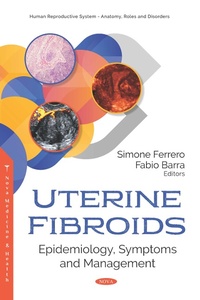
Uterine Fibroids: Epidemiology, Symptoms and Management
Erschienen am 15. Mai 2019
284 Seiten
978-1-5361-5525-9 (ISBN)
Beschreibung

Uterine myomas are the most common form of benign uterine tumors, occurring in 50-60% of women. Clinically, they are mostly asymptomatic, often incidentally found on pelvic examination or by routine gynecological ultrasonographic evaluation; otherwise, in 30-40% of cases, they cause a large variety of symptoms, depending on their location and size. Currently, the therapeutic options for myomas are medical, radiological, and surgical. The aim of this book is to summarize the evidence regarding epidemiology, pathogenesis, clinical presentation, diagnosis and management of uterine myomas.
Weitere Details
Weitere Ausgaben
Andere Ausgaben
Buch
05/2019
Nova Science Publishers Inc
302,21 €
Versand in 15-20 Tagen
Inhalt
- Intro
- Contents
- Preface
- Chapter 1
- Epidemiology and Risk Factors of Uterine Myomas
- Abstract
- 1. Introduction
- 2. Epidemiology of Myomas
- 2.1. Demographic Patterns: Age and Race
- 3. Etiology
- 4. Risk Factors
- 4.1. Markers of Endogenous Hormone Levels
- 4.1.1. Menarche, Menstrual Patterns, and Menopause
- 4.1.2. Reproductive Factors
- 4.1.3. Anthropometric Characteristics
- 4.1.4. Diabetes and Polycystic Ovary Syndrome (PCOS)
- 4.2. Use of Exogenous Hormones
- 4.2.1. Oral Contraceptives
- 4.2.2. Postmenopausal Hormone Use
- 4.2.3. Depot Medroxyprogesterone Acetate
- 4.2.4. Diethylstilbestrol (DES)
- 4.3. Lifestyle
- 4.3.1. Dietary Factors
- 4.3.2. Alcohol and Caffeine
- 4.3.3. Cigarette Smoking
- 4.3.4. Physical Activity
- 4.3.5. Stress
- 4.4. Infection and Uterine Injury
- 4.5. Genetics and Epigenetics Factors
- 4.6. Other Potential Risk Factors
- 4.6.1. Demographic Characteristics
- 4.6.2. Hypertension
- 4.6.3. Environmental Factors
- References
- Chapter 2
- Classification of Uterine Myomas and Clinical Correlations
- Abstract
- 1. Introduction
- 1.1. Topographical Classification and Clinical Correlation
- 1.1.1. Subserous Fibroids
- 1.1.2. Intramural Fibroids
- 1.1.3. Submucous Fibroids
- 2. Wamsteker/ESGE Classification (1993)
- 3. The STEP-W Classification (2005)
- 4. The FIGO Staging System for Uterine Fibroids (2011)
- Conclusion
- References
- Chapter 3
- Ultrasonographic Assessment of Uterine Myomas
- Abstract
- Introduction
- The Role of Ultrasound
- Conclusion
- References
- Chapter 4
- Surgical Pathology of Uterine Myomas: From Usual Forms to Differential Diagnosis
- Abstract
- 1. Introduction
- 2. Usual Gross Features
- 3. Usual Microscopic Features: Spindle Cell Leiomyoma
- 4. Epithelioid Leiomyoma
- 5. Myxoid Leiomyoma
- 6. Rare and Peculiar Variants and Presentations
- 6.1. Mitotically Active Leiomyoma
- 6.2. Cellular Leiomyoma
- 6.3. Hemorrhagic Cellular Leiomyomas
- 6.4. Leiomyoma with Bizarre Nuclei
- 6.5. Hydropic Leiomyomas
- 6.6. Parasitic Leiomyomas
- 6.7. Leiomyomatosis Peritonealis Disseminata
- 6.8. Intravenous Leiomyomatosis and Leiomyoma with Vascular Invasion
- 6.9. Benign Metastasizing Leiomyomas
- 6.10. Hormonal and Therapy-Induced Modifications
- 7. Hints and Pitfalls in Differential Diagnosis
- 7.1. Tumor Cell Necrosis ("Coagulative Necrosis")
- 7.2. Cytologic Atypia
- 7.3. Mitotic Index
- Conclusion
- References
- Chapter 5
- Presurgical Hormonal Treatment for Uterine Myomas
- Abstract
- Introduction
- Steroid Hormones Role
- Medical Therapy
- Gonadotrophin Releasing Hormone Analogues
- Aromatase Inhibitors
- Selective Progesterone Receptor Modulator
- The Story
- Compounds
- Pharmacodynamics
- Progesterone Receptor Modulator Associated Endometrial Changes
- Ulipristal Acetate
- Clinical Studies
- Safety
- Comparison between Preoperative Medical Options for Myomas
- References
- Chapter 6
- Minilaparotomic Myomectomy
- Abstract
- 1. Introduction
- 2. Indication to Surgical Myomas Removal
- 3. Choosing the Right Surgical Route for Myomas
- 4. Minilaparotomic Myomectomy
- 4.1. Surgical Technique
- 4.2. Comparison with Laparoscopic Myomectomy
- Conclusion
- References
- Chapter 7
- Laparoscopic Myomectomy
- Abstract
- 1. Indications
- 1.1. Patients Selection for Laparoscopic Myomectomy
- 2. Surgical Technique
- 3. Minimization of Blood Loss
- 4. Enucleation Procedure and Tissue Extraction
- 5. Closure of the Uterine Breach
- 6. Adhesion Prevention Barriers
- 7. Surgical Outcomes
- 8. Effects on Fertility
- Conclusion
- References
- Chapter 8
- Hysteroscopic Myomectomy
- Abstract
- 1. Introduction
- 2. Indication to Hysteroscopic Myomectomy
- 3. Preoperative Evaluation
- 3.1. Classification of Submucous Fibroids
- 4. Operative Hysteroscopic Procedure
- 4.1. Hysteroscopic Equipment and Surgical Techniques
- 4.1.1. Hysteroscopic Resectoscope
- 4.1.2. Hysteroscopic Miniresectoscope
- 4.1.3. Hysteroscopic Morcellator
- 4.1.4. Laser Technology
- 4.1.5. Treatment of Myomas Completely within the Uterine Cavity (G0)
- 4.2. Treatment of Myomas with Intramural Extension (G1-G2)
- 4.2.1. Mazzon Technique
- 4.2.2. Litta Technique
- 4.2.3. OPPIuM Technique
- 4.2.4. Haimovich: OPPIuM Technique Modified
- 4.2.5. Combination of Techniques
- 5. Pharmacological-Aided Techniques
- 6. Effects of Hysteroscopic Myomectomy on Menstrual Pattern and Infertility
- 6.1. Success Rate in Controlling Abnormal Uterine Bleeding
- 6.2. Pregnancy Rates after Hysteroscopic Myomectomy
- 7. Complications of Hysteroscopic Myomectomy
- 7.1. Intraoperative and Short-Term Complications
- 7.2. Long-Term Complications
- 8. Preoperative and Intraoperative Medical Therapy Role
- References
- Chapter 9
- Levonorgestrel-Releasing Intrauterine Device for the Treatment of Heavy Menstrual Bleeding Caused by Uterine Myomas
- Abstract
- 1. Introduction
- 1.1. Definition of HMB
- 1.2. Etiology of Menorrhagia
- 1.3. Social Aspects and Costs
- 2. Alternative Methods to Quantify the Intensity of the Menstrual Cycle and Establish the Causes of HMB
- 2.1. PBAC
- 2.2. PALM -COEIN
- 2.2.1. Polyps
- 2.2.2. Adenomyosis
- 2.2.3. Malignancy and Others
- 2.2.4. Ovulatory Dysfunction
- 2.2.5. Disorders of Hemostasis and Coagulopathy
- 2.2.6. Endometrial
- 2.2.7. The Uterine Fibromatosis
- 3. HMB Caused by Leyomioma
- 3.1. Counselling
- 3.2. Clinical Approach
- 3.2.1. Gynecological Examination
- 3.2.2. Transvaginal Ultrasonography
- 3.2.3. Hysteroscopy
- 4. Intrauterine Device
- 4.1. Eligible Patients for Levonorgestrel-Releasing Intrauterine System
- 4.2. Levonorgestrel-Releasing Intrauterine System (Mirena)
- 4.3. Indications
- 4.4. LNG Intrauterine Device in Obese Patients
- 4.5. Effects of LNG IUD on Fibrinolytic Factors in the Endometrium Cells
- 4.6. Hystological Effects of Locally Released Progesterone on the Endometrium Cells
- 4.7. The Role of Inflammatory Pathway and AUB Related
- 5. Adenomyosis and Uterine Fibromatosis Different Aspects and Treatments
- 6. Target of the Medical Therapy
- 6.1. Efficacy of Levonorgestrel-Releasing Intrauterine Device as Treatment of HMB Compared with Oral Progestins in Women with Uterine Leiomyoma
- 7. Follow up After LNG IUD Placement
- References
- Chapter 10
- Non-Invasive Procedures for Uterine Myomas
- Abstract
- 1. Introduction
- 2. Indications
- 3. Procedure
- 4. Adverse Effects
- 5. Outcomes
- References
- Chapter 11
- Uterine Myomas and Fertility
- Abstract
- Epidemiology
- Impact of Myomas on Fertility
- Diagnosis
- Customized Treatment for Improving Fertility: Which Choice is the Most Appropriate?
- Conclusion
- References
- Chapter 12
- Uterine Myomas and Sexual Function
- Abstract
- 1. Introduction
- References
- Chapter 13
- Office Hysteroscopic Myomectomy Using the Versapoint Bipolar Electrode
- Abstract
- Introduction
- Surgical Technique
- Clinical Studies
- Conclusion
- References
- Chapter 14
- Risk of Sarcoma Dissemination during Laparoscopic Myomectomy
- Abstract
- Introduction
- Conclusion
- References
- Chapter 15
- Robotic-Assisted Myomectomy
- Abstract
- Introduction
- References
- About the Editors
- Index
- Blank Page
