

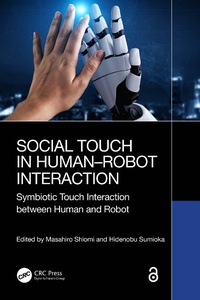
Social Touch in Human-Robot Interaction
Symbiotic touch interaction between human and robot
1. Auflage
Erschienen am 29. März 2024
319 Seiten
978-1-040-01522-3 (ISBN)
Beschreibung

In this book for researchers and students, editors Shiomi and Sumioka bring together contributions from researchers working on the CREST project at ATR Deep Interaction Laboratories, a world leader in social robotics, to comprehensively describe robot touch systems from hardware to applications.
Appropriate touch from robots to humans is essential for social robots, but achieving this requires various solutions at every stage of the touch process. Through this book, readers will gain an understanding of the needs, essential systems and communication cues, behaviour designs, and real-world issues for social touch applications. This book compiles and updates technical and empirical research that was previously scattered throughout the literature into a single volume. Through individually authored chapters addressing various elements of ATR's CREST project, this book tackles key areas where understanding is needed to realize acceptable touch interaction, including pre-touch interaction, interaction design for touching and being touched, behaviour changes caused by touch interaction, and applications of social touch interaction. It introduces a touch sensor and robots developed by the authors, including several touch-related behaviours and design policies. This approach will enable readers to easily apply this knowledge to their own social robotics programs. This book is invaluable for anyone who wishes to understand and develop social robots that physically interact with people.
It is most beneficial for researchers and upper undergraduate and graduate students in the fields of human-robot/agent/computer interaction and social touch interaction and those in the broader fields of engineering, computer science, and cognitive science.
Appropriate touch from robots to humans is essential for social robots, but achieving this requires various solutions at every stage of the touch process. Through this book, readers will gain an understanding of the needs, essential systems and communication cues, behaviour designs, and real-world issues for social touch applications. This book compiles and updates technical and empirical research that was previously scattered throughout the literature into a single volume. Through individually authored chapters addressing various elements of ATR's CREST project, this book tackles key areas where understanding is needed to realize acceptable touch interaction, including pre-touch interaction, interaction design for touching and being touched, behaviour changes caused by touch interaction, and applications of social touch interaction. It introduces a touch sensor and robots developed by the authors, including several touch-related behaviours and design policies. This approach will enable readers to easily apply this knowledge to their own social robotics programs. This book is invaluable for anyone who wishes to understand and develop social robots that physically interact with people.
It is most beneficial for researchers and upper undergraduate and graduate students in the fields of human-robot/agent/computer interaction and social touch interaction and those in the broader fields of engineering, computer science, and cognitive science.
Weitere Details
Auflage
1. Auflage
Sprache
Englisch
Verlagsort
London
Großbritannien
Verlagsgruppe
Taylor & Francis Ltd
Zielgruppe
Für höhere Schule und Studium
Für Beruf und Forschung
Illustrationen
15 Tables, black and white; 73 Line drawings, black and white; 55 Halftones, black and white; 128 Illustrations, black and white
Dateigröße
31,55 MB
ISBN-13
978-1-040-01522-3 (9781040015223)
Copyright in bibliographic data and cover images is held by Nielsen Book Services Limited or by the publishers or by their respective licensors: all rights reserved.
Schweitzer Klassifikation
Weitere Ausgaben
Andere Ausgaben
Masahiro Shiomi | Hidenobu Sumioka
Social Touch in Human-Robot Interaction
Symbiotic touch interaction between human and robot
Buch
ca. 12/2025
1. Auflage
CRC Press
78,70 €
Noch nicht erschienen
Masahiro Shiomi | Hidenobu Sumioka
Social Touch in Human-Robot Interaction
Symbiotic touch interaction between human and robot
Buch
03/2024
1. Auflage
CRC Press
123,10 €
Versand in 10-20 Tagen
Personen
Masahiro Shiomi is a senior research scientist and a group leader of the Agent Interaction Design Laboratory at the Interaction Science Laboratories at ATR, Kyoto, Japan. He is also a visiting professor at Kobe University. He earned an MEng and a PhD in engineering from Osaka University in 2004 and 2007, respectively. He served as a program chair on Ro-MAN2020, HAI2021, and HRI2022 and as an associate editor for the ACM Transactions on Human-Robot Interaction.
Hidenobu Sumioka is a group leader of Presence Media Research Group in Hiroshi Ishiguro Laboratories, ATR, Kyoto, Japan. He is also a visiting associate professor at Kobe University. He earned a PhD in engineering from Osaka University in 2008.
Hidenobu Sumioka is a group leader of Presence Media Research Group in Hiroshi Ishiguro Laboratories, ATR, Kyoto, Japan. He is also a visiting associate professor at Kobe University. He earned a PhD in engineering from Osaka University in 2008.
Inhalt
Section 1: Introduction. 1. Introduction to Social Touch in Human-Robot Interaction. Section 2: System Development for Social Touch Interaction. 2. Development of Fabric Sensor System toward Natural Pre-touch and Touch Interaction. 3. Application of Fabric Sensors for Soft Robot Hand for Positioning an Object without Touching It. 4. Wearable Tactile Sensor Suit for Natural Body Dynamics Extraction: Case Study on Posture Prediction Based on Physical Reservoir Computing. 5. SOTO: An Android Platform for Social Touch Interaction. Section 3: Modeling Pre-touch Proxemics. 6. Implementing Pre-touch Reaction Distance around Face for a Social Robot. 7. Implementing Pre-touch Reaction Distance around Upper Body Parts for a Social Robot. 8. Comparison of Pre-touch Reaction Distance between Physical and VR Environments. Section 4: Interaction Design for Touching and Being Touched. 9. Understanding Natural Reaction Time toward Touch. 10. Communication Cues Effects in Human-Robot Interaction. 11. Gaze and Height Design for Acceptable Touch Behaviors. 12. Designing Touch Characteristics to Express Simple Emotions. 13. Modeling Touch Timing and Length to Express Complex Emotions. Section 5: Behavior Change Effects in Human-Robot Touch Interaction. 14. Robot Hugs Encourage Self-disclosures. 15. Audio-Visual Stimuli Improve Both Robot's Hug Impressions and Stress-Buffering Effects. 16. Praise with Tactile Stimulus Increases Motivation. 17. Understanding Self-Touch Behaviors and Stress-Buffering Effects. 18. Mediated Hug Modulates Impressions of Hearsay Information. 19. Multi-modal Interaction through Anthropomorphically Designed Communication Medium to Enhance the Self-disclosures of Personal Information. Section 6: Applications of Social Touch Interaction. 20. A Minimal Design of a Human Infant Presence: A Case Study toward Interactive Doll Therapy for Older Adults with Dementia. 21. Interactive Baby Robot for Seniors with Dementia: Long-term Implementation in Nursing Home. 22. A Huggable Device Can Reduce the Stress of Calling a Stranger on the Phone for Individuals with ASD. 23. Viewing a Presenter's Touch Affects the Feeling of Kawaii of Others toward an Object.
