

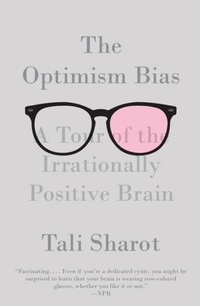
The Optimism Bias
Beschreibung

Psychologists have long been aware that most people maintain an irrationally positive outlook on life-but why? Turns out, we might be hardwired that way. In this absorbing exploration, Tali Sharot-one of the most innovative neuroscientists at work today-demonstrates that optimism may be crucial to human existence. The Optimism Bias explores how the brain generates hope and what happens when it fails; how the brains of optimists and pessimists differ; why we are terrible at predicting what will make us happy; how emotions strengthen our ability to recollect; how anticipation and dread affect us; how our optimistic illusions affect our financial, professional, and emotional decisions; and more. Drawing on cutting-edge science, The Optimism Bias provides us with startling new insight into the workings of the brain and the major role that optimism plays in determining how we live our lives.
Weitere Details
Weitere Ausgaben
Andere Ausgaben

Person
Tali Sharot's research on optimism, memory, and emotion has been the subject of features in Newsweek, The Boston Globe, Time, The Wall Street Journal, New Scientist, and The Washington Post, as well as on the BBC. She has a Ph.D. in psychology and neuroscience from New York University and is the director of the Affective Brain Lab and an Associate Professor of Cognitive Neuroscience in the department of Experimental Psychology at University College London. She lives in London.
Inhalt
- Intro
- Title Page
- Copyright
- Dedication
- Contents
- Prologue: A Glass Forever Half Full?
- 1. Which Way Is Up?: Illusions of the Human Brain
- 2. Are Animals Stuck in Time?: The Evolution of Prospection
- 3. Is Optimism a Self-Fulfilling Prophecy?: How the Mind Transforms Predictions into Reality
- 4. What Do Barack Obama and Shirley Temple Have in Common?: When Private Optimism Meets Public Despair
- 5. Can You Predict What Will Make You Happy?: The Unexpected Ingredient for Well-being
- 6. Crocuses Popping Up Through the Snow?: When Things Go Wrong: Depression, Interpretation, and Genes
- 7. Why Is Friday Better Than Sunday?: The Value of Anticipation and the Cost of Dread
- 8. Why Do Things Seem Better After We Choose Them?: The Mind's Journey from Expectation to Choice and Back
- 9. Are Memories of 9/11 as Accurate as They Seem?: How Emotion Changes Our Past
- 10. Why Is Being a Cancer Survivor Better Than Winning the Tour de France?: How the Brain Turns Lead into Gold
- 11. A Dark Side to Optimism?: From World War II to the Credit Crunch-Underestimating Risk Is Like Drinking Red Wine
- Epilogue: A Beautiful Mademoiselle or a Sad Old Lady?: From Prediction to Perception to Action
- Acknowledgments
- Notes
- About the Author
