

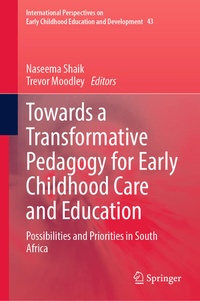
Towards a Transformative Pedagogy for Early Childhood Care and Education
Beschreibung

This book addresses the priorities and possibilities towards developing transformative pedagogies in post-apartheid South Africa. To this end, the book has assembled a group of researchers who interrogated and engaged with a variety of dimensions that warrant pedagogical change in early childhood in South Africa. The book focuses on young children, practitioners, and leaders with intersecting discussions about envisaged systemic changes to promote transformative pedagogies. The collection highlights the importance of beliefs, ways of knowing, and ways of being as framings that impact on pedagogical approaches. The book discusses the challenges that interplay between priorities and possibilities that practitioners face in a diverse and multi-cultural society like South Africa.
The work uses a variety of examples to show priorities. One example is about how practitioners have limited knowledge about how music, as a culturally responsive tool, can be used to transform pedagogy in Early Childhood Care and Education. The book opens up dimensions as priorities that lead to thinking about possibilities that recast adults and young children as transformative agents in a dimension for transformative pedagogies.
Weitere Details
Weitere Ausgaben
Andere Ausgaben
Personen
Dr Naseema Shaik is the Head of Department for Foundation Phase teaching and is Coordinator of the Diploma Grade R in the Faculty of Education at the Cape Peninsula University of Technology, South Africa. Dr Shaik is the lead coordinator of the Transformative Pedagogy Project funded by the Department of Higher Education and the European Union. She is also the section editor for the Foundation Phase of the South African Journal of Childhood Education. Dr Shaik's research interests are in the critical paradigm aligned with bringing about transformative change in early childhood pedagogy. Thus, her research has been in children's participatory rights and participatory pedagogies and has been published in both local and international journals.
Professor Trevor Moodley is an associate professor in the Department of Educational Psychology, Faculty of Education, University of the Western Cape, South Africa. He is also a registered educational psychologist. He has a PhD in Child Psychology and has been in education for over 30 years, both at school and at university level. His research interests include early childhood education, inclusive education and factors influencing teaching and learning.
Inhalt
Chapter 1. The need for a transformative pedagogy for early childhood care and education in South Africa (Shaik).- Chapter 2. Exploring teachers' understandings of democratic pedagogies in early childhood education (Shaik and Moodley).- Chapter 3. Early childhood care and education teachers' understandings of culture and cultural diversity: A case study in Polokwane, South Africa (Lebopa et al).- Chapter 4. Enactments of care in early childhood education: Towards inclusion and transformation (Martin and Martin).- Chapter 5. Children's decision making in early childhood education (Shaik).- Chapter 6. Mentees voices: Disablers and Enablers for mentorship in early childhood teacher education (Ebrahim et al).- Chapter 7. Priortising transformation through involving parents in early childhood education centres: A critical theory perspective (Aloka and Charimba).- Chapter 8. Reimagining Music and music making in early learning spaces (As and Vreden).
