

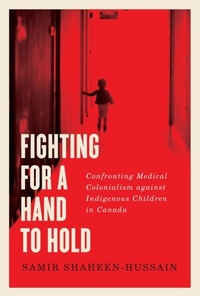
Fighting for a Hand to Hold
Confronting Medical Colonialism against Indigenous Children in Canada
1. Auflage
Erschienen am 23. September 2020
361 Seiten
978-0-2280-0513-1 (ISBN)
Beschreibung
Launched by healthcare providers in January 2018, the #aHand2Hold campaign confronted the Quebec government's practice of separating children from their families during medical evacuation airlifts, which disproportionately affected remote and northern Indigenous communities. Pediatric emergency physician Samir Shaheen-Hussain's captivating narrative of this successful campaign, which garnered unprecedented public attention and media coverage, seeks to answer lingering questions about why such a cruel practice remained in place for so long. In doing so it serves as an indispensable case study of contemporary medical colonialism in Quebec. Fighting for a Hand to Hold exposes the medical establishment's role in the displacement, colonization, and genocide of Indigenous peoples in Canada. Through meticulously gathered government documentation, historical scholarship, media reports, public inquiries, and personal testimonies, Shaheen-Hussain connects the draconian medevac practice with often-disregarded crimes and medical violence inflicted specifically on Indigenous children. This devastating history and ongoing medical colonialism prevent Indigenous communities from attaining internationally recognized measures of health and social well-being because of the pervasive, systemic anti-Indigenous racism that persists in the Canadian public health care system - and in settler society at large. Shaheen-Hussain's unique perspective combines his experience as a frontline pediatrician with his long-standing involvement in anti-authoritarian social justice movements. Sparked by the indifference and callousness of those in power, this book draws on the innovative work of Indigenous scholars and activists to conclude that a broader decolonization struggle calling for reparations, land reclamation, and self-determination for Indigenous peoples is critical to achieve reconciliation in Canada.
Rezensionen / Stimmen
"Fighting for a Hand to Hold denounces with ferocity the utterly inhuman, decades-long practice of separating children from their families during emergency medevacs in northern and remote regions of Quebec. In a precise, compelling, and well-documented narrative, Samir Shaheen-Hussain challenges our collective understanding of systemic racism and social determinants of health applied to Indigenous communities most dependent on medevac airlifts and most impacted by the non-accompaniment rule. An eye-opening, tough, and essential book." Dr Joanne Liu, pediatric emergency physician and former international president of Medecins Sans Frontieres "Samir Shaheen-Hussain's Fighting for a Hand to Hold is a searing indictment of medical colonialism in Canada. This must-read book shatters the myth of universal and equitable healthcare as a pillar of this country's benevolent social democracy and forcefully exposes the active involvement of the medical system in upholding historic and ongoing settler-colonial power." Harsha Walia, author of Undoing Border Imperialism "In Fighting for a Hand to Hold Samir Shaheen-Hussain exposes the social, cultural, and historical structures that allow medical colonialism to hide in plain sight as it harms generations of Indigenous children and their families. It is an unflinching analysis that should be required reading in every medical school in the country." Maureen Lux, professor, Brock University and author of Separate Beds: A History of Indian Hospitals in Canada, 1920s-1980s "Its clever framing, detailed research, and frequent critical gems put Fighting for a Hand to Hold in the very good company of a small group of stellar books and articles about Indigenous health issues, all of them manifestos for change. It's a passionate and informed report from the medical frontlines that exposes some of the social determinants and racial subtexts that prevent us from improving and safeguarding the lives of Indigenous peoples and other minorities in Canada." Gary Geddes, author of Medicine Unbundled: A Journey through the Minefields of Indigenous Health Care "Shaheen-Hussain argues that genuine reconciliation can't occur without reparations and restitution. Besides disclosure and acknowledgment of the harm done, this means a genuine demonstration of sorrow and regret, a promise to never do harm again, and action that ensures the harm will not be repeated. This book should be read by anyone who wants to meaningfully enter into reconciliation with Indigenous people." Marie Wadden, author of Where the Pavement Ends: Canada's Aboriginal Recovery Movement and the Urgent Need for Reconciliation "A sick child is transported by plane to a hospital 1,000 kilometres away, alone, without a parent: a state practice without pity. This practice was no mere residue of an old colonial system long gone. Instead it is a telling sign of an ongoing settler colonialism, one deeply structured to 'disappear Indians' and to declare Indigenous lives to be worth less than white ones. Samir Shaheen-Hussain's clear-eyed account reminds us that we can change but not until we recognize this ugly truth." Sherene H. Razack, distinguished professor and Penny Kanner Endowed Chair in Gender Studies, UCLA, and author of Dying from Improvement: Inquests and Inquiries into Indigenous Deaths in Custody "Heartbroken. This is how I feel after reading Fighting for a Hand to Hold. It hurts to read about children suffering. Shaheen-Hussain's book does not relieve that pain. Yet his words hold the potential to help us create broader healing, if his insights are heeded." John Borrows, Canada Research Chair in Indigenous Law, University of Victoria Law School "An astonishing book. It begins with the anguished story of Cree and Inuit children from northern Quebec travelling alone by air, sick or injured, panic-stricken, to hospitals in the south, and becomes one of the most moving, ferocious, historically comprehensive narratives of medical colonialism and indigenous cultural genocide that I have ever read. It's a stunning piece of work. When I finally put it down, I was gasping ... an absolute tour-de-force." Stephen Lewis, co-director, AIDS-Free World "A necessary and sobering read. Shaheen-Hussain masterfully exposes the ways in which the logics of settler colonialism and genocide are structurally embedded into Canada's healthcare system. He illuminates how egregious racial violence takes place - in plain sight - under the direction of a publicly funded institution that is broadly understood, by most Canadians, as a social good. The book, meticulously researched, firmly centres Canada's medical system as a crucial site for ongoing anti-colonial struggle." Robyn Maynard, author of Policing Black Lives: State Violence in Canada from Slavery to the Present "While grounded firmly in the academic literature, Fighting for a Hand to Hold uses language that is accessible to a general audience and inspires the reader to engage in a profound examination of Canada's history and its relationship with Indigenous peoples. A moving and necessary book, and a must-read for all who are interested in one of the most macabre faces of medical colonialism: its genocidal and eugenicist face." Quebec Native Women/Femmes Autochtones du Quebec Inc. "The memories of the Inuit children I attended as a young interpreter at the Montreal Children's Hospital came flooding back to me. The sad face of a child looking up at me: nurses informed me that he was not speaking, but I immediately recognized the fear in his face, in his eyes. As soon as I spoke to him in Inuktitut, he looked at me in disbelief, but in the next moment his tears began to roll and I could only sound out the Inuit sound of love, 'mmph,' and tell him it would be all right, that his mom or a relative would be arriving soon. I felt for that child, and as he began to relax and open up, we had a lovely conversation in Inuktitut. He did not feel so alone in this strange place he had just been deposited in, as if he were cargo. To this day, I still feel for him. Throughout all these years, we all have been made to believe that this is how things should work. It was one of those things we stayed quiet about for decades. But no longer. We Inuit, we are a people. We love our children. Fighting for a Hand to Hold helps us understand the issues of colonization in the medical system that have vexed us as Indigenous peoples. Today, we Inuit are working to bring our health back to our communities. Healthy communities and families mean self-governance to us, and the decolonization process will happen." Lisa Qiluqqi Koperqualuk, vice-president of international affairs, Inuit Circumpolar Council Canada "This book takes us down dark corridors where both unintentional and deliberate racism are condoned by bureaucratic nonsense pretending to be government policy. The author jolts the reader from complacency page after page, detail after detail, pushing the reader beyond individual incidents to an understanding of a bigger picture. First, he writes, he must dispel "the commonly held belief that the medical establishment is inherently benevolent." Montreal Review of Books "Shaheen-Hussain painstakingly details the practice of separating children, its harms, and the difficulties in ending it. Fighting for a Hand to Hold would be an achievement for any author; it is astonishing to think of it as the product of a pediatric emergency physician's spare time. I hope it and the French translation find the large readerships they merit." Canadian Journal of Law and Society "The author meticulously employs the Hand to Hold story to help readers access the more significant narrative about racism, effectively connecting the two in a work that meaningfully adds to the canon of indigenous advocacy. The specific examples of callous removal of indigenous children without their parents for emergency medical treatment are seamlessly integrated within the larger narrative of residential schools, racism, and debates about the supposed difference between equity and equality. Recommended. All readers." Choice "Anyone who thinks that racism in Canada is more benign than it is in the United States--or that Canada has left its genocidal policies in the past--must read Samir Shaheen-Hussain's new book. Fighting for A Hand to Hold is an engaging and well-documented analysis of medical colonialism that deserves further discussion and, most important, action." Canadian Dimension "Fighting for a Hand to Hold is important in encouraging us to reflect and rethink it. Samir's call for the decolonisation of health care would entail reparations for Indigenous nations, which includes the return of land and sovereignty over the labour of care. Indigenous land defenders fighting colonial development, Indigenous projects of food sovereignty and agroecology, and the resurgence of Indigenous traditional knowledge, including practices of healing, all point to the importance of reclaiming sovereignty over care as pathways for decolonising health care." Race & Class "Fighting for a Hand to Hold reveals systemic challenges through an approach that offers a holistic look at the structures that hold injustices in place. Inspired by patients, Shaheen-Hussain examines the impacts of medical colonialism on the lives of Indigenous young people. This book made me think about how we can create the change that is necessary to address the anti-Indigenous racism of Canada's past and present." Margo Greenwood, The LancetWeitere Details
Reihe
Sprache
Englisch
Verlagsort
Montreal, QC
Kanada
Zielgruppe
Für höhere Schule und Studium
Für Beruf und Forschung
Editions-Typ
Digitale Ausgabe
Illustrationen
8 illustrations, 4 maps
7 illustrations, 2 maps
Dateigröße
8,31 MB
ISBN-13
978-0-2280-0513-1 (9780228005131)
Copyright in bibliographic data and cover images is held by Nielsen Book Services Limited or by the publishers or by their respective licensors: all rights reserved.
Schweitzer Klassifikation
Weitere Ausgaben
Personen
Samir Shaheen-Hussain is assistant professor in the Faculty of Medicine at McGill University and works as a pediatric emergency physician in Montreal (Tio'tia:ke).
Inhalt
- Cover
- FIGHTING FOR A HAND TO HOLD
- Title
- Copyright
- Dedication
- Contents
- Figures
- Foreword Cindy Blackstock
- Preface and Acknowledgments
- A Note to Readers
- Part One Above All, Do No Harm
- Timeline
- Introduction
- 1 Medevac Airlifts in Quebec and the Non-Accompaniment Rule
- 2 The #aHand2Hold Campaign: Confronting a System
- Part Two Structural Fault Lines in Health Care
- 3 Social Determinants of Health: Equality, Equity, and Limitations
- 4 Recognizing Systemic Racism: A Social Justice Approach
- 5 Medical Culture and the Myth of Meritocracy
- Part Three Medical Colonialism and Indigenous Children
- 6 A Little Matter of Genocide: Canada and the United Nations Convention
- 7 From the Smallpox War of Extermination to Tuberculosis Deaths in Residential Schools
- 8 Experimental Laboratories: Malnutrition, Starvation, and the BCG Vaccine
- 9 Cruel Treatment: Indian Hospitals, Sanatoria, and Skin Grafting
- 10 Gendered Violence: Forced Sterilization and Coercive Contraception
- 11 Breaking Up Families: Child Welfare Services, Mass Evacuations, and Medical Disappearances
- 12 Oral Histories and the Narrative of Genocide
- Part Four The Structural Determinants of Health and Decolonizing Our Future
- 13 Capitalism and the Cost of Caring
- 14 History Matters: Colonialism, Land, and Indigenous Self-Determination
- 15 Decolonizing Health Care: Reparations before Reconciliation
- Conclusion
- Afterword Katsi'tsakwas Ellen Gabriel
- References
- Index
