

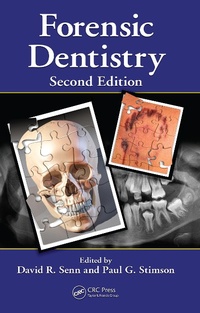
Forensic Dentistry
2. Auflage
Erschienen am 25. Januar 2010
470 Seiten
978-1-4200-7837-4 (ISBN)
Beschreibung

The identification of unknown individuals and the estimation of age, race, and gender are among the chief functions of forensic dentistry. Other important applications include the investigation and analysis of bitemarks and oral injuries in abuse cases and evaluating, reporting, and testifying in civil litigation cases. Twelve years after the benchmark first edition of this book explored these topics, the long-awaited Forensic Dentistry, Second Edition offers a comprehensive update and revision of the material.
Offering insight from many new contributors on the cutting edge of forensic science and odontology, this new edition expands the book's scope to include a broader historical and theoretical analysis, a thorough assessment of the past decade's developments, and a far-reaching projection of future trends.
New topics in the second edition include:
Forensic dental radiography
Age estimation
Jurisprudence and legal issues
History of forensic dentistry
Landmark cases, including September 11th and Hurricane Katrina
In order for forensic odontology to continue to progress as a specialty of forensic science, there must be a consistent stream of new ideas and original and applied research. Heavily illustrated and enhanced with a 16-page color insert with additional photos, this volume captures the critical issues that confront today's forensic dentist, explores the field's limitations, and provides a window on the future of this crucial sector within the forensic identification science arena.
Offering insight from many new contributors on the cutting edge of forensic science and odontology, this new edition expands the book's scope to include a broader historical and theoretical analysis, a thorough assessment of the past decade's developments, and a far-reaching projection of future trends.
New topics in the second edition include:
Forensic dental radiography
Age estimation
Jurisprudence and legal issues
History of forensic dentistry
Landmark cases, including September 11th and Hurricane Katrina
In order for forensic odontology to continue to progress as a specialty of forensic science, there must be a consistent stream of new ideas and original and applied research. Heavily illustrated and enhanced with a 16-page color insert with additional photos, this volume captures the critical issues that confront today's forensic dentist, explores the field's limitations, and provides a window on the future of this crucial sector within the forensic identification science arena.
Weitere Details
Auflage
2nd edition
Sprache
Englisch
Verlagsort
Baton Rouge
USA
Verlagsgruppe
Taylor & Francis Inc
Zielgruppe
Für Beruf und Forschung
Forensic dentists, pathologists, scientists, medical examiners, anthropologists, and criminal justice professionals.
Editions-Typ
Überarbeitete Ausgabe
Illustrationen
160 s/w Abbildungen, 31 farbige Abbildungen, 25 s/w Tabellen
25 Tables, black and white; 31 Illustrations, color; 160 Illustrations, black and white
ISBN-13
978-1-4200-7837-4 (9781420078374)
Copyright in bibliographic data and cover images is held by Nielsen Book Services Limited or by the publishers or by their respective licensors: all rights reserved.
Schweitzer Klassifikation
Weitere Ausgaben
Andere Ausgaben
David R. Senn | Paul G. Stimson
Forensic Dentistry
Buch
10/2024
2. Auflage
CRC Press
83,50 €
Versand in 10-20 Tagen
David R. Senn | Paul G. Stimson
Forensic Dentistry
Buch
01/2010
2. Auflage
CRC Press
253,50 €
Versand in 15-20 Tagen
Personen
David R. Senn, D.D.S., attended the University of Texas in Austin and received his dental degree from the University of Texas Dental Branch at Houston. He is director, Center for Education and Research in Forensics; director, Fellowship in Forensic Odontology; and director, Southwest Symposium on Forensic Dentistry. He is also a forensic odontology consultant and chief forensic odontologist for the Bexar County (Texas) Medical Examiner's Office.
Paul G. Stimson, D.D.S., M.S., is a graduate of Loyola University Dental School and has an M.S. degree in general pathology from the University of Chicago. He is an emeritus professor in the Department of Oral and Maxillofacial Pathology at the University of Texas Dental Branch in Houston. He is a registered emeritus diplomate of the American Board of Oral and Maxillofacial Pathology and an active diplomate of the American Board of Forensic Odontology.
Paul G. Stimson, D.D.S., M.S., is a graduate of Loyola University Dental School and has an M.S. degree in general pathology from the University of Chicago. He is an emeritus professor in the Department of Oral and Maxillofacial Pathology at the University of Texas Dental Branch in Houston. He is a registered emeritus diplomate of the American Board of Oral and Maxillofacial Pathology and an active diplomate of the American Board of Forensic Odontology.
Inhalt
Science, the Law, and Forensic Identification. History of Forensic Dentistry. Scope of Forensic Odontology. Death Investigation Systems. Forensic Medicine and Human Identification. Fingerprints and Human Identification. DNA and DNA Evidence. Forensic Anthropology. Forensic Dental Identification. Forensic Dental Radiography. Forensic Dental Photography. Dental Identification in Multiple Fatality Incidents. Age Estimation from Oral and Dental Structures. Bitemarks. Abuse: The Role of Forensic Dentists. Jurisprudence and Legal Issues. Evidence Management. Future of Forensic Dentistry. Appendix: U.S. Federal and State Court Cases of Interest in Forensic Odontology. Index.
