

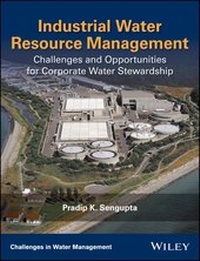
Industrial Water Resource Management
Beschreibung

Weitere Details
Weitere Ausgaben
Andere Ausgaben
Person
Inhalt
Series Editor Foreword - Challenges in Water Management xvi
Foreword xviii
Preface xx
Acknowledgements xxv
1 Introduction 1
1.1 The context 1
1.1.1 The story of Coca?]Cola in India 2
1.2 Water goals in the 21st Century 4
1.3 Water ethics 7
1.4 Value of water 10
1.4.1 Water valuation 11
1.4.2 Application of water valuation 12
1.5 Water and energy nexus 13
1.5.1 Impact of energy production on water resources 16
1.6 Global water stress 17
1.7 Industrial impact on water resource 20
1.7.1 Impact on the quantity of the source water 20
1.7.2 Hydro?]morphological impact 20
1.7.3 Quality impact 20
1.7.4 Impact on the access to water by the stakeholders 21
1.7.5 Affordability of water 21
1.8 Water sustainability 21
1.9 Impact of climate change 24
1.10 Dimensions in industrial water management 25
1.10.1 Global perspective 27
1.10.2 Water accounting 27
1.10.3 Water stewardship 28
1.10.4 Adaptive management 28
1.11 Green growth and green business 28
1.11.1 The challenges of green growth 29
1.11.2 Natural capital concept 30
1.11.3 Green growth policy fundamentals 30
1.11.4 Indicators of green growth 31
1.12 Conclusion 31
Note 32
Bibliography 32
2 Water Scenarios and Business Models of The Twenty?]first Century 37
2.1 Water scenario 37
2.1.1 Countrywise water scenario 39
2.2 Water indicators 45
2.2.1 Baseline water stress 45
2.2.2 Inter?]annual variability 46
2.2.3 Water conflict 46
2.2.4 River basins and aquifers under threat and conflict 47
2.2.5 Physical water risk in business 49
2.2.6 Disruption in the supply chain 49
2.2.7 Failure to meet basic water needs 49
2.3 Global water trends 50
2.4 Business models 50
2.4.1 Business as usual model 51
2.4.2 Alternative model 51
2.5 Integrated water resource management 52
2.5.1 History of IWRM 53
2.5.2 Principles of IWRM 53
2.6 Sustainable development goal for business sector 56
2.7 Conclusion 56
Bibliography 58
3 Understanding Water 61
3.1 Introduction 61
3.2 Hydrological cycle 63
3.2.1 Water cycle and ecosystems 67
3.3 Water on land 67
3.3.1 Soil water 68
3.4 Stores of water 70
3.5 Surface runoff 72
3.5.1 Meteorological factors affecting runoff 72
3.5.2 Physical factors affecting runoff 72
3.5.3 Human activities can affect runoff 73
3.6 River and river basin 74
3.6.1 Stream order 76
3.6.2 Drainage basin, catchment and watershed boundaries 76
3.6.3 Classification of river basin and hydrological unit 76
3.7 Industrial impact on river flow 78
3.7.1 Temporal and spatial control over river flow 79
3.7.2 Water direct withdrawal 79
3.7.3 Physical disturbance of riverbeds 79
3.7.4 Pollution 79
3.7.5 Water clogging 80
3.8 Surface water management 81
3.8.1 Key component of a SWMP 82
3.9 Groundwater 83
3.9.1 Groundwater hydrology (hydrogeology) 84
3.9.2 Fundamentals concepts 85
3.9.3 Aquifer and confining beds 85
3.9.4 Groundwater system 95
3.9.5 Essential studies in groundwater 96
3.9.6 Relation between groundwater withdrawal and stream flow 98
3.9.7 Groundwater withdrawal in the recharging zone 100
3.9.8 Hydrogeological investigation 100
3.9.5 Groundwater management 103
3.10 Conclusion 103
Notes 106
Bibliography 106
4 Corporate Water Stewardship 109
4.1 Introduction 109
4.2 Why water stewardship? 110
4.2.1 Partnership development 111
4.2.2 Improve efficiency 111
4.2.3 Public acceptance 112
4.2.4 Incentives 112
4.2.5 Balancing risk and economic performance 113
4.2.6 Reinforces communication 113
4.3 Aspects of water stewardship 116
4.3.1 Legal aspect 116
4.3.2 Environmental aspect 117
4.3.3 Social aspect 117
4.3.4 Technological aspect 117
4.3.5 Economic aspect 119
4.4 Challenges in water stewardship 119
4.4.1 Legal challenges 119
4.4.2 Challenges in the value chain 120
4.4.3 Watershed Challenges 121
4.4.4 Social challenges 122
4.4.5 Market challenges 124
4.5 Developing a corporate strategy in water stewardship 125
4.5.1 Understand and recognise sustainability 126
4.5.2 Develop an engagement framework 126
4.5.3 Identification of stakeholders 126
4.5.4 Engagement risks 127
4.5.5 Collective action framework 127
4.6 Goals and commitments 129
4.7 Establish systems and processes 132
4.8 Opportunities in water stewardship 132
4.8.1 Management improvement 132
4.8.2 Knowledge asset development 133
4.8.3 Investment 133
4.8.4 Developing information and database 133
4.8.5 Human resource development 136
4.9 Water Literacy 138
4.9.1 Definition and concept 138
4.9.2 Water literacy framework 139
4.10 Action programmes under WSI 140
4.10.1 Conduct a water resource assessment 140
4.10.2 Conduct a water footprint analysis 140
4.10.3 Conduct a sustainability analysis 140
4.10.4 Water accounting and disclosure 141
4.10.5 Implement mitigation measures 142
4.11 Outcome of water stewardship initiatives (WSI) 142
4.12 Water stewardship standards 142
4.13 Global organisations for facilitating water stewardship 143
4.14 Water stewardship tools 150
4.15 Case studies 150
4.15.1 Unilever 150
4.15.2 BASF 151
4.15.3 TOM's of Maine 151
4.15.4 Mars Inc. 151
4.15.5 Nestlé 152
4.15.6 Coca?]Cola 152
4.16 Conclusion 153
Bibliography 153
5 Water Governance Framework and Water Acts 158
5.1 Introduction 158
5.2 What is water governance? 159
5.3 Water laws 161
5.4 Tasks of water governance 161
5.5 Challenges in water governance 162
5.6 Legal framework 163
5.7 Institutional framework 164
5.7.1 Ministries 166
5.7.2 Government departments 166
5.7.3 Authorities 167
5.7.4 Institutions 167
5.8 Principles of water governance 167
5.9 Spatial scale of water governance 168
5.10 Hierarchical governance 169
5.11 Cross?]cutting authority of governance 170
5.12 Stakeholders engagement in water governance 170
5.13 Functions and functionaries of the water governance 171
5.14 Role of civil society organisations (CSO) 172
5.15 Water governance framework of different countries (case studies) 174
5.15.1 European union water framework directives 174
5.15.2 Water governance in Australia 176
5.15.3 Water governance in Brazil 178
5.15.4 Water governance in Canada 179
5.15.5 Water governance in China 181
5.15.6 Water governance in India 183
5.15.7 Water governance in Indonesia 185
5.15.8 Water governance in Namibia 185
5.15.9 Water governance in South Africa 188
5.16 Conclusion 190
Notes 190
Bibliography 191
6 Water Quality Standards and Water Pollution 195
6.1 Water quality?]standards 195
6.1.1 Introduction 195
6.1.2 Quality parameters for drinking water 196
6.1.3 Microbiological contaminants 197
6.1.4 Physical parameters 197
6.1.5 Organic chemical pollutants 197
6.1.6 Parameters indicative of environmental pollution 197
6.1.7 Guidelines for standard quality parameters 202
6.1.8 Water quality requirements of industries 202
6.1.9 Water quality of effluent 205
6.2 Industrial water pollution 210
6.2.1 Definition 210
6.2.2 Direct reasons of water pollution 216
6.2.3 Indirect reasons of pollution 216
6.2.4 Indicators of industrial water pollution 217
6.2.5 Socio economic indicator of water pollution 217
6.2.6 Biological indicators of water pollution 218
6.2.7 Industrial sources of pollution 219
6.2.8 Water pollution from industrial emission 219
6.2.9 Water pollution from industrial effluent 221
6.2.10 Water pollution from solid?]waste disposal 222
6.2.11 Impacts of mining on water quality 222
6.2.12 Water pollution potentiality in petrochemical and power industry 222
6.2.13 Groundwater pollution from industrial effluents and leachates 223
6.2.14 Water pollution identifiers 227
6.2.15 Management and control of water pollution 228
6.2.16 Wastewater management 232
6.2.17 Disposal of wastewater 233
6.2.18 Effluent treatment 235
6.2.19 Treatment methods 235
6.2.20 Solid?]waste management 238
6.2.21 Management of leachate 241
6.3 Conclusion 241
Notes 241
Bibliography 241
7 Water Abstraction, Purification and Distribution 246
7.1 Overview 246
7.2 Water sourcing by industries 247
7.3 Surface water abstraction 248
7.3.1 Reservoir intake 249
7.3.2 River and lake intakes 251
7.3.3 Impacts of surface water abstraction 252
7.4 Methods of groundwater abstraction 253
7.4.1 Abstraction of baseflow 253
7.4.2 Abstraction of groundwater from aquifer 254
7.4.3 Construction of a tube well 255
7.4.4 Impacts of groundwater abstraction 262
7.5 Water abstraction from the sea 264
7.5.1 Environmental impact of seawater withdrawal 264
7.6 Conveyance system 264
7.6.1 Conveying water from the source to the treatment plant 265
7.7 Water purification 265
7.7.1 Primary screening 267
7.7.2 Clarification 267
7.7.3 Disinfection 269
7.7.4 Desalination 269
7.7.5 Membrane technologies 270
7.8 Water supply and distribution 274
7.8.1 Pipes 275
7.8.2 Storage system 275
7.9 Water delivery and distribution software 277
7.9.1 Overview 278
7.9.2 Capabilities 278
7.9.3 Applications 279
7.10 Conclusion 280
Bibliography 280
8 Water Resource Assessment 282
8.1 Introduction 282
8.2 Water resource assessment tools 284
8.3 General scenario 286
8.4 WRA basics 286
8.4.1 Conceptual and policy framework 286
8.4.2 Defining a research agenda 288
8.4.3 Defining the physical boundary 288
8.5 WRA data generation 289
8.5.1 Secondary data collection 289
8.5.2 Primary data generation 290
8.5.3 Biophysical data 290
8.5.4 Hydrometeorological data 294
8.5.5 Data table 295
8.5.6 Hydrogeological data 295
8.5.7 Socioeconomic data 297
8.5.8 Water use and discharge 298
8.6 Water balance 298
8.7 Estimation of surface runoff 299
8.7.1 Khosla's Formula 301
8.7.2 Estimation of rainfall runoff by SCS curve number (CN) method 301
8.7.3 Runoff calculation 304
8.8 Estimation of stream discharge 308
8.8.1 Volumetric gauging 308
8.8.2 Float gauging 308
8.8.3 Current metering 308
8.9 Estimation of renewable groundwater resource 309
8.9.1 Water level fluctuation method 309
8.9.2 Rainfall infiltration method 311
8.9.3 Soil water balance method 311
8.10 Estimation of pond/reservoir storage volume 312
8.10.1 Area calculation irregularly shaped ponds 312
8.10.2 Pond depth and volume estimation 313
8.11 Estimation of source?]water quality 313
8.11.1 Water sampling 314
8.11.2 Water analysis 316
8.12 Aquifer test 316
8.12.1 Field procedures 317
8.12.2 Test procedures 317
8.12.3 Pumping test data reduction and presentation 320
8.12.4 Analysis of test results 320
8.12.5 Calculations and aquifer test results 321
8.13 Build understanding of key catchment processes and interaction 321
8.14 Long?]term simulation of catchment behaviour 321
8.15 Assessment of sustainable and exploitable water over assessment period 321
8.16 Presentation of water resource assessment 322
8.17 Conclusion 322
Note 323
Bibliography 323
9 Corporate Water Accounting and Disclosure 325
9.1 The context 325
9.1.1 Water Risk 325
9.1.2 Water stress 327
9.1.3 Water intensity 328
9.2 Methods of assessing water risk 328
9.2.1 Water risk assessment tools 328
9.2.2 Data generation and internal assessment 332
9.3 Water profiling 332
9.3.1 Water profile of the basin 332
9.3.2 Benefit of a watershed profile 333
9.3.3 Water profile of a company 334
9.3.4 Water balance calculation 335
9.3.5 Impact assessment 337
9.4 Water footprint 338
9.4.1 The relevance of WFA to industry 341
9.4.2 Virtual water chain 342
9.4.3 Assessment of green water footprint 342
9.4.4 Assessment of blue water footprint 343
9.4.5 Assessment of grey water footprint (GWF) 344
9.4.6 Assessment of business water footprint (BWF) 345
9.4.7 Life cycle-based assessment 351
9.4.8 Application of water footprint assessment 352
9.4.9 Benefits of WFA 352
9.4.10 Water footprint assessment as a framework for corporate water sustainability 353
9.4.11 International standards of water footprint assessment 355
9.4.12 Case studies 355
9.5 Industrial response to WF assessment 356
9.6 Water disclosure document 356
9.7 Benefits of water disclosure 357
9.8 Conclusion 357
Notes 358
Bibliography 358
10 Detection of Water Loss and Methods of Water Conservation in Industries 361
10.1 Overview 361
10.2 Getting started: Develop a water conservation strategy 362
10.3 Detection of overuse 363
10.3.1 Benchmarking 363
10.4 Water audit 364
10.4.1 Fundamentals of water audit 364
10.4.2 Benefits of water audit 365
10.4.3 Scopes and objectives of water audit 366
10.4.4 Human resource requirements for water audit 366
10.4.5 Corporate process in water audit 367
10.4.6 Water audit processes 368
10.4.7 Water audit software 376
10.4.8 Industrial response to water audit report 380
10.4.9 Real loss management 382
10.5 Methods of water conservation 382
10.5.1 Water use management 382
10.5.2 Demand management 383
10.5.3 Changing the water use behaviour 384
10.5.4 Water use assessment 384
10.5.5 Reduced consumption and water loss 384
10.5.6 Reuse and recycle 385
10.5.7 Zero liquid discharge plants 385
10.6 Water saving in agriculture industries 386
10.6.1 Soil moisture sensors 386
10.6.2 Rain sensors 386
10.6.3 Drip/micro-irrigation 387
10.6.4 Sprinkler heads 387
10.6.5 Centre pivot irrigation 387
10.7 Rainwater harvesting 388
10.7.1 Introduction 388
10.7.2 Regulations and guidelines 389
10.7.3 Why industries should take up RWH 390
10.7.4 Components of RWH 391
10.7.5 Rainwater harvesting potential 396
10.7.6 Artificial recharge of groundwater 398
10.7.7 Surface runoff harvesting 401
10.7.8 Issues in RWH 403
10.7.9 Maintenance of RWH system 403
10.7.10 Constraints in adopting a rainwater harvesting system 403
10.7.11 Promotion and further development of rainwater utilisation 404
10.7.12 Example of an industrial RWH 405
10.8 Conclusion 406
Bibliography 407
11 Corporate Social Responsibility: Way Ahead in Water and Human Rights 409
11.1 Introduction 409
11.2 Public policy on CSR 410
11.3 CSR policy of corporations 412
11.4 Addressing water in CSR 413
11.4.1 Water security 413
11.4.2 Drinking water and sanitation 413
11.4.3 Ecological development 414
11.5 CSR management framework 414
11.5.1 Policy 415
11.5.2 Procedure 415
11.5.3 Institutional arrangement 416
11.5.4 Partnership and stakeholders' engagement 416
11.5.5 Reporting 417
11.6 CSR initiatives in the water sector 417
11.7 International standards and guidelines 418
11.8 Case studies 420
11.8.1 Coca?]Cola 420
11.8.2 Nike 420
11.8.3 Swiss Re Group 420
11.8.4 Molson Coors 420
11.8.5 Levi Strauss & Co 421
11.9 Future of CSR 421
11.10 Conclusion 422
Note 422
Bibliography 423
Glossary 425
Annexure 444
Index 446
Preface
The online edition of Merriam-Webster dictionary defines the word 'stewardship' as 'the activity or job of protecting and being responsible for something'. This goes a long way towards explaining the subject matter of this book, that is, the responsibility of the corporate world to society by way of water stewardship; which, in recent times, has become an essential part of corporate management termed corporate water stewardship (CSW).
In 1776, Adam Smith introduced the concept of the 'invisible hand' in his book The Wealth of Nations, which instantly became the driving force of industrialisation and capitalism. The philosophy propounds that every individual strives to make as much money as he can; he neither intends to promote public interest, nor knows how much he is promoting it "he intends only his own gain, and he is in this, as in many other cases, led by an invisible hand to promote an end which was not a part of his intention. The fact that it was not a part of his intention does not always worsen the situation for the society. By pursuing his own interest he frequently promotes that of the society more effectually than when he really intends to promote it. I have never known much good have been done by those who affected to trade for the public good" (italics mine). What Adam Smith could not have foreseen two and a half centuries ago is the ambivalence of rapid industrialisation, which is plainly visible now: Aside from accelerating modernization (see Chaplin's Modern Times), the invisible hand is surreptitiously leading the world to unliveable conditions (which is hardly surprising, seeing that the maximum impetus to technological advancement came from the two World Wars and the Cold War that followed).
It is high time for the world to become aware of the water problem before the problem becomes irreversible. This book aims to promote such awareness, and I hope that my Muse will grant me such simplicity so that my readers can identify with the subject in hand and the book may acquire another status - not that of a polemic, nor of a mere source of topical reference but of turning it into a well-described text with an attempt to present it to, and make it understood by large numbers of the public; that, then, is my priority in which simplicity of presentation is just as important as the idea of water stewardship vis-à-vis industrialization.
When I started my career as a hydro-geologist in a state government department of India in the mid-1970s, the concept that water is a 'resource', like gold, for instance, was incomprehensible to users; in my home state, West Bengal, water is quite abundant, by virtue of an average rainfall of more than 1500 mm per year and groundwater level close enough to the surface to make dug wells and tube wells affordable even to low-income groups. The West Bengal landscape is dotted by huge waterbodies used for irrigation and fisheries. Most of the rivers are perennial and navigable in the rainy season. Availability of usable water was taken for granted, except in the relatively thinly populated western districts, which are chronically draught-prone. The Gangetic alluvial plain is one of the richest aquifers in the world. During the 1970s, the government of West Bengal was implementing the 'Minor Irrigation Policy' by installing thousands of deep and shallow tube wells across the state. Groundwater was exploited as an apparently inexhaustible resource and was made available to small and marginal farmers at subsidised rates. It was a boon to the farmers. Needless to say, however, such good times do not last forever. By the end of the 1980s, the water problem was first noticed when arsenic in toxic concentrations was detected in the groundwater of eastern districts. It was also observed that groundwater levels had gone down in many areas, so opportunistically, many privately owned irrigation tube wells came up and farmers had to purchase water at a premium. This was the time when water started becoming an unorganised business sector not just in West Bengal but in India as a whole.
It was during these times of rising water problems that I visited some of the other states of India, some of which differed from West Bengal in terms of hydrogeological conditions and, therefore, water culture in general. The groundwater level in some states was so deep that heavy-duty submersible pumps were required to lift water from low-yielding aquifers. Those states are still suffering from a chronic shortage of water due to over-extraction, erratic rainfall and poor aquifer storage. In my home state too, the hydrological scenario has changed rapidly under the pressure of the minor irrigation sector; aquifer levels went far below the centrifugal pumping limits pushing extraction costs beyond the affordability of small and marginal farmers, who constitute the vast majority of the agricultural sector. Heavy industry was not a big player in the water market at that time because their number in West Bengal was lower compared to other states. Heavy industries started exploring West Bengal prospects in the 1990s, and it was land, not water, which was the main hurdle. Resistance to industrialisation came mainly from small and marginal farmers who, as mentioned earlier, constitute the majority and depended almost solely on agriculture for livelihood; farmer resistance, therefore, had the support of the civil society. Consequently, industries were allotted land in non-agricultural belts, that is in hard-rock or laterite-covered areas deficient in water. Though the land was made available, water scarcity of this land compelled industries to take appropriate measures to secure their water supply, which meant industries had to draw water from distal aquifers and rivers, which in turn, formed the lifeline of the agrarian population in the source region. It soon became clear that industries could take water for granted. Perforce, therefore, industrialists had to assure rural people that industries would not snatch their glass of water and, for a substantive assurance campaign, industrialists had to undertake a quantified assessment of water like any other valuable resource. Industry, agriculture and society thus became entwined in issues relating to water; the issues being over-withdrawal, quality deterioration by contamination, and monopolisation of water sources.
In agriculture-based economies of South and Southeast Asia, industrialisation collided head on with farming communities and domestic water consumption. What was once considered to be a boon now became a polarising force separating two fundamentally important economic sectors: agriculture and manufacturing. The only way to surmount, or at least mitigate the divisive force of water is informed management of water distribution, that is, water stewardship. With hindsight, it can be appreciated that the modified avatar of water was an inevitable consequence of the steam-powered Industrial Revolution set in motion by colonising countries. Moreover, there is also the climate change set in motion by industrialisation, compounding the job of water stewardship.
The British Geological Survey document, Groundwater Information Sheet on The Impact of Industrial Activity (Water Aid, 2008) termed industries as an environmental pressure. It claims that industries draw much more water than they consume and are fraught with polluted effluent discharge to the environment. Untreated wastewater has the potential to cause irreversible damage to the ecosystem. As an instrument of economic development, industries need to act as facilitators of social wellbeing; this is a tough task, but it is crucial to sustainability. There are laws and enforcement machinery, however, to compel industries to move on the right track. In developed countries and also in some developing countries, there are stringent laws to compel industries to ensure pollution-free discharge. But safeguarding the remaining water reserve is not enough. Usable water like any other geological resource is finite, but population growth is unbounded. Water stewardship is mandated to keep economic growth running apace with growing population.
The introductory chapter (Chapter 1) of this book provides an overview of the status of global water, how it is shared by different sectors of the society like domestic, agriculture and industry, and the various effects forced upon the ecosystem due to such sharing processes. The introduction also deals with other topics like why water is a critical business issue for companies and why water crisis is a risk to their operations and brands. The chapter also discusses how industries should manage water from an ethical standpoint and how water should be priced and evaluated. Pre-war industries, and especially the war industries during World War II, operated without restraint; but now industries are facing social and political pressure to operate under regulating norms. Since manufacturing industries are major consumers of fresh water, it is incumbent upon them to foster green growth through water stewardship.
In Chapter 2 global trends of business are put into perspective against the backdrop of water crisis; that is, how business relates to global water crisis and how increased consumption leads to conflicts as a consequence of population growth; the impact of the ever-increasing demand of water for industrial growth is also discussed. Also offered for discussion are examples of water-related conflicts in different parts of the world. The...
