

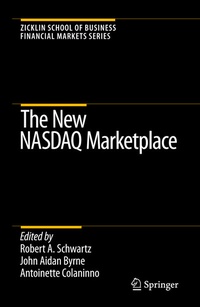
The New NASDAQ Marketplace
Beschreibung

Weitere Details
Weitere Ausgaben
Andere Ausgaben
Personen
Robert A. Schwartz is Marvin M. Speiser Professor of Finance and University Distinguished Professor in the Zicklin School of Business, Baruch College, CUNY. Before joining the Baruch faculty in 1997, he was Professor of Finance and Economics and Yamaichi Faculty Fellow at New York University's Leonard N. Stern School of Business, where he had been a member of the faculty since 1965. Professor Schwartz received his Ph.D. in Economics from Columbia University. His research is in the area of financial economics, with a primary focus on the structure of securities markets. He has published numerous journal articles and eleven books, including Equity Markets in Action: The Fundamentals of Liquidity, Market Structure and Trading, Wiley & Sons, 2004, and Reshaping the Equity Markets: A Guide for the 1990s, Harper Business, 1991 (reissued by Business One Irwin, 1993). He has served as a consultant to various market centers including the New York Stock Exchange, the American Stock Exchange, NASDAQ, the London Stock Exchange, Instinet, the Arizona Stock Exchange, Deutsche Börse, and the Bolsa Mexicana. From April 1983 to April 1988, he was an associate editor of The Journal of Finance, and he is currently an associate editor of the Review of Quantitative Finance and Accounting, the Review of Pacific Basin Financial Markets and Policies, and The Journal of Entrepreneurial Finance & Business Ventures, and is a member of the advisory board of International Finance. In December 1995, Professor Schwartz was named the first chairman of NASDAQ's Economic Advisory Board, and he served on the EAB until Spring 1999.
Inhalt
Moderator: Wayne Wagner, Consultant, ITG, Inc.28
Kim Bang, CEO, Bloomberg Tradebook
Robert Hegarty, Managing Director, TowerGroup Securities &, Investment Group
Richard Repetto, Principal, Sandler O'Neill &, Partners
Jamie Selway, Managing Director, White Cap Trading
Henry Yegerman, Director, ITG, Inc.
ROBERT SCHWARTZ: Like many of you, I remember the days when we had NASDAQ and Instinet, and everyone viewed these two entities as standalone competitors. But I always believed that Instinet, even back then, was part of the broader NASDAQ marketplace. Look at it from the perspective of the issuing companies. The issuers care about the market where their stocks are traded. The fact that Instinet benefited customers in trading NASDAQ stocks added value to the broader marketplace. That same sense of contributing to the broader marketplace persists today in new areas. After the order-handling rules were introduced in 1997, Instinet discovered for the first time that it was, in fact, an ECN. Fast forward a little. Now Instinet finds out that it is not an ECN anymore, but instead is part of NASDAQ. Yet the broader NASDAQ marketplace continues to exist with a variety of new alternatives, including Pipeline, Liquidnet, and others. This is the new NASDAQ marketplace that we will focus on in today's conference. So, let's keep our vision of the NASDAQ marketplace broad. And who better to lead the charge to the broader marketplace than Wayne Wagner! WAYNE WAGNER: We are going to do this a little differently than the previous two panels. We will open this up to the audience as soon as I get my own two cents in. I was flying over here in the new American Airlines pretzel class. To ward off thoughts of starvation, I was thinking about what is going on in this industry. What are the underlying motives behind this consolidation?
I came up with three hypotheses. First, what we have is a gathering of allies in preparation for the clash of the titans - New York and NASDAQ - to determine who will be the dominant market in the future. Second, on a more clandestine note, what we are seeing is the establishment swatting down the flies who have made their lives so miserable for the past 15 to 25 years. Basically, the major market centers are trying to put out of business the ones who have been sapping lifeblood from the major exchanges. Third, we are witnessing a re-gathering of the strength of a central market. This is in contrast to what has happened in the past 15 years, a time when the buyside dominated the debate about what is needed, and about which way it is going to go, something that I am quite familiar with and highly support.
When you think about the needs of the big institutional traders - I am including hedge funds - there are two things that an exchange must do. First, it must gather and enhance liquidity. Reto Francioni spoke about that. Second, it needs to preserve confidentiality and trust. You cannot have an institutional-sized trading market unless your orders are kept confidential and anonymous. You also must have the ability to create liquidity when the ebb and flow of the buy and sell streams are not producing it. Now I would like to congratulate myself. This is my first speech in about ten years that did not include the word 'iceberg' (laughter).
Let me introduce my panel. We have Kim Bang from Bloomberg, Rob Hegarty from TowerGroup, Rich Repetto from Sandler O'Neill, ITG's Henry Yegerman and White Cap Trading's Jamie Selway. All of these professionals are extensive users as well as tremendous thinkers on markets and market operations. Let me bounce one question down the line. Who will be the 800-pound gorilla?
KIM BANG: The only 800-pound gorilla in our space is Bloomberg. We sit on top and are fully integrated with that 800-pound gorilla. But in terms of transactional space, we are quite modest. Our focus is very much on servicing the Bloomberg client, the institutional client if you like. Actually, there is a fair amount of speculation now that Bloomberg Tradebook is one of the few independents left holding an ECN medallion. The question is, does that now create a business opportunity for us? My response is, the economics of operating an ECN have diminished significantly.
