

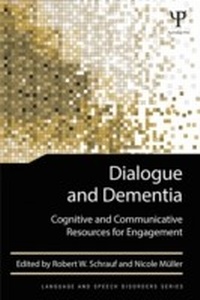
Dialogue and Dementia
Cognitive and Communicative Resources for Engagement
1. Auflage
Erschienen am 20. November 2013
304 Seiten
978-1-317-91661-1 (ISBN)
Beschreibung

This volume takes the positive view that conversation between persons with dementia and their interlocutors is a privileged site for ongoing cognitive engagement. The book aims to identify and describe specific linguistic devices or strategies at the level of turn-by-turn talk that promote and extend conversation, and to explore real-world engagements that reflect these strategies.
Final reflections tie these linguistic strategies and practices to wider issues of the "self" and "agency" in persons with dementia. Thematically, the volume fosters an integrated perspective on communication and cognition in terms of which communicative resources are recognized as cognitive resources, and communicative interaction is treated as reflecting cognitive engagement. This reflects perspectives in cognitive anthropology and cognitive science that regard human cognitive activity as distributed and culturally rooted.
This volume is intended for academic researchers and advanced students in applied linguistics, linguistic and medical anthropology, nursing, and social gerontology; and practice professionals in speech-language pathology and geropsychology.
Final reflections tie these linguistic strategies and practices to wider issues of the "self" and "agency" in persons with dementia. Thematically, the volume fosters an integrated perspective on communication and cognition in terms of which communicative resources are recognized as cognitive resources, and communicative interaction is treated as reflecting cognitive engagement. This reflects perspectives in cognitive anthropology and cognitive science that regard human cognitive activity as distributed and culturally rooted.
This volume is intended for academic researchers and advanced students in applied linguistics, linguistic and medical anthropology, nursing, and social gerontology; and practice professionals in speech-language pathology and geropsychology.
Weitere Details
Reihe
Sprache
Englisch
Verlagsort
London
Großbritannien
Verlagsgruppe
Taylor & Francis Ltd
Zielgruppe
Für höhere Schule und Studium
Illustrationen
4 s/w Abbildungen, 17 s/w Tabellen, 4 s/w Zeichnungen
17 Tables, black and white; 4 Line drawings, black and white; 4 Illustrations, black and white
Dateigröße
3,54 MB
ISBN-13
978-1-317-91661-1 (9781317916611)
Copyright in bibliographic data and cover images is held by Nielsen Book Services Limited or by the publishers or by their respective licensors: all rights reserved.
Schweitzer Klassifikation
Weitere Ausgaben
Andere Ausgaben
Robert W. Schrauf | Nicole Mueller
Dialogue and Dementia
Cognitive and Communicative Resources for Engagement
Buch
12/2013
1. Auflage
Psychology Press Ltd
216,50 €
Versand in 3-4 Wochen
Robert W. Schrauf | Nicole Mueller
Dialogue and Dementia
Cognitive and Communicative Resources for Engagement
Buch
12/2013
1. Auflage
Psychology Press Ltd
96,10 €
Versand in 3-4 Wochen
Personen
Robert W. Schrauf is professor and head of the Department of Applied Linguistics at the Pennsylvania State University. He conducts both qualitative and quantitative research in cross-cultural gerontology, narrative gerontology, Alzheimer's disease, experimental and longitudinal approaches to multilingualism, and bilingual autobiographical memory. He is former president of the Association for Anthropology and Gerontology, a fellow of the Gerontological Society of America, and member of the editorial boards of the Journal of Cross-Cultural Gerontology and Cross-Cultural Research.
Nicole Mueller is a professor of Communicative Disorders at the University of Louisiana at Lafayette, where she holds a Doris B. Hawthorne/BoRSF Endowed Professorship. Her areas of research interest include clinical linguistics, clinical discourse studies and pragmatics, age-related disorders of communication and cognition, multilingualism, and systemic functional linguistics. She is co-editor of the journal Clinical Linguistics and Phonetics and of the book series Communication Disorders across Languages.
Nicole Mueller is a professor of Communicative Disorders at the University of Louisiana at Lafayette, where she holds a Doris B. Hawthorne/BoRSF Endowed Professorship. Her areas of research interest include clinical linguistics, clinical discourse studies and pragmatics, age-related disorders of communication and cognition, multilingualism, and systemic functional linguistics. She is co-editor of the journal Clinical Linguistics and Phonetics and of the book series Communication Disorders across Languages.
Inhalt
Part 1: Which Paradigm, Whose Engagement, What Resources? Conversation as Cognition: Reframing Cognition in Dementia. N. Mueller, R.W. Schrauf. "What They're Said to Say": The Discursive Construction of Alzheimer's Disease by Older Adults, RW. Schrauf, M. Iris. Part 2: Cognitive and Communicative Resources for Engagement. "Getting to Know You": Situated and Distributed Cognitive Effort in Conversations with Dementia, N. Mueller, Z. Mok. "Talking with Maureen": Extenders, and Formulaic Language in Small Stories and Canonical Narratives, B. Davis, M. Maclagan. Interactional and Cognitive Resources in Dementia: A Perspective from Politeness Theory, J. Guendouzi, A. Pate. Conflicting Demonstrations of Understanding in the Interactions of Individuals with Frontotemporal Dementia: Considering Cognitive Resources and their Implications for Care and Communication, L. Mikesell. Part 3: Expressive Approaches to Enriching Engagement. "In My Own Words": Writing Down Life Stories to Promote Conversation in Dementia, E. Bouchard Ryan, D. Crispin, M. Daigneault. Preparing for a Theatrical Performance: Writing Scripts and Shaping Identities in an Early Memory Loss Support Group, H.E. Hamilton, M.Baffy. Alzheimer Pathographies: Glimpses into How People with AD and Their Caregivers Text Themselves, V. Ramanathan. Formulaic Language and Threat: The Challenge of Empathy and Compassion in Alzheimer's Disease Interaction, A.Wray.
