
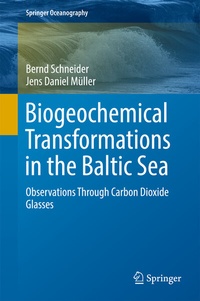
Biogeochemical Transformations in the Baltic Sea
Beschreibung
Alles über E-Books | Antworten auf Fragen rund um E-Books, Kopierschutz und Dateiformate finden Sie in unserem Info- & Hilfebereich.
This book provides a comprehensive review of the biogeochemistry in the Baltic Sea. It is based on the fact that biogeochemical processes that are relevant for the ecological state of the Baltic Sea (and other sea areas), are all in some way related to the production and mineralization of organic matter (biomass) and thus are associated with the consumption or release of CO 2 . The significant progress with regard to our chemical analytical capabilities concerning the marine CO 2 system has facilitated new approaches to study the Baltic Sea biogeochemistry, in particular with regard to a quantitative process understanding. To demonstrate this, the authors present the fundamentals of the marine CO 2 system in a theoretically sound, but still intelligible way. This is followed by a comprehensive presentation of our current knowledge about the CO 2 system in the Baltic Sea and the implications for our understanding of biogeochemical processes suchas production/mineralization of organic matter and the stoichiometry involved, nitrogen fixation, denitrification, and phosphate transformations at varying redox conditions. Finally, the CO 2 gas exchange balance and related problems such as acidification are addressed.
Weitere Details
Weitere Ausgaben
Andere Ausgaben

Inhalt
Systemvoraussetzungen
Dateiformat: PDF
Kopierschutz: Wasserzeichen-DRM (Digital Rights Management)
Systemvoraussetzungen:
- Computer (Windows; MacOS X; Linux): Verwenden Sie zum Lesen die kostenlose Software Adobe Reader, Adobe Digital Editions oder einen anderen PDF-Viewer Ihrer Wahl (siehe E-Book Hilfe).
- Tablet/Smartphone (Android; iOS): Installieren Sie bereits vor dem Download die kostenlose App Adobe Digital Editions oder die App PocketBook (siehe E-Book Hilfe).
- E-Book-Reader: Bookeen, Kobo, Pocketbook, Sony, Tolino u.v.a.m.
Das Dateiformat PDF zeigt auf jeder Hardware eine Buchseite stets identisch an. Daher ist eine PDF auch für ein komplexes Layout geeignet, wie es bei Lehr- und Fachbüchern verwendet wird (Bilder, Tabellen, Spalten, Fußnoten). Bei kleinen Displays von E-Readern oder Smartphones sind PDF leider eher nervig, weil zu viel Scrollen notwendig ist. Mit Wasserzeichen-DRM wird hier ein „weicher” Kopierschutz verwendet. Daher ist technisch zwar alles möglich – sogar eine unzulässige Weitergabe. Aber an sichtbaren und unsichtbaren Stellen wird der Käufer des E-Books als Wasserzeichen hinterlegt, sodass im Falle eines Missbrauchs die Spur zurückverfolgt werden kann.
Weitere Informationen finden Sie in unserer E-Book Hilfe.