

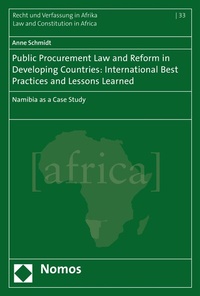
Public Procurement Law and Reform in Developing Countries: International Best Practices and Lessons Learned
Namibia as a Case Study
1. Auflage
Erschienen am 17. Juli 2017
608 Seiten
978-3-8452-7902-2 (ISBN)
Beschreibung

The book provides a broad overview of best practices and lessons learned in public procurement law and reforms in developing countries. It addresses any student, academic or professional in the field of public procurement (law) seeking information on public procurement systems and in particular law and reform. Moreover, all practitioners responsible for the successful implementation of the law and all stakeholders involved in reform processes can benefit from this book. A comprehensive analysis of the most important international and selected national public procurement legal instruments, including the GPA, the UNCITRAL Model Law and the South African system, is followed by the Namibian case study giving useful insights into legal but also practical problems with introducing and implementing public procurement law in developing countries.
Weitere Details
Weitere Ausgaben
Andere Ausgaben
Anne Schmidt
Public Procurement Law and Reform in Developing Countries: International Best Practices and Lessons Learned
Namibia as a Case Study
Buch
06/2017
1. Auflage
Nomos
149,00 €
Versand in 7-9 Tagen
Inhalt
- Cover
- List of Abbreviations
- Introduction
- 1. Background
- 2. Problem Statement
- 3. Literature Review
- 4. Research Methodology
- a. General Remarks
- b. Field Research in Namibia
- 5. General Outline
- PART I: The Nature and the Regulation of Public Procurement
- Chapter 1: The Nature of Public Procurement and its general Regulation
- 1. Introduction
- 2. Principles of Public Procurement
- 3. Pillars of Public Procurement Systems
- 4. Stages of Public Procurement Procedures
- 5. Procurement Methods
- 6. E-Procurement
- 7. Organisational Structure and Workforce
- 8. Review Procedures
- Chapter 2: Transparency and the Problem of Corruption
- 1. Introduction
- 2. Corruption and possible Effects
- 3. Transparency Requirements in Public Procurement
- 4. Additional Instruments to ensure Transparency
- 5. Compromising Efficiency?
- Chapter 3: Secondary Objectives
- 1. Introduction
- 2. Types of Socio-Economic Objectives
- a. Preferential Procurement
- b. Inclusion of Criteria increasing Social Welfare
- c. Preferential Procurement from different Viewpoints: Protectionism vs. Liberalisation
- 3. Environmental Procurement
- Chapter 4: Summary of Findings
- PART II: International and National Public Procurement Regulations
- Chapter 1: The WTO Government Procurement Agreement
- 1. Introduction
- 2. The Essentials of the GPA
- a. Background
- i. Principles, Objectives and Scope
- ii. Review of the Agreement
- iii. Terminology
- b. Objectives and Principles
- c. Scope and Coverage of the GPA
- i. Scope and Coverage
- ii. General Exceptions
- 3. Procedures
- a. Procurement Methods and Procedures
- b. Tender Specification, Award Criteria and Evaluation Methods
- i. Qualification Criteria
- ii. Description of the Subject Matter
- iii. Evaluation Criteria
- iv. Method of Evaluation
- 4. Institutions: The Committee on Government Procurement
- 5. The Treatment of Developing and Least-developed Countries
- a. The 1994 Agreement
- b. The revised Agreement
- 6. Transparency
- a. General Transparency Provisions
- b. Procurement Planning
- 7. Secondary Objectives
- a. The 1994 Agreement
- b. The revised Agreement
- c. Rules of Origin and Offsets
- 8. Enforcement
- a. Introduction
- b. Challenging Breaches of the Agreement
- c. Domestic Review Procedures
- 9. The Reluctance of Developing Countries to seek GPA Accession
- a. The 1994 GPA
- b. The revised GPA
- 10. Conclusion
- Chapter 2: UNCITRAL Model Law on Procurement
- 1. Introduction
- 2. About UNCITRAL
- 3. The Essentials of the UNCITRAL Model Law on Procurement
- a. Background
- b. Objectives and Principles
- c. Scope and Coverage
- 4. Tender Procedures
- a. Procurement Methods and Procedures
- b. Tender Specification, Award Criteria and Evaluation Methods
- i. Qualification Criteria
- ii. Description of the Subject Matter
- iii. Evaluation Criteria
- iv. Method of Evaluation
- v. Rejection of Abnormally Low Submissions
- 5. Institutions and Staff Regulations
- 6. Transparency
- 7. Secondary Objectives
- a. The Scope of Application of Secondary Objectives
- b. The Principle of Non-Discrimination
- 8. Review Procedures
- 9. Conclusion
- Chapter 3: COMESA Procurement Reform - The Example of Mauritius
- 1. Introduction
- 2. COMESA Procurement Reform Project
- a. Background
- b. Laws and Regulations
- i. COMESA Procurement Directive (2003)
- ii. COMESA Procurement Regulations
- c. Objectives and Principles
- d. Scope and Coverage
- e. Institutions and Staff
- f. Procedures
- i. Procurement Methods and Procedures
- ii. Tender Specification, Award Criteria and EvaluationMethods
- g. Transparency
- h. Secondary Objectives
- i. Review Procedures
- j. Procurement Planning
- k. Contract Administration
- l. Provisions for the Implementation of Reform
- 3. Interim Conclusion
- 4. Mauritian Procurement Law
- a. Background
- b. The Framework
- i. Laws and Regulations
- ii. Objectives and Principles
- iii. Scope and Coverage
- c.I nstitutions and Staff
- d. Procedures
- i. Procurement Methods and Procedures
- ii. Tender Specification, Award Criteria andEvaluation Methods
- iii. Procurement Planning
- iv. Contract Administration
- e. Transparency
- f. Secondary Objectives
- g. Review Procedures
- 5. Conclusion
- Chapter 4: Public Procurement Law in South Africa
- 1. Introduction
- 2. The Framework
- a. Laws and Policies regarding Public Procurement
- b. Objectives and Principles
- i. Merging Procurement and Financial Management
- ii. Redressing the Imbalances of the Past
- c. Scope and Coverage
- 3. Institutions and Staff
- 4. Basics of the Supply Chain Management System
- a. Procurement Methods
- b. Tender Specifications, Award Criteria andEvaluation Methods
- i. Uniformity
- ii. Electronic Procurement
- 5. Transparency and Strategies to Combat Corruption
- a. Specific Procurement-related Transparency Provisions
- b. Non-Procurement Specific Regulations
- 6. Secondary Objectives
- a. The Preferential Procurement Policy Framework Act andRegulations
- b. Targeted Procurement
- c. Pros and Cons of the South African PreferentialProcurement System
- d. South African Preferential Procurement in theInternational Context
- 7. Review Procedures
- a. Administrative Review
- b. Non-Judicial External Review
- c. Judicial Review
- d. The main Principles of Public Procurement in South AfricanCase Law
- e. Problems in the South African Public Procurement ReviewMechanisms
- 8. Conclusion
- Chapter 5: Best Practices in Public Procurement
- 1. Introduction
- 2. Best Practices in Public Procurement Legal Systems
- a. Objectives
- b.I nstitutional and Organisational Form
- c. Workforce
- d. Scope
- e. Procedures and Methods
- i. Procurement Planning
- ii. Pre-bidding Phase
- iii. Bidding Phase
- iv. Award Phase
- v. Contract Management
- f. Secondary Objectives
- g. Transparency
- h. Review Mechanisms
- 3. Lessons Learned from Mauritius
- 4. Lessons Learned from South Africa
- PART III: Namibia as a Case Study: Public Procurement Law and Reform
- Chapter 1: The Namibian Public Procurement Law
- 1. Introduction
- 2. The Framework
- a. Laws and Policies regarding Public Procurement on different Levels of Government Structure
- b. Public Procurement-related Development Policies in Namibia: Affirmative Action
- i. Introduction
- ii. Affirmative Action (Employment) Act
- c. Objectives and Principles
- d. Scope and Coverage
- e. Institutions and Staff
- 3. Basics of the Public Procurement system
- a. Procurement Methods
- b. Procurement Planning and Contract Management
- c. Tender Specification, Award Criteria and Evaluation Methods
- i. Contents of Tender Documents
- ii. Evaluation of Tenders
- 4. Transparency and Strategies to Counteract Corruption
- a. Specific Procurement-related Transparency Provisions
- b. Non-Procurement specific Regulations
- 5. Secondary Objectives
- a. Price Preference Policy
- b. Other Socio-Economic Objectives
- c. TIPEEG Tenders
- d. Interim Conclusion
- 6. Chinese Construction Companies in the Namibian Public Procurement System
- 7. Review Procedures
- a. Introduction
- b. Administrative Review
- c. Non-Judicial External Review
- d. Judicial Review
- 8. The main Principles of Public Procurement in Namibian Case Law
- a. Procedural Issues
- b. The Principle of Legality
- c. The Requirement to provide Reasons under Article 18
- d. CSC Neckartal Dam Joint Venture v The Tender Board of Namibia & Others
- i. Background
- ii. The Court Decision
- e. Interim Interdicts and the Matter of Urgency
- f. Summary of Case Law
- g. Interim Conclusion
- 9. Conclusion
- Chapter 2: Reform of Public Procurement Law
- 1. Introduction
- 2. The Reform
- a. Reform Drivers
- b. Reform Hindrances
- c. The first Steps of a Public Procurement Reform
- d. Legal Drafting
- e. Implementation
- 3. Organisational Issues
- a. Regulated Process vs. Managerial Task
- b. Decentralised vs. Centralised Approach
- c. Institutional Capacity
- d. Human Resources
- 4. Procedures and Methods
- 5. Transparency
- 6. Secondary Objectives
- a. Inclusion of Secondary Objectives into Public Procurement Law
- b. Inclusion of Environmental Criteria
- 7. Review Procedures
- 8. Other Important Considerations
- a. Procurement Planning
- b. Contract Management
- c. E-Procurement
- 9. Conclusion
- Chapter 3: Procurement Reform in Namibia
- 1. Introduction
- 2. The Reform Project
- a. Outline of the Reform Process
- b. Reform Drivers
- c. Stakeholders Involvement
- d. Influence of International and Foreign Law
- e. Reform Hindrances
- 3. Essential Aspects and Recommendations for a new Public Procurement Law
- a. Scope
- b. Objectives and Principles
- c. Organisational Issues
- i. Institutions
- ii. Human Resources
- d. Methods and Procedures
- e. Transparency
- f. Secondary Objectives
- g. E-Procurement
- h. Procurement Planning
- i. Contract Management
- j. Review System
- 4. Learning from Mistakes - an Attempt to make the Reform a Success
- a. Changes with regard to the Scope
- b. Institutional and Organisational Structure
- c. Review Mechanisms
- d. Interim conclusion
- 5. Conclusion
- Chapter 4: Lessons Learned and Conclusion
- 1. Conclusion
- 2. Lessons Learned
- References
- Bibliography
- List of Legislation
- Namibia
- South Africa
- Mauritius
- Others
- List of International Legal Instruments
- List of Cases
- Namibia
- South Africa
- WTO Disputes
- Annexes
- Annex 1: List of Interview Partners
- Annex 2: List of Sample Questions
- Annex 3: Essential Aspects of Public Procurement Reform Processes
- Index
