

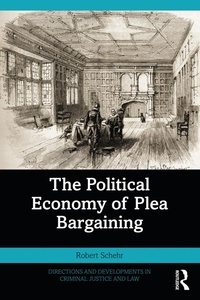
The Political Economy of Plea Bargaining
1. Auflage
Erschienen am 10. Dezember 2024
294 Seiten
978-1-040-26746-2 (ISBN)
Beschreibung

The Political Economy of Plea Bargaining provides the political, economic, and cultural context for understanding the evolution of plea bargaining as a juridical technology implemented to ensure the efficient administration of violations of criminal law.
Across two parts, this book contends that the confluence of political, economic, and cultural factors necessary to enhance the legal preservation of the slave system and white supremacy spatiotemporally coincided with burgeoning Northern industrial capitalism and the liberty of contract doctrine, and that each was contextualized within hegemonic liberal republican ideology out of which grew the implementation of an efficient technology of juridical control achieving normative legal status - plea bargaining. It argues that, as with their predecessors, contemporary actors operating within the criminal legal system and who are responsible for administering plea bargaining are perpetuating a system reproducing a steering mechanism that historically constitutes a through line from Reconstruction to the present day. Following Von Mises, these actors serve as useful innocents, modern-day confused and misguided sympathizers. They are juridical actors who inherited and are perpetuating a system of conflict resolution that serves to maintain a form of social control uniquely situated to historically relevant political, economic, and cultural power in the United States.
The Political Economy of Plea Bargaining will be important reading for legal and social science academics researching and practicing within the field of criminal law and procedure. It will also act as a valuable guide to the debates surrounding plea bargaining for students with a keen interest in criminal law.
Across two parts, this book contends that the confluence of political, economic, and cultural factors necessary to enhance the legal preservation of the slave system and white supremacy spatiotemporally coincided with burgeoning Northern industrial capitalism and the liberty of contract doctrine, and that each was contextualized within hegemonic liberal republican ideology out of which grew the implementation of an efficient technology of juridical control achieving normative legal status - plea bargaining. It argues that, as with their predecessors, contemporary actors operating within the criminal legal system and who are responsible for administering plea bargaining are perpetuating a system reproducing a steering mechanism that historically constitutes a through line from Reconstruction to the present day. Following Von Mises, these actors serve as useful innocents, modern-day confused and misguided sympathizers. They are juridical actors who inherited and are perpetuating a system of conflict resolution that serves to maintain a form of social control uniquely situated to historically relevant political, economic, and cultural power in the United States.
The Political Economy of Plea Bargaining will be important reading for legal and social science academics researching and practicing within the field of criminal law and procedure. It will also act as a valuable guide to the debates surrounding plea bargaining for students with a keen interest in criminal law.
Rezensionen / Stimmen
"The Political Economy of Plea Bargaining offers a wide-ranging exploration of the history and development of the dominant dispute-resolution mechanism in US criminal law. Drawing on an eclectic mix of history, social and critical theory, political philosophy, constitutional jurisprudence, and personal reflection, the author powerfully demonstrates how procedural efficiency and an anti-democratic impulse to maintain social control over marginal populations have displaced the long-standing American commitment to trial by jury. This timely work brings a unique critical-theoretic lens to the current debate and should prompt new misgivings about the plea-bargaining paradigm."Russell D. Covey, Law Professor and Co-Chair of the ABA Plea Bargaining Task Force
"This fresh, insightful, and wide-ranging work explores-and explodes--a leading cause of contemporary injustice-plea bargaining. Drawing on various disciplines and legal doctrine, Professor Schehr powerfully deconstructs the flawed rationales for extinguishing the fundamental right to jury trial, and catalogues the resulting catastrophic damage to US law and society."
Jack Chin, Professor of Law, and Director of Clinical Legal Education, UC Davis School of Law
"This captivating exploration delves into the origins and evolution of plea bargaining as a legal instrument of social control in capitalist America. Drawing on interdisciplinary scholarship from Law, Political Economy, and Sociology, this must-read book offers a unique perspective on the anti-democratic nature of plea bargaining, its role within capitalist systems, and the injustices it perpetuates."
Geert Dhondt, Associate Professor of Economics, John Jay College of Criminal Justice, The City University of New York
Weitere Details
Reihe
Auflage
1. Auflage
Sprache
Englisch
Verlagsort
London
Großbritannien
Verlagsgruppe
Taylor & Francis Ltd
Zielgruppe
Für höhere Schule und Studium
Für Beruf und Forschung
Illustrationen
3 Line drawings, black and white; 3 Illustrations, black and white
ISBN-13
978-1-040-26746-2 (9781040267462)
Copyright in bibliographic data and cover images is held by Nielsen Book Services Limited or by the publishers or by their respective licensors: all rights reserved.
Schweitzer Klassifikation
Weitere Ausgaben
Andere Ausgaben
Robert Schehr
The Political Economy of Plea Bargaining
Buch
12/2024
1. Auflage
Routledge
58,60 €
Versand in 10-20 Tagen
Robert Schehr
The Political Economy of Plea Bargaining
Buch
12/2024
1. Auflage
Routledge
196,60 €
Versand in 10-20 Tagen
Person
Robert Schehr is a Professor in the Department of Criminology and Criminal Justice at Northern Arizona University, USA. His research expertise and publications focus on wrongful conviction, the political economy of law and order, and the jurisprudence of plea bargaining. He is an international speaker on the topic of wrongful conviction. Professor Schehr received a PhD in Sociology from Purdue University in 1991, completed a post-doctoral fellowship at the University of Georgia, and has held positions at Colgate University and the University of Illinois at Springfield. Dr Schehr has been a United States Fulbright Scholar, during which he taught at both Griffith College Law School and Trinity College Law School, Ireland. In May of 2022, Dr Schehr completed a Master's in the Study of Law at Yale Law School.
Inhalt
List of figures Preface Acknowledgements Part One Chapter 1 Chapter 2 Chapter 3 Chapter 4 Part Two Chapter 5 Chapter 6 Chapter 7 Chapter 8 Chapter 9 Index
