

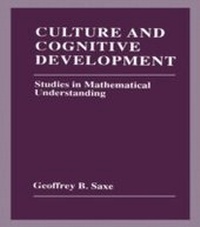
Culture and Cognitive Development
Studies in Mathematical Understanding
1. Auflage
Erschienen am 28. Januar 2015
222 Seiten
978-1-317-72808-5 (ISBN)
Beschreibung

Researchers examining children's mathematics acquisition are now questioning the belief that children learn mathematics principally through formalized, in-school mathematics education. There is increasing evidence that children gain mathematical understanding through their participation in out-of-school cultural practices and that their mathematics only occasionally resembles what they learn in the classroom.
Culture and Cognitive Development presents the latest research by Dr. Geoffrey Saxe on this issue. In examinations of the mathematical understandings of child candy sellers in an urban center in northeastern Brazil, Dr. Saxe finds sharp contrasts between mathematics as practiced in school and in real-world settings. In this unique research project he presents a penetrating conceptual treatment of the interplay between culture and cognitive development, filling a void in current research literature.
Subjects examined include:
the interplay between sociocultural and cognitive developmental processes
the differences between math knowledge learned in and out of the classroom
the ways math learning in the classroom is modified by children's out-of-school mathematics and, correspondingly, how practical out-of-school mathematics use is modified by formal education
Culture and Cognitive Development presents the latest research by Dr. Geoffrey Saxe on this issue. In examinations of the mathematical understandings of child candy sellers in an urban center in northeastern Brazil, Dr. Saxe finds sharp contrasts between mathematics as practiced in school and in real-world settings. In this unique research project he presents a penetrating conceptual treatment of the interplay between culture and cognitive development, filling a void in current research literature.
Subjects examined include:
the interplay between sociocultural and cognitive developmental processes
the differences between math knowledge learned in and out of the classroom
the ways math learning in the classroom is modified by children's out-of-school mathematics and, correspondingly, how practical out-of-school mathematics use is modified by formal education
Rezensionen / Stimmen
"Saxe manages to bring together the individual and the situation by drawing on both perspectives to create an integrative analytic framework and to design an eclectic and effective data collection effort....The contribution of this book lies not only in its analytic framework but also in the rich and well-structured data set presented to flesh out the framework and illustrate the research approach it suggests....The book is pioneering in its conceptualization of the cognition-culture interface and exemplary in its presentation of informative data. Its integrative perspective is a significant contribution to the field."-Contemporary Psychology
"...a valuable example of the empirical analysis of the role of culture in cognitive development....a welcome contribution to both the Piagetian constructivist and Vygotskian literatures because it provides a clear model for the empirical analysis of the joint participation of sociocultural and personal processes in construction of meaning through a practical integration of Piaget's constructivism with Vygotsky's dialectical method....As Saxe's analysis makes apparent, it is only when constructive processes are conceived in terms of participation of multiple psychological, social, and cultural functions in the construction of new cognitive skills, that an understanding of contextual channelling and alternative developmental pathways really emerges."
-Human Development
"....this book could well achieve `cult' status. It is a seductive book that will appeal to many readers at different levels....Because of the research focus on learning and cognitive development, the three components (the subjects, the tasks, and their analyses) are chosen to `catch' the dynamics of cognitive change and growth. The choices, in my view, are remarkably successful....It is a fascinating and rare combination of psychological and ethnographic inquiry styles....As Chevallard (1990) says, `The problems of mathematics education and culture should be everyone's concern'(p.26), and Saxe's book demonstrates convincingly the truth of that statement."
-Journal for Research in Mathematics Education
"Clearly of interest to mathematicians, this book could also be an important addition to the study of cognitive development and research design."
-Harvard Educational Review
"...the focal problems of learning in mathematics provide excellent case studies for what are demonstrably the more fundamental issues of mind-society relations...Saxe's writing has a clarity and crisp tone, and the analysis of data he provides in the context of illuminating the utility of the research framework is robust and well-argued. Most importantly, one can imagine from the detailed example he offers how one might apply the theoretical and research framework to culture-cognition relations for other content domains."
-Roy D. Pea
Institute for Research on Learning in Educational Researcher
Weitere Details
Sprache
Englisch
Verlagsort
London
Großbritannien
Verlagsgruppe
Taylor & Francis Ltd
Zielgruppe
Für Beruf und Forschung
Produkt-Hinweis
Reflowable
Dateigröße
2,42 MB
ISBN-13
978-1-317-72808-5 (9781317728085)
Copyright in bibliographic data and cover images is held by Nielsen Book Services Limited or by the publishers or by their respective licensors: all rights reserved.
Schweitzer Klassifikation
Weitere Ausgaben
Andere Ausgaben

Buch
07/2016
1. Auflage
Psychology Press Ltd
81,72 €
Versand in 10-20 Tagen
Buch
10/1990
1. Auflage
Psychology Press
214,82 €
Versand in 10-20 Tagen
Person
Saxe, Geoffrey B.
Inhalt
Contents: Part I: Culture and Cognition: A Method of Study. Culture and Cognitive Development. A Research Approach. Part II: Component 1: Emergent Mathematical Goals. Parameter 1: The Structure of the Candy-selling Practice. Parameters 2 and 3: Social Interactions and Practice-linked Artifacts and Conventions -- A Focus on the Sell Phase. Parameters 2 and 3: Social Interactions and Practice-linked Artifacts and Conventions -- A Focus on the Purchase Phase. Parameter 4: Sellers' Emergent Mathematical Goals and Their Prior Understandings. Emergent Mathematical Goals of the Practice: A Summary and Discussion of the First Analytic Component Applied to the Candy-selling Practice. Part III: Component 2: Form-Function Shifts in Candy Sellers' Mathematics. The Influence of Practice Participation on Sellers' Mathematics. The Development of Sellers' Mathematics. Form-function Shift in Sellers' Mathematics: Links Between Components 1 and 2. Part IV: Component 3: The Interplay Between Learning in and out of School. Some Contrasts Between Mathematics of the School and of the Candy-selling Practice. The Influence of Schooling on Sellers' Mathematics. The Influence of Selling Experience on Learning Mathematics in School. Appropriation and Specialization in the Practice. Part V: Culture and Cognitive Development. Epilogue. Appendices: Recruitment of Sellers. Background Information on Sellers and Their Practice. Extended Description of Tasks.
