

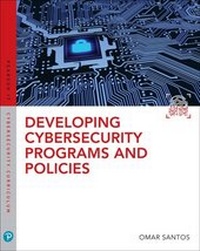
Developing Cybersecurity Programs and Policies
3. Auflage
Erschienen am 20. Juli 2018
600 Seiten
978-0-13-485854-8 (ISBN)
Beschreibung

All the Knowledge You Need to Build Cybersecurity Programs and Policies That Work
Clearly presents best practices, governance frameworks, and key standards
Includes focused coverage of healthcare, finance, and PCI DSS compliance
An essential and invaluable guide for leaders, managers, and technical professionals
Today, cyberattacks can place entire organizations at risk. Cybersecurity can no longer be delegated to specialists: success requires everyone to work together, from leaders on down. Developing Cybersecurity Programs and Policies offers start-to-finish guidance for establishing effective cybersecurity in any organization. Drawing on more than 20 years of real-world experience, Omar Santos presents realistic best practices for defining policy and governance, ensuring compliance, and collaborating to harden the entire organization.
First, Santos shows how to develop workable cybersecurity policies and an effective framework for governing them. Next, he addresses risk management, asset management, and data loss prevention, showing how to align functions from HR to physical security. You'll discover best practices for securing communications, operations, and access; acquiring, developing, and maintaining technology; and responding to incidents.
Santos concludes with detailed coverage of compliance in finance and healthcare, the crucial Payment Card Industry Data Security Standard (PCI DSS) standard, and the NIST Cybersecurity Framework.
Whatever your current responsibilities, this guide will help you plan, manage, and lead cybersecurity-and safeguard all the assets that matter.
Learn How To
? Establish cybersecurity policies and governance that serve your organization's needs
? Integrate cybersecurity program components into a coherent framework for action
? Assess, prioritize, and manage security risk throughout the organization
? Manage assets and prevent data loss
? Work with HR to address human factors in cybersecurity
? Harden your facilities and physical environment
? Design effective policies for securing communications, operations, and access
? Strengthen security throughout the information systems lifecycle
? Plan for quick, effective incident response and ensure business continuity
? Comply with rigorous regulations in finance and healthcare
? Plan for PCI compliance to safely process payments
? Explore and apply the guidance provided by the NIST Cybersecurity Framework
Clearly presents best practices, governance frameworks, and key standards
Includes focused coverage of healthcare, finance, and PCI DSS compliance
An essential and invaluable guide for leaders, managers, and technical professionals
Today, cyberattacks can place entire organizations at risk. Cybersecurity can no longer be delegated to specialists: success requires everyone to work together, from leaders on down. Developing Cybersecurity Programs and Policies offers start-to-finish guidance for establishing effective cybersecurity in any organization. Drawing on more than 20 years of real-world experience, Omar Santos presents realistic best practices for defining policy and governance, ensuring compliance, and collaborating to harden the entire organization.
First, Santos shows how to develop workable cybersecurity policies and an effective framework for governing them. Next, he addresses risk management, asset management, and data loss prevention, showing how to align functions from HR to physical security. You'll discover best practices for securing communications, operations, and access; acquiring, developing, and maintaining technology; and responding to incidents.
Santos concludes with detailed coverage of compliance in finance and healthcare, the crucial Payment Card Industry Data Security Standard (PCI DSS) standard, and the NIST Cybersecurity Framework.
Whatever your current responsibilities, this guide will help you plan, manage, and lead cybersecurity-and safeguard all the assets that matter.
Learn How To
? Establish cybersecurity policies and governance that serve your organization's needs
? Integrate cybersecurity program components into a coherent framework for action
? Assess, prioritize, and manage security risk throughout the organization
? Manage assets and prevent data loss
? Work with HR to address human factors in cybersecurity
? Harden your facilities and physical environment
? Design effective policies for securing communications, operations, and access
? Strengthen security throughout the information systems lifecycle
? Plan for quick, effective incident response and ensure business continuity
? Comply with rigorous regulations in finance and healthcare
? Plan for PCI compliance to safely process payments
? Explore and apply the guidance provided by the NIST Cybersecurity Framework
Alle Preise
Weitere Details
Auflage
3rd edition
Sprache
Englisch
Verlagsort
Upper Saddle River
USA
Verlagsgruppe
Pearson Education (US)
Zielgruppe
Für höhere Schule und Studium
Dateigröße
6,80 MB
ISBN-13
978-0-13-485854-8 (9780134858548)
Copyright in bibliographic data and cover images is held by Nielsen Book Services Limited or by the publishers or by their respective licensors: all rights reserved.
Schweitzer Klassifikation
Weitere Ausgaben
Andere Ausgaben
Omar Santos
Developing Cybersecurity Programs and Policies
Buch
10/2018
3. Auflage
Pearson IT Certification
77,99 €
Versand in 3-4 Wochen
Person
Omar Santos is a principal engineer in the Cisco Product Security Incident Response Team (PSIRT) within the Cisco Security Research and Operations. He mentors and leads engineers and incident managers during the investigation and resolution of security vulnerabilities in all Cisco products, including cloud services. Omar has been working with information technology and cybersecurity since the mid-1990s. Omar has designed, implemented, and supported numerous secure networks for Fortune 100 and 500 companies and the U.S. government. Prior to his current role, he was a technical leader within the World-Wide Security Practice and the Cisco Technical Assistance Center (TAC), where he taught, led, and mentored many engineers within both organizations.
Omar is an active member of the security community, where he leads several industrywide initiatives and standard bodies. His active role helps businesses, academic institutions, state and local law enforcement agencies, and other participants that are dedicated to increasing the security of the critical infrastructure.
Omar often delivers technical presentations at many conferences and to Cisco customers and partners. He is the author of dozens of books and video courses. You can follow Omar on any of the following:
Personal website: omarsantos.io
Twitter: @santosomar
LinkedIn: https://www.linkedin.com/in/santosomar
Omar is an active member of the security community, where he leads several industrywide initiatives and standard bodies. His active role helps businesses, academic institutions, state and local law enforcement agencies, and other participants that are dedicated to increasing the security of the critical infrastructure.
Omar often delivers technical presentations at many conferences and to Cisco customers and partners. He is the author of dozens of books and video courses. You can follow Omar on any of the following:
Personal website: omarsantos.io
Twitter: @santosomar
LinkedIn: https://www.linkedin.com/in/santosomar
Inhalt
Chapter 1. Understanding Cybersecurity Policy and Governance
Chapter 2. Cybersecurity Policy Organization, Format and Styles
Chapter 3. Cybersecurity Framework
Chapter 4. Governance and Risk Management
Chapter 5. Asset Management and Data Loss Prevention
Chapter 6. Human Resources Security
Chapter 7. Physical and Environmental Security
Chapter 8. Communications and Operations Security
Chapter 9. Access Control Management
Chapter 10. Information Systems Acquisition, Development, and Maintenance
Chapter 11. Cybersecurity Incident Response
Chapter 12. Business Continuity Management
Chapter 13. Regulatory Compliance for Financial Institutions
Chapter 14. Regulatory Compliance for the Healthcare Sector
Chapter 15. PCI Compliance for Merchants
Appendix A. Information Security Program Resources
Appendix B. Sample Information Security Policy
Appendix C. Information Systems Acceptable Use Agreement and Policy
Chapter 2. Cybersecurity Policy Organization, Format and Styles
Chapter 3. Cybersecurity Framework
Chapter 4. Governance and Risk Management
Chapter 5. Asset Management and Data Loss Prevention
Chapter 6. Human Resources Security
Chapter 7. Physical and Environmental Security
Chapter 8. Communications and Operations Security
Chapter 9. Access Control Management
Chapter 10. Information Systems Acquisition, Development, and Maintenance
Chapter 11. Cybersecurity Incident Response
Chapter 12. Business Continuity Management
Chapter 13. Regulatory Compliance for Financial Institutions
Chapter 14. Regulatory Compliance for the Healthcare Sector
Chapter 15. PCI Compliance for Merchants
Appendix A. Information Security Program Resources
Appendix B. Sample Information Security Policy
Appendix C. Information Systems Acceptable Use Agreement and Policy
