

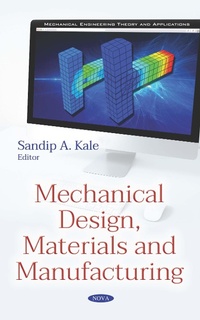
Mechanical Design, Materials and Manufacturing
Erschienen am 5. Februar 2019
324 Seiten
978-1-5361-4792-6 (ISBN)
Beschreibung

Though the developments in the field of electronics and digital industries are significant, the importance of the basic mechanical industry remains always on the top side. The purpose of this book is to present some advanced research studies on mechanical design, materials and manufacturing. The first chapter presents an analysis of a novel force transducer which has a special shape that allows strategic placement of the strain gauges and senses axial forces by ignoring the moments. The second chapter explains the basic principle of calculation and analysis of the defective structure of solids. The third most interesting chapter presents advanced methods used in molecular dynamics simulation of macromolecules. Chapter Four explores an extended method of mathematical modelling of Freudenstein-Chebyshev approximation theory for sigmoidal function applied to four and five precision points. Chapter Five presents an algorithm to find the transfer vertex of a given epicyclic gear train. In the sixth chapter, an analytical study (using ABAQUS/CAE) on the strengthening of the beam-column joint under seismic conditions using carbon fiber reinforced polymer (CFRP) sheets has been carried out. Chapter Seven discusses preparation, properties and applications of nanomterials, ceramics and bioceramics. Chapter Eight presents a methodology to design, develop and simulate a twin spindle turning special purpose machine based on the data collected from hydraulic, pneumatic, and electro pneumatic data which will serve as low cost automation. The last chapter is about the estimation of axial force in incremental sheet metal forming. (Imprint: Nova)
Weitere Details
Weitere Ausgaben
Andere Ausgaben

Sandip A. Kale
Mechanical Design, Materials and Manufacturing
Buch
02/2019
Nova Science Publishers Inc
302,92 €
Versand in 15-20 Tagen
Inhalt
- Intro
- Contents
- Preface
- Chapter 1
- Finite Element Analysis of Three DoF Strain Gauge Force Transducer
- Abstract
- 1. Introduction
- 2. Strain Gauge Based Force Sensing
- 3. Transducer Design
- 3.1 Converting of Cartesian Coordinates
- 4. Finite Element Analysis
- 4.1 Material Properties
- 4.2 Meshing
- 4.3 Loading Conditions
- 5. Results
- 6. Observations
- Conclusion
- References
- Chapter 2
- The Basic Principle of Calculation and Analysis of the Defective Structure of Solids
- Abstract
- 1. Introduction
- 2. High Temperature Impurity Precipitation
- 3. Precipitation of the Impurity in Accordance with the Model of the Solid State of Vlasov
- 4. Formation of Secondary Structural Imperfections
- 5. Controlling the Defective Structure of Crystals
- 6. The Possibility of Applying The Model of High-Temperature Precipitation For Other Solids
- Conclusion
- References
- Advanced Methods Used in Molecular Dynamics Simulation of Macromolecules
- Chapter 4
- Study on Error in Sigmoidal Function Generation of 4R Mechanism
- Abstract
- 1. Introduction
- 2. Kinematic Synthesis
- 2.1. Four Precision Point Synthesis
- 2.2. Five Precision Point Synthesis
- 3. Optimization of the Structural Error
- 3.1. Modifying the Design Equation for Four and Five Presicion Points
- 3.2. Optimization for Four and Five Presicion Points
- 4. Results and Discussion
- Conclusion
- References
- Chapter 5
- Identifying Transfer Vertex from the Adjacency Matrix for Epicyclic Gear Trains
- Abstract
- 1. Introduction
- 1.1. Linkage Adjacency Matrix
- 1.2. Hamming Procedure
- 1.3. Rotational Analysis
- 1.4. Example
- 2. Intelligent Methods
- 2.1. Example
- Conclusion
- References
- Chapter 6
- 3-D Simulation Studies on Strengthening of Beam-Column Joint
- Abstract
- 1. Introduction
- 2. Material Properties
- 3. Model Validation
- 4. Convergence Study
- 5. Results and Discussions
- Conclusion
- References
- Chapter 7
- Nanomaterials, Ceramic Bulk and Bioceramics: Synthesis, Properties and Applications
- Abstract
- Abbreviations
- 1. Nanomaterials
- 1.1. Introduction
- 1.2. Ultrafine Particles
- 1.3. Nanomaterials
- 1.4. History and Advances of Nanomaterials
- 1.5. Classification of Nanomaterials
- 1.6. Importance of Nanomaterials
- 2. Ceramics
- 2.1. Synthesis
- 2.2. Sintering
- 2.3. History
- 2.4. Classification of Ceramics
- 2.4.1. Heavy Clay Wares
- 2.4.2. Refractories
- 2.4.3. Special Ceramics
- 2.4.4. Pottery (Whitewares)
- 2.5. Properties of Ceramics
- 2.5.1. Plasticity
- 2.5.2. Factors Affecting Plasticity
- 2.5.3. Determination of Plasticity
- 2.5.3.1. Pfefferkorn Test
- 2.5.3.2. Atterberg Plasticity Test
- 2.5.3.3. Test Methods
- 2.6. Raw Materials
- 2.6.1. Fillers
- 2.6.2. Quartz Sand
- 2.6.3. Flints
- 2.6.3.1. Chalk Flint
- 2.6.3.2. Wash Mill Flints
- 2.6.3.3. Beach Flints
- 2.6.4. Fluxes
- 2.6.4.1. Feldspars
- 2.6.4.2. Nepheline Syenite
- 2.6.4.3. Cornish Stone
- 2.6.4.4. Talc
- 2.6.5. Clyas
- 2.6.6. Limestone
- 2.7. Methods of Investigation
- 2.7.1. Densification Parameters
- 2.7.2. Mechanical Properties
- 2.8. Body Glaze
- 2.9. Thermal Expansion
- 2.10. Applications
- 3. Bioceramics
- 3.1. Introduction
- 3.2. SOL-GEL Techniques and Applications
- Conclusion
- References
- Chapter 8
- Simulation of Low Cost Automation and Life Cycle Cost Analysis for a Special Purpose Machine
- Abstract
- Nomenclature
- Abbreviations
- 1. Introduction
- 2. Methodology
- 2.1. Key Main Product Features of Automation
- 2.2. Purpose of Special Purpose Turning Machine
- 2.3. Circuit Design
- 2.3.1. Sequence of Operation
- 2.3.2. Position Step Diagram
- 2.3.3. Flow Diagram of Step Sequence Operation
- 2.3.4. Drawing of Pneumatic Circuit
- 3. Results and Discussion
- 3.1. Circuit Simulation
- 3.2. Programmable Logic Controller Ladder Programming
- 3.3. Life Cycle Cost Analysis
- 3.3.1. Economic Analysis
- 3.3.1.1. Economic Analysis of Conventional Lathe Machine
- 3.3.1.2. Economic Analysis of NC Turning Machine
- 3.3.1.3. Economic Analysis of Special Purpose Machine
- 3.3.2. Comparative Analysis of These Three Machines
- Conclusion
- References
- Chapter 9
- Estimation of Axial Force in Incremental Sheet Metal Forming
- Abstract
- 1. Introduction
- 2. The Basic Setup for SPIF
- 3. Types of Asymmetric Incremental Sheet Metal Forming Technique
- 3.1 Clamping
- 3.2 Types of Tools Used in ISF
- Effect of Lubrication
- 3.3 Forming Limit Diagram
- 4. Force Prediction in SPIF Deduced from Experimental and Finite Element Analysis
- Conclusion
- References
- About the Editor
- Index
- Blank Page
